Tuesday, May 17, 2011

MAY FULL MOON


"HARE'S 1st FULL MOON" by David Kettley

When you look up at the big bright moon tonight, you may think of it only as the May Full Moon. However, this moon has many names. They include Flower Moon (many Native American tribes), Green Leaf Moon (Lakota Sioux), Milk Moon (Colonial America), Bright Moon (Celtic), Dragon Moon (Chinese) Planting Moon (Cherokee and Sioux), Green Grass Moon (neo Pagans) and Hare Moon (Medieval England).

Those who think of the May Moon as the Flower Moon say that the flowers grow at night during this time, and even dance in honor of the moon. That is a wonderful image. However, of all the moon names, my favorite is Hare Moon, because of its association with the moon-gazing hare, of which there are a number of delightful paintings on the web.

Notice I said moon-gazing hare. Hares should never be confused with rabbits. They are entirely different species and are, except in physical resemblance, quite unalike. Baby rabbits (kittens) are born hairless, blind and helpless. Baby hares (leverets) are born fully-furred, can see and have independent movement. Hares are generally larger and have longer hind legs and longer ears with characteristic black markings. Only hares change color in the winter. Hares and rabbits have different diets. Rabbits are social creatures, while hares are mostly solitary creatures. Rabbits generally live underground in tunnels and burrows, but hares are always on the surface.


"MOON GAZING HARE" by Joanna May

The symbol of the moon-gazing hare is almost universal and dates back to ancient times. It symbolizes fertility. Pagans believed moon-gazing hares would bring growth, re-birth, abundance, new beginnings and fortune. To others, the hare symbolized purity, and a single hare was often used to signify the Virgin Mary's purity. This image of the hare, of course, is in sharp contrast to that of the fertile common rabbit.

In ancient Egyptian belief, hares were intrinsically linked to the moon's cyclical movement - being at once masculine when waxing and feminine when waning. Hares would thus be depicted as alchemists making the elixir of immortality or as messengers of the female moon deity.

I especially love the images directly above and below, because they shows a moon-gazy hare looking at an image of a hare on the moon! Since ancient times people have claimed to see the image of a rabbit or hare on the face of the moon. In East Asian culture, the Moon Rabbit or Jade Rabbit lives on the moon and is seen pounding a mortar and pestle. In Chinese folklore, the image is that of a companion to the Goddess Chang'e, who is pounding the elixir of life for her.


In Buddhist lore, a monkey, an otter, a jackal, and a rabbit resolved to practice charity on the day of the full moon, believing a demonstration of great virtue would earn a great reward. When an old man begged for food, the monkey gathered fruits from the trees and the otter collected fish, while the jackal wrongfully pilfered a lizard and a pot of milk-curd.

The rabbit, who knew only how to gather grass, instead offered its own body, throwing itself into a fire the man had built. The rabbit, however, was not burned. The old man revealed himself to be Ĺšakra, a Buddhist deity, and, touched by the rabbit's virtue, drew the likeness of the rabbit on the moon for all to see. It is said the lunar image is still draped in the smoke that rose when the rabbit cast itself into the fire. (In another version, the rabbit's companions are a fox and a monkey.)


"LUNA HARE" by Nicola Slattery

Similar hare/rabbit-on-the-moon legends occur in Mexican folklore. According to an Aztec legend, the god Quetzalcoatl, then living on Earth as a man, started on a journey and, after walking for a long time, became hungry and tired. With no food or water around, he thought he would die. Then a rabbit grazing nearby offered himself as food to save his life. Quetzalcoatl, moved by the rabbit's noble offering, elevated him to the moon, then lowered him back to Earth and told him, "You may be just a rabbit, but everyone will remember you; there is your image in light, for all men and for all times."

Another legend from the New World tells of the brave and noble sacrifice of Nanahuatzin during the creation of the fifth sun. Humble Nanahuatzin sacrificed himself in fire to become the new sun, but the wealthy god Tecciztecatl hesitated four times before he finally set himself alight to become the moon. Due to Tecciztecatl's cowardice, the gods felt that the moon should not be as bright as the sun, so one of the gods threw a rabbit at his face to diminish his light. It is also said that Tecciztecatl was in the form of a rabbit when he sacrificed himself to become the moon, casting his shadow there.


"GLASTONBURY HARE" by Christopher Fry
http://www.glastonburygalleries.com/
(If you look closely at the lower left side of
the painting, you will see Glastonbury Tor.)

A Native American (Cree) legend tells a different variation, about a young rabbit who wished to ride the moon. Only the crane was willing to take him. The trip stretched Crane's legs as the heavy rabbit held them tightly, leaving them as elongated as crane's legs are now. When they reached the moon Rabbit touched Crane's head with a bleeding paw, leaving the red mark cranes wear to this day. According to the legend, Rabbit still rides the moon.

As the moon waxes and wanes, the common view of the hare has also waxed and waned. Revered in ancient times, the hare was later regarded with contempt and suspicion in early Christianity. It was considered to be a shape-shifting creature serving the interests of witches, ready to tempt man into perdition.


"THREE HARES"© Sue Wookey

A very intriguing aspect of hare legend and lore is the ancient symbol of The Three Hares. In her blog, artist Sue Wookey writes that "No one knows the real origin or meaning of this strange symbol, but it is found all along the Silk Road from China to South West England where it can be seen on church roof bosses and in stained glass.

"The Three Hares chase each other around and share three ears (not six) so it's a bit of an optical illusion. It's one of the many symbols that contain a trinity, like the triskelion (the Isle of Man symbol) and the Celtic symbol of three interlocking spirals. The symbol could be connected to the lunar cycle. Or perhaps not. No one knows. I've put moons in the painting anyway because - to me - it represents the cyclical passing of time which both races by faster than we can catch it and repeats at one and the same time."

The quotes around the outside of the painting are: "In time take time while time doth last, for time is no time when time is past." (anonymous) and "The passing minute is every man's equal possession, but what has once gone by is not ours." (Marcus Aurelius).

According to The Three Hares project, which investigated the origin of this symbol, the image is "an extraordinary and ancient archetype, stretching across diverse religions, cultures, many centuries and many thousands of miles. It is part of the shared medieval heritage of Europe and Asia - of Buddhism, Islam and Judaism."


Wendy Andrew wrote and illustrated
this delightful book (print also available)
~~~~~~~~~~

"FULL MOON RHYME"
~ by Judith Wright

There's a hare in the moon tonight
Crouching alone in the bright
buttercup field of the moon
and all the dogs in the world
howl at the hare in the moon.
"I chased that hare to the sky"
the hungry dogs cry.
"The hare jumped to the moon
and left me here in the cold.
I chased that hare to the moon.
Come down again, wild hare,
we can see you there"
The dogs all howl to the moon.
"Come down again to the world,
you mad black hare in the moon
Or we will grow wings and fly
up to the star-grassed sky
to hunt you out of the moon"
The hungry dogs of the world
howl at the hare in the moon.


~~~~~~~~~~

NOTES:

The fantastic Stonewylde series of books, which I promote on  my sidebar, features moon-gazing rabbits and also a moon-gazy girl, the heroine Sylvie. When the moon is full, Sylvie finds herself powerlessly drawn to follow the hares and dance herself into a trance beneath the shining orb.

**********
I, myself, have never seen a hare on the moon. Every time I look at the full moon, I see the same old thing: The enigmatically smiling face of the Man in the Moon. If you wish to see some widely varying interpretations, just Google the words "hare" (or rabbit) on the moon". Maybe you'll find the hare you always see when you gaze up at the moon.

Friday, May 6, 2011

SHE WALKS IN BEAUTY


"NIGHT" by Edward Robert Hughes


"She walks in beauty like the night
Of cloudless climes and starry skies;
And all that's best of dark and bright
Meet in her aspect and her eyes:
Thus mellow'd to that tender light
which heaven to gaudy day denies"

First verse of "She Walks in Beauty"
~ by George Gordon, Lord Byron


A new book of poetry compiled and introduced by Caroline Kennedy takes its title from the first line of Byron's famous poem. "She Walks in Beauty: A Woman's Journey Through Poems" was recently released, and I think it would make an excellent Mother's Day gift. (I treated myself, ha!)

I almost didn't find it at the bookstore the other day. I was looking for an oversized, coffee table type book with lots of lush photographs and a few of the world's best-loved poems. I was surprised to discover it is a "regular"- (novel)-sized book.And instead of large color photos, the pages feature black and white photos of peonies from leaf to bud to bloom. Very  understated and tasteful - I approve!

And the book is chock full of poems. The best-loved poems are there, and they include poems we've all read in high school or beginning college classes: "There's my last duchess hanging on the wall" (Robert Browning), "How do I love thee, let me count the ways" (Elizabeth Barrett Browning), and Emily Dickinson's tale of heartbreak:

"My life closed twice before its close --
It yet remains to see
If immortality unveil
A third event to me,

So huge, so hopeless to conceive
As these that twice befell.
Parting is all we know of Heaven
And all we need of hell."

"My Life Closed Twice Before its Close"

But then, a pleasant surprise: the deeper, more profound and less accessible - but still remarkable poems, written by the poets I read in advanced poetry classes, like Theodore Roethke, Gregory Corso, Sylvia Plath, Delmore Schwartz and Rainer Maria Rilke.

There are poems of astonishing beauty, like Christina Rossetti's "A Birthday": "My heart like a singing bird/whose nest is in a watered shoot;/My heart is like an appletree/Whose boughs are bent with thickset fruit".

But then there are the surprising poems - new to me, daring and sophisticated, some dangerous, others revealing beauty in in the very depths of ugliness:

" I want a red dress.
I want it flimsy and cheap.
I want it too tight, I want  to wear it
until someone tears it off me."

First lines from "What Do Women Want?"
~ by Kim Addonizio

~~~~~~~~~~

"I want you women up north to know
how those dainty children's dresses you buy
at macy's, wanamakers, gimbels, marshall fields,
are dyed in blood, are stitched in wasting flesh,
down in San Antonio, "where sunshine spends the winter".

First stanza from "I Want You Women Up North to Know"
~by Tillie Olson.

I mentioned earlier that I thought this would be a wonderful Mother's Day gift, as the second part of the title would indicate: "A Woman's Journey Through Poems". Kennedy has divided the poems into several different categories, including "Falling In Love"; "Breaking Up"; "Marriage"; "Work"; "Beauty, Clothes and Things of this World"; "Motherhood"; "Friendship"; "Growing Up and Growing Old"; and "Death and Grief".

As we all know, Kennedy has encountered much grief in her lifetime, having lost all of her original family; three uncles on her father's side; and many other uncles, aunts and cousins. She relates in one chapter how she turns to poetry for solace in times of grief.

I think this anthology will help women everywhere work through all the phases of their lives. The only best-loved poems of mine that I wish Kennedy would have included - nature poems - did not fit her theme, but I have other anthologies that fit the bill. All in all, I am happy to add this anthology to my small poetry collection.


This book has inspired me to re-open my Art and Poetry blog and add my favorite poems there (both from this book and elsewhere). I will be adding several these next few hours.

Here is the link to my Art and Poetry Fest blog: http://poetryfest-julie.blogspot.com/

Wednesday, May 4, 2011

NO NEW BLOG AFTER ALL


"HYLAS AND THE WATER NYMPHS" by J. W. Waterhouse

Remember me calling Spring capricious a couple of weeks ago? Now I'm thinking that I am going to have to call myself capricious as well, in the sense that I haven't been able to make up my mind.

At the April full moon, I started a new blog called "A Hopeless Romantic". I did this because Celtic Lady had gotten too .... well, too CELTIC. I started to feel that in researching my Celtic roots and publishing the results online, I had lost "me"; the self, the personality that was originally a part of Celtic Lady.

As a result, I alienated a lot of readers and lost touch with many good blogging friends. I wrote that since I am hoping to retire within a few months, I would have time to re-connect with those dear friends and re-establish the joyful camaraderie I had with them - and to once again exchange comments, e-mails, snail mail, small gifts, etc.

I titled that new blog A Hopeless Romantic, which I have been all of my life and remain so in face of all of life's realities. When a girlfriend from a journalism class stopped by my dorm room, she saw a 4 x 4 hot pink felt "bulletin board" I had hung right above my top bunk. I had cut out beautiful images from magazines and artfully arranged them. There were no sloppy notes, lists, random jottings, etc. No, everything on that board had its own place and was "just for pretty", as the Amish say. (All these many years later, I am still doing that in collage form.)

"Wow, you are really A HOPELESS ROMANTIC," she exclaimed in all caps. I could not demur. "Another born romantic, that's me", as John Mellencamp would say.

I intended the new blog to cover the many, many things I love: music and architecture and history; great classical and traditional art, Art Nouveau, the Arts and Crafts movement and the Pre-Raphaelite painters; reading and libraries and poetry; birds and animals, especially dogs; the prairie of my home, but also woods, lakes and rivers; flowers, especially prairie roses, irises and lilacs; the seasons and the sun, the moon and the sky; so many people, both the near and dear and the faraway but kindred spirits; road trips and fireplaces and warm bread; freshly-mown grass and freshly-powdered babies; newly-cut lumber and pine trees; my heritage and where I'm from; food and cooking; fine old things; order, cleanliness, serenity, grace, peace and beauty.

A long time ago a good blogging friend told me that new projects are best started at the dark of the moon rather at the full moon. I think I finally understand that I should not have started the new blog - at the full moon or ever. I ultimately decided I could combine the best of both blogs - no way was I going to give up the the gorgeous J. W. Waterhouse background created by Itkupilli, a Finnish artist who lives in L.A! (Just click on the link on the upper left of this blog to find her free backgrounds.)

I realized I can write about all the aforementioned topics, plus add to all the myriad and various subjects I've ever written about in the four-plus years since I started "Celtic Lady". As for those who follow me just for the Celtic posts, they will just have to be patient with me. I will continue to post about all the Celtic holidays and "All Things Celtic" in March. I did not start this blog to be wholly a Celtic blog. The title Celtic Lady was meant to be an expression of who and what I feel myself to be at the very deepest level of my soul. Therefore, I will not be guilted into being a Celtic-only blog, even though I have been (very happily and thankfully) named to a couple of Best Celtic Blogs lists.

I feel like saying sorry about this capriciousness, although I don't quite know why, except in the case of my dear old blogging friend Annie who was so excited to be the first one to comment on the new blog! Annie, you'll always be first in my book!!

Manga tak (many thanks), as we Norwegians say, to those other old blogging friends who came by the new blog added their comments on the first post. Your URLs hold a place of pride on my Friends and Kindred Spirits list on THIS blog.

Saturday, April 30, 2011

BELTANE


"BELTANE" by Julia Jeffrey


Tonight is the Eve of Beltane, one of the two most important Celtic festivals of the year, or, as we Americans know it, May Day. It is properly observed from sunset April 30 to sunset May 1.

I am so bummed out this Eve of Beltane. First, because we are having a blizzard here! Yes, a ton of snow and wind are combining to make for a nasty spring snowstorm in Bismarck. Will spring ever arrive here?

The second reason is that I have lost something near and very dear to me. It was a blog, of all things, a blog I shared with another person. It was called Ancestral Sisters, and it was about two young women in Britannia (Great Britain) in ancient Celtic times; two kindred spirits who could scry each other through fire (my character) and water (the other character).


"BELTANE" by Ric Kemp

The two of us took turns writing posts in character. My character, Aine (Anya), was a herbalist and healer who lived in Southern England. The other young woman was the keeper of a well in Ireland.

For my part, I did a lot of research on the daily life of the Ancient Celts and I scoured the web for dozens and dozens of paintings to accompany my posts. I wrote about Aine's life - her village, her hut and her companion animals; the preparations for and the celebrations of the major Celtic holidays; her work in growing  plants and in making medicines; her visits to a trade fair, a solo trip to the shore to gather seaside plants and a sacred trip with others across southern England to Stonehenge and the sacred tor at Glastonbury.


Fairy Ring Oracle
Illustrator Paul Mason
-
Have I impressed upon you how hard I worked on the research and the writing, and how much this was a labor of love? There was enough there for a short book.

And now it is gone, "disappeared" by the other writer. Granted, I had not written on the blog for quite a while, but I expected it to be there forever and that I could draw upon it at anytime. And now it is lost to me forever. This was a bitter truth for me to learn, and for for all you bloggers to take a lesson from, especially those of you who share a blog. If you love something you've written or artwork or photos, save it somewhere else as a backup.


"BELTANE LORD AND LADY", Margaret Harwood
 
I had intended to use Aine's Beltane celebration for today's post, but now I will have to share with you a post I wrote at Beltane a couple of years ago:

On Beltane (or Beltaine) Eve and its counterpart, Samhain Eve (or Halloween), the veil between the two worlds is at its thinnest. But unlike Samhain, when spirits of the dead roam the world, on Beltane Eve it is the fairies who are returning from their winter respite, carefree and full of fairy delight and mischief. Beware, tonight the Queen of the Fairies will ride out on her white steed to entice humans away to fairyland. If you hear the bells on her horse, turn your face away, or she may choose you!

Beltane is a Gaelic festival, celebrated by those in Ireland, Scotland, and the Isle of Man. (Other Celts, like those in Wales and Gaul, had similar spring celebrations). The name Beltane means bright fire, bale fire, or Fire of Bel (Bel or Belinos being the Sun God). Halfway between the vernal equinox and the summer solstice, this day marks the beginning of the bright half of the year.


"BELTANE GROVE" by Mickie Mueller
Preparations for Beltane began with gathering flowers for the Maypole and for wearing on the body and in the hair. Young men went May boughing or May birching, gathering garlands of hawthorn (Mayflower) and rowan (mountain ash) to hang over doorways and windows. On the Isle of Man, the youngest child of a family would gather primroses to throw against the door of the house for protection.

From the woods, villagers gathered nine different types of sacred wood. From this wood, two giant bonfires, or need fires, were built on top of a hill. The villagers drove domestic animals between the two fires to purify and protect themselves and the animals, insure their fertility, and bring luck. People also jumped over the bonfires (hopefully after they had died down a bit) in a fertility ritual. In Scotland, boughs of juniper were added to the fire for purification and blessing.

The Beltane celebration honored life over death and celebrated the rebirth of the world. Above all, it was a fertility festival, a symbolic union of the God and Goddess, of the divine masculine and the divine feminine. A young virgin, often dressed in white with a crown of flowers, was chosen to be the Queen of the May. Her consort went by many names, including the Green Man, the May Groom, the May King, and Jack-of-the-Green, often dressed in green and decorated with leaves.


"THE MAY QUEEN" by Emily Balivet

In Scotland, bannocks (or oatcakes), were passed around in a bonnet. One bannock had been blackened by the fire, and the person choosing the blackened bannock became The Fool. It was the hope that all misfortune would henceforth fall on The Fool and no one else. Poor Fool, he also had to jump over the bonfire three times.

After the fires died down, the youth of the village would slip into the woods to go "A-Maying", to act out in reality the symbolic joining of the God and Goddess. No wonder they sing about "The Lusty Month of May" in "Camelot".

May Day morning, the young people would emerge from the woods, perhaps mussed and disheveled, to dance around the Maypole, gaily decorated with colorful ribbons, flowers, leaves and garlands. Flowers were put in baskets and left on doorsteps for those who were too ill or too old to participate in the festival. From that, we get our modern day May baskets.


"BELTANE" by Wendy Andrew
Beltane was serious business for the Celts. They believed that the wheel of the sky would not turn without their intervention, and they did everything in their power - with their fires, celebrations and rituals - to ensure that summer returned each year.

Beltane was celebrated in English villages up into the 1950s. The festivities came to include mummers' plays, Morris dancing, riding the hobby horse, feasting and drinking. Beltane is still celebrated in some areas. My dear English blogging friend Leanne (Dorset Days/Somerset Seasons) went to Glastonbury today, lucky, lucky lady. Tonight, the Beltane Fire Festival on Calton Hill in Edinburgh, Scotland, will attract 12,000 to 15,000 people.

Because of the blizzard (and city regulations, ha!), there will be no May bonfires for me tonight here in Bismarck, and certainly no creeping into the woods to go "A-Maying." Instead, I will play "Huron Beltane Fire Dance" by Loreena McKennitt a number of times. Since I can never listen to this music without dancing, I'll do a little springtime dance of my own, and maybe that will improve my spirits a bit.


"DANCING THE CIRCLE" by Mickie Mueller

Monday, April 4, 2011

"THE NAMES UPON THE HARP", A BOOK OF IRISH MYTH AND LEGENDS


"THE NAMES UPON THE HARP", written by Marie Heaney
and illustrated by P. J. Lynch

I had planned to write a post about this book while it was still March, so that I could include it in my "All Things Celtic" theme. However, I only received the book today. I'm going to write about it anyway, so just pretend it's still March (we have plenty of snow piles to make it seem so).

I learned about the book while I was writing my previous post about Niamh and Oisin. I discovered it only after I had found several wonderful illustrations for it from the gallery of P. J. (Patrick James) Lynch, a famous Irish artist.

According to the book, since childhood Lynch "has had images of Finn, the son of Cumhaill, and leader of the Fianna; Conor MacNessa, the King of Ulster; and Cuchulainn, the great hero, in his head. But only in collaboration with a story teller as respected as Marie Heaney did he feel ready to commit his images to paper."


Aiofe puts a spell on her stepchildren, turning
them into swans in "The Children of Lir"

Heaney, by the way, is the wife of famous Irish poet Seamus Heaney and a well respected writer and preserver of Irish folklore in her own right.

So far I have only had time to peruse the fabulous illustrations, but I will get around to reading the tales soon.
There are eight of them (plus one poem): "Moytura", "The Children of Lir", "The Birth of Cuchulainn", "Bricriu's Feast", "Deirdre of the Sorrows", "Finn and the Salmon of Knowledge", "The Enchanted Deer" and "Oisin in the Land of Youth."

Of the many characters in these stories, I had only heard of Cuchulainn, Deirdre, Oisin and Lugh of the Long Arm (from "Moytura"), so I have a lot of information to absorb!


The beautiful Eithlinn, held captive
in a tower, from "Moytura"

Heaney divides her book into three categories: "The Mythological Cycle", "The Ulster Cycle" and "The Finn Cycle". She gives a brief description of each of these cycles before relating the tales from them. I found this very useful, as I have run into these titles many times without really grasping what they meant.


From "Oisin in the Land of Youth"

"Fiercely fought battles, tender romances, spells and curses, loyalty and betrayal: the stuff of great drama, and unforgettable storytelling." That's what the publishers promise. I can't wait to immerse myself in these stories. Of them, Heaney says "What ensures their place in world literature is their agelessness, their value as expressions of the perennial art of the storyteller."
Through the millenia, these legends would have been lost forever if not for raconteurs and scribes like her.


Fomorian leader Balor of the Evil Eye, from "Moytura"

Although I found most of the illustrations to be stunningly beautiful, there are some ugly ones too (like Balor, above, who could slay 100 men with one glance), and even gruesome (a severed head), so you may want to check out the book before giving it to a child.

Supposedly, this book is for children about the age of 8 or 9. But I certainly found it to be enjoyable at the adult level. In fact, Heaney tells these great Irish legends far better than any version I have yet seen! I especially appreciated the pronunciation guide, as I have a tendency to pronounce them as they're spelled, e.g. oy-zin instead of ush-een (Oisin), loog instead of loo (Lugh) and ay-oi-fuh instead of eef-eh (Aoife).

The book retails at $19.95 but I was able to find a perfect used copy for $8.00 on amazon.com. I will also be looking for Heaney's other book, "Over Nine Waves: A Book of Irish Legend."

~~~~~~~~~~~~~~~~~~~~~~~

"You and I leave names upon the harp"
Cuchulainn to Conor, from "Baile's Strand" by W. B. Yeats

Saturday, March 26, 2011

NIAMH AND OISIN AND THE LAND OF TIR NA N'OG


"Oisin and Niamh of the Golden Hair" by P.J. Lynch
(A set of Irish postal stamps is based on this illustration!)

At least twice this past week, I found myself wishing I was somewhere far away from North Dakota. One time was Tuesday afternoon, when I was fighting my way home during the second blizzard in 11 days. Another was the next morning, when I got stuck in the parking lot at work and it took three guys to push me out. They were nice enough to blame not bad driving on my part but on my "light, little" Sunbird for getting me into trouble.

Anyway, I was wishing I was somewhere bright and warm, where you don't have to go out and earn a living. Somewhere with no health or money worries and no nasty people to deal with. Some place like .... Tír na nÓg.

TĂ­r na nĂ“g (pronouced Tear na Noge) is the most famous of the otherworlds in Celtic mythology. The name roughly means "Land of Youth." When the last generation of Tuatha DĂ© Danann (the gods and goddesses who ruled ancient Ireland) were conquered in battle, they were allowed to stay in Eire - if they went underground. Some retreated to live under the hollow hills and thence became known as the sidhe - or fairies - of ancient Celtic myth. Others went to TĂ­r na nĂ“g.


Artist Unknown

TĂ­r na nĂ“g was considered to be a place beyond the edges of the map, located on an island far to the west of Ireland. It could be reached by either an arduous voyage or an invitation from one of its fairy residents. This otherworld was a place where sickness and death did not exist. It was a place of eternal youth and beauty. Here, music, strength, life, and all pleasurable pursuits came together in a single place. Here happiness lasted forever; no one wanted for food or drink. It is sometimes considered to be  the Irish equivalent of the Greek Elysium, or the Valhalla of the Norse.

However, Tír na nÓg was not a place where souls went after death. The island was only inhabited by fairies and elves. Only a few mortals had even seen the island and their journies there often ended unhappily.


Greg and Tim Hildebrandt
TĂ­r na nĂ“g is perhaps best known from the tale of OisĂ­n (O-Sheen), one of the few mortals who ever lived there, and a fairy goddess, Niamh (Neeve).

Oisin was one of the great warrior poets of ancient Ireland. He was a member of his father Fionn’s band of legendary heroes, the Fianna. One day while Oisin was out hunting, a beautiful maiden approached him. She was Niamh of the Golden Hair, one of the Tuatha De Danann and the daughter of Manannán mac Lir, the god of the sea. Naturally, Oisin fell in love with her. She chose him to be her lover and live with her in Tir na nĂ“g.


"Niamh, OisĂ­n and Embarr", Artist Unknown

They traveled to the Blessed Realm on a magical horse named Embarr, able to gallop on water. There they were married and lived happily together in that enchanted fairyland. Nobody - including Oisin - ever grew old or sick in Tir na nĂ“g. But even the land of eternal youth couldn’t banish memories and he began to miss his people and his home terribly. Niamh understood his need to visit the mortal world again and see his friends. She provided him with a fairy horse to take him there. She warned him, however, that he must not set foot on the earth – if he did, he would never be able to return.

Arriving back in Ireland, Oisin was devastated to learn that 300 years had passed in Ireland since he had been with Niamh, though it seemed to him only one year. His father and his men were long dead and the Fianna were the stuff of legends. Oisin decided to return to Tir Na nÓg and his beloved Niamh. On his way back he came across some men trying to lift a heavy rock and bent down to help them. Tragedy struck when he slipped from the saddle. Falling on mortal soil, Oisin was instantly transformed into an old blind man.

Oisin wandered Ireland for many years before St. Patrick took him into his house and tried to convert him to Christianity. Oisin told St. Patrick all of his tales of the Fianna and of The Land of Dreams. He eventually died without ever again setting eyes upon Niamh and Tir Na Óg.


"Oisin and St. Patrick", by P.J. Lynch

Sunday, March 20, 2011

HAPPY OSTARA - OR SPRING EQUINOX!


"OSTARA BLESSINGS" by Angels Creations

The vernal - or spring - equinox occurs in my time zone about 6:30 this evening. As I have done in the past few years to honor this date, I am posting pictures showing beautiful spring goddesses. The goddess Ostara - or Eostre in Germanic languages - is honored at this time of year.

After publishing so many spring goddess paintings over the past few spring equinoxes, I was afraid that I wouldn't find any new images. But I did find a number of lovely ones to choose from, picking the most beautiful and rejecting any that I thought unattractive. There was one of Eostre with a face half human and half hare. Although the hare is a strong symbol of the vernal equinox, I found the image rather off putting. I also rejected any that showed nude women. Not that I found them unattractive, but I thought some readers might be offended.


"BELTANE", copyright Matt Hughes
MattHughesArt.com
 
I hardly need to explain the vernal equinox. It is one of the two times of the year when day and night are of equal length. It is one of the eight major holidays of the Celtic Year. The Celtics called this day Alban Eiler.

In my time zone, the sun at this time of year comes up about 8:00 am and sets about 8:00 pm. Here in America we switched over to Daylight Savings Time a week ago today. It is lovely to have light late into the evening, but it is so hard to get up in the morning.

I had gotten used to - and had been happily - rising in daylight, but after the time change I found myself out of sorts all week. Many people say this feeling is because of the loss of one hour as we spring forward, but that is nonsense. It's the loss of light in the morning that throws us for a loop.


Paulina Stuckey-Cassidy
The Christian Easter holiday is derived from the pagan holiday Eostre or Ostara, as can easily been by the name. Many times, Ostara and Easter occur relatively close to each other, but this year it is not the case, as Easter will take place on April 24, almost the latest date it can occur. Easter is a moveable feast, meaning it is tied to the lunar calendar rather than a specific date - and can occur as early as March 22 or as late as April 25. Therefore, I tried to avoid using images that featured goddesses holding baskets of Easter eggs!

So here are my 2011 Ostara/Eostre paintings/images. I am sorry that so many are unattributed. I try hard to attribute all paintings I find on the web, but I find many on what I call "secondary sites", those which have already "borrowed" the paintings/images and not bothered to credit the artist.


"READING ABOUT EOSTRA" by Trudi Doyle

Incidentally, I recently received a very formal e-mail from an artist whose work I had used once. She had the absolute gall to send me a CONTRACT which would enable me to show her work on my site. Of course, I would have had to pay a healthy fee to do so. What nerve! I promptly removed her image from that particular post and will never, ever use her again.

I have actually received e-mails from a few wonderful Celtic fantasy artists who are so thrilled that I use their art. I even devote entire posts to my most-admired artists. As often as I can, I include their website, although this is not really necessary, given that any reader can Google an artist's name and easily find their website. I find that most artists are truly thrilled and pleased to learn that I have given their work a wider audience. Not that I am a very widely-read blogger, but every little bit of publicity helps an artist sell his or her work, right?

(Note added April 9: I received an e-mail comment from Trudi Doyle, the artist whose painting is shown above. She asked me if I would mind adding a link to the print of this painting, which is for sale in her Etsy shop. Trudi, I'd be delighted to! Here's the link: http://www.etsy.com/listing/63497712/art-print-reading-about)


"SPRING EQUINOX" by Holly Zollinger

I also make it a practice to purchase prints or cards by these artists. For example, I found the work above on Etsy today. Although I am too late for the holiday this year, these would make great gifts for next spring equinox.


Artist Unknown

It is not truly spring here, although it is trying to be. March came in like a lion. The frigid Arctic air and fierce Alberta Clippers were unwilling to give up their hold over the state well into the middle of the month. Finally this week we have experience a slow melt. A slow melt is good for flood-weary ND folk who endured some really terrible flooding just two years ago in 2009. Even Bismarck, usually flood-free because of the Garrison Dam, had flooding problems that year in the southwest portion of the city because of a massive local ice jam.


Artist Unknown

March can be a very deadly and serious month for weather problems in ND. A week ago Friday, a terrifying late spring blizzard sprang up with very little warning and closed down virtually all highways in the state. About 800 people were stranded on the roads during this vicious storm, including state highway troopers and one pregnant woman who feared she had gone into labor. Fortunately, ALL were rescued, with only minor injuries. This is almost a miracle.

The next day, newspapers carried stories of the notorious blizzard of The Ides of March, March 15, 1941, in which many people lost their lives. The trouble with these late wubter blizzards is that the day starts out just fine. People, fooled by the mild weather, would travel to town and then be caught in a tempest on their way home. Such was last Friday's blizzard. As I drove to work that morning, it was mild and featured blue skies. By 10:00 am it was snowing and by 3:00 pm they sent us home, with the Interstate highways already closed off.


"GODDESS OF SPRING" by Alayna


Today, the streets are clear and the gutters are running with water. Our massive snowbanks are shrinking, but they are dirty, covered with sand and black dirt. All the detritus of winter has now been revealed - loose papers, pop cans and bottles, stray shoes (how do people lose one shoe?), etc. It is truly quite ugly, but even so, we are not as depressed as we were in the frigid, seemingly endless days of winter.


"OSTARA FAY" by Jenna Prosverina

I have blogging friends in the Southern US and in England. I read their blogs with pure envy. WE don't have blooming daffodils, primroses and crocus. Our willow catkins won't be out for another month. Our fruit trees won't bloom until May. Our grass is dead and brown. But now, we have HOPE, hope that spring will indeed come as it has for millenia, just when we began to despair that it ever would come again.


"OSTARA" by Nicole Samlinski

I love this Ostara painting which features a full moon. Did you see last night's supermoon, in which the moon was closer to earth than it was in the last 18 years? (The last full moon so big and close to Earth occurred in March of 1993.) Supposedly it was a full moon of rare size and beauty, but because of cloud cover we were not able to see it.

Full moons vary in size because of the oval shape of the moon's orbit. It is an ellipse with one side (perigee) about 50,000 km closer to Earth than the other (apogee). Nearby perigee moons are about 14% bigger and 30% brighter than lesser moons that occur on the apogee side of its orbit.

Well, we still have tonight, when to my unscientific eye the moon will still appear full on this, the spring equinox. Will it still be a supermoon? I don't know, but I do hope to see it. It will add to celebration of spring arrived at long last.

Thursday, March 17, 2011

HAPPY ST. PATRICK'S - NO, HAPPY ERIU DAY!


"ERIU" by Nicole Cadet

Happy St. Patrick's Day! Erm - let's make that Happy Ériu Day instead. I like honoring an ancient Celtic goddess more than an upstart Catholic saint on this, Ireland's day.

The names Ériu, Éire and Erin for Ireland are national personifications -  or anthropomorphizations - of a nation. In Ireland's case, they are all feminine, although this is not always true. (England has John Bull and the U. S. has Uncle Sam). However, they are all well-recognized symbols or emblems of a country.

In Celtic mythology, Ériu was the matron goddess of Ireland. (The modern name for Ireland comes from the name Ériu and the word "land".)

With her sisters, Banba and Fódla, Ériu was part of an important triumvirate of goddesses of sovereignty. She was one of the queens of Ireland when the Milesians from Galicia invaded. All three sisters made deals with the Milesians that their names would be given to the defeated country. This was granted to them, although Ériu/Éire became the chief name in use (Banba and Fódla are still sometimes used as poetic names for Ireland.)


"KATHLEEN NI HOULIHAN", Sir John Lavery, 1923

Another, more modern and more political personification of Ireland is Cathleen (or Kathleen) Ni Houlihan, a symbol of Irish patriotism (especially of an independent and separate Irish state). During times of trouble, especially war, Cathleen walks across Ireland to gather the support of men and boys to aid her in battle. As she gathers her supporters, she has the appearance of an old woman. Yet when she has gained her followers, she takes the shape of a fresh, high-spirited young woman.

The help of young Irish men willing to fight and die to free Ireland from the tyranny of colonial rule often resulted in the men becoming martyrs for this cause. However, their deaths were not be looked upon as tragic or needless, because they died as heroes and they will always be remembered as giving their life's blood to Ireland.

The great Irish poet and playwright William Butler Yeats, along with Lady Augusta Gregory, wrote a famous eponymous play about Cathleen Ni Houlihan - who is also sometimes called the Old Woman or Mother Ireland - in 1902.

It is set in a peasant cottage in the Irish village of Killala on August 22, 1798, the place and date where French troops landed to support the United Irishmen's revolution against England. Indicative of the symbiotic relationship between literature and politics, the play was performed just before the famous 1916 Irish Easter Rising against the English.

Here is the script of the play: http://cathleen-ni-houlihan.blogspot.com/

Saturday, February 19, 2011

TOP 30 CELTIC CULTURE BLOGS


"MOTHER NATURE" (Artist Unknown)

I recently received an e-mail from a fellow named Tim Dalton informing me that he had included my blog in a compilation on his website called “Tales from the Past and Dreams for the Future: The Top 30 Celtic Culture Blogs” (link at the end of the post).

On his site, he writes: "Whether you have Celtic ancestry, or you are Irish on March 17th (like everyone else in the world!), these top 30 Celtic Culture blogs will surely keep you entertained. These bloggers have done a great job expressing the beautiful history, sites, and sounds of Celtic traditions."

Dalton's list covers three areas of Celtic blogging: Celtic Music, Irish American and Regional Irish Groups, and Celtic Ancestry. My blog is listed under the third area. Of this category, Dalton writes: "These blogs cover all of the basics and beyond of Celtic History. Not to be missed!"


"MEMORIES OF THE KING", Nicole Cadet

He also give a brief description of each blog. Of mine, he writes, "This Celtic Lady has a pretty blog that explores everything from art to cats. With her Celtic roots, she does a great job touching on basic to intricate Celtic topics."

I find myself to be quite flattered but not entirely believing he listed the right blog, because I don't think I've ever written about cats. I've posted artwork featuring black cats around Halloween, but that's about it. However, I'll just say "Thanks, Tim, for the nod!"

The listing brings to mind my custom of the past couple of years to write about "All Things Irish" during March. It's no secret that I've been in a blogging slump lately. The world always closes in around me at this time of year and this winter is no exception. As I wrote once, like Persephone I seem to descend into the Underworld during the winter, only to emerge into light and life in April.

In "The Wasteland", T. S. Eliot wrote that "April is the cruellest month, breeding lilacs out of the dead land". I disagree. Because it is my month of re-birth, I love April! But ever since 2008, February has been the month for cruelty toward me and mine. In the past few Februaries I have lost a job, had a devastating car accident, had a car die on me, wrenched my knee so that I couldn't walk for the entire month, etc.


 "FAOLAN, ANA AND DRUSTAN", by Denise Elizabeth Smith

This February is no exception. My latest car had a run in with a light pole as a consequence of my being stuck in a snowbank in our driveway. The winds blow frigidly from the Arctic. I have a very hateful and cruel co-worker who sits nearly on top of me because the two of us are packed like sardines in a "not even proper cubicle" meant for one person. I've been data entering information about all kinds of nasty diseases to the point where I've almost become a germophobe. And we have had scary news that I can't talk about yet.

I was only spared from February's wrath last year, when I didn't work and kept myself immersed in books. By cocooning at home and staying out of her way, I was spared February's "slings and arrows of outrageous fortune" aimed right at me.

It's no wonder that I started my Celtic research during winter, in the February of 2009. It was pure escapism for me, to learn about a group of people who were so close to nature, as I had been as a child. A group who believed in magical and mystical things, unearthly things. A group who believed - so unlike us moderns - that the afterlife is just an extention of our earthly life. 


"AVALON" by Mary Layton

It's no wonder that I'd like to be taken out of a world of Alberta Clippers, subzero temperatures, nasty people, flesh- and bowel-eating bacteria, broken cars and worries and woes, and enter into a world of sacred groves and misty lakes, gatherings of enchanted souls, fiery gods and goddesses, beautiful queens and valiant heroes, Druids and dryads, the lands of Avalon and Tír na nÓg, pookas and sprites, selkies and the fae, moon dancing and hidden portals.

Yes, it's definitely time - past time - to start thinking of All Things Irish - nay, All Things Celtic - for my March posts.

Here's the link to Tim Dalton's site:

http://theologydegreesonline.com/tales-from-the-past-and-dreams-for-the-future-the-top-30-celtic-culture-blogs/


"THE WAY INTO THE WOODS", Angela Jayne Barnett

Wednesday, February 2, 2011

CHEAP THRILLS


"Bridget", artist uncredited
 

Today, Feb. 2, is celebrated as Groundhog Day in the US. To Catholics, it is Candlemas, or St. Bridget's Day. To the ancient Celts, it was Imbolc, one of the eight major holidays of the year and a day to celebrate the Goddess Brighid (Brigid).

Fire is one of the symbols of this goddess, whom I have written about several times (just check out my Feb. 2 posts the past few years).


"Brighid" by Shattered Dreams on deviantart.net

However, here in North Dakota, ice, not fire, is a much more likely symbol for Feb. 2.  And any groundhogs we have around here would be way stupid to come out of their burrows. So what does one do on an early morning when the temperature is -23 degrees F, the coldest day of winter so far?

THIS!!!:


That is what happens when you throw boiling water into frigid air. Way cool, huh? (This image is from the Internet - filmed in Saskatchewan at -40 C - but our result was very much the same.)

A bunch of us gathered shortly after 8 this morning in the little atrium of the building in which we work while one brave soul dashed outside and threw a cup of boiling water into the air. (Actually, it had cooled off a bit from boiling, since it had to be brought from the kitchen.)

Apparently, ice crystals are formed when you do this, but to me it looked like snow, and it was brilliant against the clear blue sky. Someone called it "the essence of cloud." I have to say, it made my day!! I can't believe I have lived in North Dakota all my life and never knew about it.


According to Joe Larsen, a Ph.D. in chemistry at Rockwell Science Center in Los Angeles, CA, some people claim that hot water freezes faster than cold water. "This happens because the hot water is so close to being steam, that the act of throwing it into the air causes it to break up into tiny droplets. (Hot water is less viscous than cold water - listen to the sound it makes when you pour it in the sink.) The small water droplets have a large surface area which allows for a great deal of evaporation; this removes heat quickly. And finally, the cooled droplets are so small, that they can be easily frozen by the winter air. All of this happens before the water hits the ground. Cold water is thicker and stickier; it doesn't break up into such small pieces when thrown into the air, so it comes down in large blobs."

So much for scientific theory. To me it was just plain fun and it might just be the way I celebrate Groundhog Day/St. Brigit's Day/Goddess Brighid's Day from now on.


So Happy Cheap Thrills Day to you.

And no matter what Groundhog Phil saw in Punxatawney this morning, there will be 10 more weeks of winter here in North Dakota. Oh, joy.


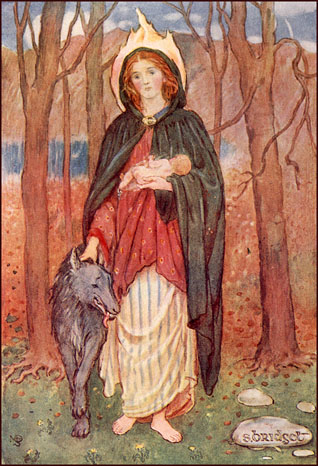
"S. Bridget", artist uncredited


There are so many beautiful images of Brighid/Bridget on the Internet and I have used a lot of them my previous Imbolc posts. Here are the links:

2008: http://celticanamcara.blogspot.com/2008/02/imbolc.html

2009 (two posts): http://celticanamcara.blogspot.com/2009/02/artist-unknown-aine-of-celts-here-on.html and
http://celticanamcara.blogspot.com/2009/02/images-of-imbolic.html

And 2010: http://celticanamcara.blogspot.com/2010/02/candlemas-imbolic-st-brigids-day.html


"Brigid", artist uncredited