Monday, May 31, 2010

A CORNER OF A FOREIGN FIELD THAT IS FOREVER SCOTLAND


William Munro, left, and Jack Munro, right


THE SOLDIER

"If I should die, think only this of me;
That there's some corner of a foreign field
That is for ever Scotland. There shall be
In that rich earth a richer dust concealed;
A dust whom Scotland bore, shaped, made aware, 
Gave, once, her flowers to love, her ways to roam,
A body of Scotland's breathing Scottish air,
Washed by the rivers, blest by suns of home.

And think, this heart, all evil shed away,
A pulse in the eternal mind, no less 
Gives somewhere back the thoughts by Scotland given;
Her sights and sounds; dreams happy as her day;
And laughter, learnt of friends; and gentleness,
In hearts at peace, under a Scottish heaven."

(With apologies to English Poet Rupert Brooke for changing the poem a bit.)

Long before I knew the story of my two Scottish great uncles who were killed in France in WWI I wept when I first read these lines: "If I should die, think only this of me; That there's some corner of a foreign field/That is for ever England. There shall be/In that rich earth a richer dust concealed.

For me, there are two corners in foreign fields that will be forever Scotland.

William Munro, a sergeant in the Seaforth Highlanders, died Nov. 13, 1916, at the age of 26. He is buried in the British Cemetery at Mailly Wood, France.

His little brother John Alexander (Jack) Munro, a regimental sergeant major in the King's Own Scottish Borderers, died just four months later, on April 12, 1917. He only 24 years old. He is buried at Feuchy Chapel British Cemetery, Waincourt, France.

I don't know exactly where John Alexander died, but William died in the hellish battle that became known as Beaumont Hamel. A fellow member of the Fifth Seaforth Highlanders wrote this poem about Beaumont Hamel:

"In the cold of the morning
A grey mist was drawn
Over the waves
That went up in the dawn
Went up like the waves
Of the wild Northern Sea
For the North has arisen
The North has broke free

Ghosts of the heroes
That died in the Wood
Looked on the killing
And saw it was good
Far over the hillsides
They saw in their dream
The kilten men charging
The bayonets gleam."

From the Diary of The Fifth Seaforths by Lt. E. A. Mackintosh


A memorial to the 5th Seaforth Highlanders
at Beaumont Hamel

William's Gravestone


Twilight at Feuchy Chapel, where Jack is buried.


Jack's Headstone. MC means
Military Cross. It was  awarded to
Jack posthumously, for conspicuous gallantry


William's Dead Man's Penny
It was decided during World War One that all next of kin of service personnel who lost their lives as a result of the war would be presented with a memorial plaque and commemorative scroll from the King and country. The plaques were cast in bronze and were approximately five inches in diameter. On the plaque itself no rank was recorded as the intention was to show equality in their sacrifice. The troops referred to them as "The Dead Man's Penny". 

The stories of William and Jack, and their older brother Archie, who was gassed and taken prisoner at the first battle of Ypres in April 1915, are here: http://celticanamcara.blogspot.com/2009/11/lest-we-forget.html

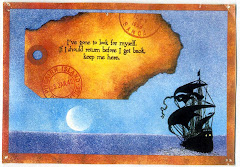
Photos of the French graves and cemeteries, and the Dead Man's Penny are courtesy of my second cousin, Shirley Sutherland of Golspie Scotland. She also helped design the e-greeting card shown at the top of this post.
I hope someday to be able to follow Shirley's footsteps and visit these cemeteries. Until then, today, Memorial Day, I salute William, Jack and Archie. (Archie - barely - survived the war, was repatriated and returned home. However, he lived only until 1920, his death directly attributable to the grievous damage to his lungs.)

~~~~~~~~~~~~~~~~~~~~~~~~~~~~~~~~~~~~~~~~~~~~~~~~~

Rupert Brooke, who wrote "The Soldier", died of sepsis on April 23, 1915 on a French hospital ship on his way to what became known as the Battle at Gallipoli. He was buried in yet another corner of a foreign field, in an olive grove on Skyros, Greece. He had not yet experienced battle.

~~~~~~~~~~~~~~~~~~~~~~~~~~~~~~~~~~~~~~~~~~~~~~~~~~

NOTE: Comment added by Cousin Shirl on 6/1: John Alex died during the Battle of Arras which began on 9 April 1917 - The following is a paragraph from the book - A Border Battalion, The 7/8th King's Own Scottish Borderers - "Sergeant-major Munro, after carrying away Private Morrison, who had been wounded, was mortally wounded when returning to Battalion Headquarters with the Signalling Officer, Lieut. Reay".

Wednesday, May 26, 2010

"LOST" - MISSING YOU ALREADY


Back to the beginning: Except for Rose and Bernard,
here's the original cast we came to love so much:
Front Row: Charlie, Jack, Kate
Second row (on the right): Sawyer, Sun, Jin, Walt, Michael
Back row: John, Hurley, Boone, Shannon, Sayid, Claire


Dear "Lost":

It's taken me a few days to absorb and process the ending of my favorite TV series ever. The initial episode was love at first sight for me, and I followed you faithfully for season after season, even when you kept me in the dark at times. But the plot was ever secondary for me. It was your characters I loved: Jack, the reluctant hero; Kate, the beautiful, strong, kick-ass girl; Sawyer, bad boy with a mile-wide good streak. You had affable, lovable Hurley; enigmatic John Locke; handsome Boone and pretty Shannon, his step sister; troubled couple Sun and Jin; ever-loving couple Rose and Bernard; father and son pair Walt and Michael; very-pregnant Claire; rock star/drug addict Charlie; and Sayid, whom we knew to be a stand-up kind of guy, good to have on your side, even if he had been an Iraqi "interrogator". I stuck by you even when you killed off some of my favorite characters.

Then, toward the end of Season Five last year, we were separated by circumstances beyond my control and I missed at least three episodes. So when you returned in February (PS - I never did like it when you started showing up for the spring season only) I was a little cold toward you because when I paid my eagerly-anticipated first visit I saw people there I didn't know. Like you, I was "Lost". I didn't know who Jacob was. I had a hard time remembering that John's body was being inhabited by The Smoke Monster. I couldn't get into the back story of Richard Alpert, the guy with eternal life. And I was totally at sea with the episode "Across The Sea". I'm ashamed to admit it but I was unhappy and consequently cheated on you with "American Idol" several times.

But in the end I came back to you, and I'm so happy I made it for the finale. Unlike a lot of people, it didn't really bother me that all the questions about the island were not answered. No, not even when you promised they would be answered. It didn't matter that you never explained why the characters time traveled to the 1970s, or how Ben could move an entire island by turning a giant wheel, or what Eloise Hawking was doing with that pendulum and circle. I don't even care that it never made sense that Hurley didn't lose weight on a diet of fruit and roast wild pig and all the exercise he got.

Daniel Faraday's equations, the polar bear, the hatch, all that button pushing, the "golden light" with its genie-in-a-bottle stopper, the Dharma Initiative, the hydrogen bomb, The Others, Dogen and the Temple People, ... what were they all about? We'll never know, although I suspect people will be speculating for a long, long time.

But I don't really care. No, all I cared about were things like, would Jack and Kate ever get together? I was rooting for them. I liked Sawyer too, and didn't want him to be left out in the cold, romantically speaking, so I'm happy about him and Juliet. I smiled when I saw Boone again after all this time, and I cried when I saw Charlie again. Dear, dear Charlie. You know me, I am the Queen of Denial and never really believed that Boone, Charlie or even John Locke were dead. I mean, dead for good. After all, the island was magical - it cured Rose's cancer, it fixed Locke's legs, why couldn't it resurrect the dead?

It was really nice to see Rose and Bernard one more time. And Vincent the dog. We all wondered about Vincent. It would have been nice to see Michael and Walt again but I guess Michael's spirit is trapped on the island and Walt is happy back home in New York. Whatever.

And Jack. Valiant Jack, who made the ultimate sacrifice. I would really, really have been pissed off if you left Jack to die all alone there in the bamboo grove. But then, Vincent showed up and lay down next to him. How fitting that the series began with Jack opening his eyes and ended with him closing them, coming full circle.

Just to let you know, I would have been heartbroken if you had left Jack dead on the beach and not explained the flash sideways story. Thank God (Christian Shepherd?) for showing us The Afterlife. Sorry about all the dim bulbs who couldn't comprehend it, even after Christian explained it very well to Jack: It was "the place they made together so they could find each other."


All those beautiful beaming faces, together again at the end! Claire and Charlie finally sharing a kiss. Hurley the good No. 1 Island Protector and Ben (!), his good No. 2. Desmond the  - what? The reunion organizer, the spiritual mother hen, an angel gathering the shepherd's flock? Jack, the savior of mankind? That was closure, and it enabled me to leave you on a joyous, rather than sorrowful note. 

Thank you "Lost". You showed me believable, beloved characters, people who fought the good fight against evil, to the bitter end. You made me think about science versus faith, about destiny versus free will, about regret and redemption, about atonement and sacrifice, about love and abiding friendship. That time on the island WAS the most important part of all those lives, wasn't it? It was a big part of my life too.

I'll be "Lost" without you, but there's always the DVD collection!

Thank You,

Love, Julie

~~~~~~~~~~~~~~~~~~~~~~~~~~~~~
For anyone who still doesn't get it: No, they did not all die in the crash of Oceanic Flight 815 (are you listening, Bill W.?). Everything that you saw happen on the island was real. The flash sideways stories were about the characters in the afterlife (but it is not purgatory). The characters died at different times. Ana Lucia, Libby, Boone, Shannon, Charlie, etc. died on the island. John Locke died after the Oceanic 6 survivors returned to L.A. Sayid, Sun, Jin and Jack died after they went back to the island. (When Jack hands the torch to Hurley and says, "I'm already dead" he means "I've been mortally wounded and I'm going to die.")

Hurley and Ben stayed on the island to be its protectors and to prevent The Smoke Monster from leaving the island and destroying the world. Desmond fulfilled his mission and was sent back home to Penny and their son. Kate, Claire and Sawyer, among others, made it off the island in the Ajira plane. Those three may have lived very long lives. However, now everyone is together in the church (where there is no "now") and they are crossing over to the other side together. All except for Ben - he stays outside because he's not yet ready to go - he hasn't redeemed himself enough yet. Got it now???

Thursday, May 20, 2010

EMILY'S DICKINSON'S GARDEN - THE POETRY OF FLOWERS


I wonder why the Creator jammed so many gorgeous flowering plants into the month of May.The profusion of blooms is almost overwhelming at this time of year. The double flowering plum next to my bedroom window is an explosion of cotton candy pink. All over town, the crab apple and apple trees are clouds of white, light pink and magenta flowers. The tulips are holding strong, and there are still some daffodils too.

Just yesterday I saw the most striking dark blue hyacinths next to a foundation. The bleeding hearts are so aairy and delicate, and the johnny jump-ups so cheerful. The phlox are sweet mounds of lavender and the chokecherries are heavenly-scented panicles of white. I even saw a clump of purple iris yesterday, and they usually don't bloom until June here. And best of all, the lilacs are set to burst into bloom in just a few days. Oh that I were Emily Dickinson, so I could write memorable poems about them.

Emily (I'll be informal and call her by her first name throughout) wrote a lot of poems featuring flowers, and her letters mentioned many types of flowers as well. Did you know that in her lifetime she was better known for her gardening expertise than her poetry? I didn't. Now, the reverse is true, but the Brooklyn Botanical Garden and the Poetry Society of America are reminding us that her two loves went hand in hand.

As co-presenters, they have put together a display in the Enid A. Haupt Conservatory at the BBG that runs through June 13. Called "Emily Dickinson's Garden - The Poetry of Flowers", the display features such "old-fashioned" flowers and plants as delphiniums, lupines, honeysuckle, roses, lilies, peonies, tulips, lily of the valley, ferns and hydrangeas. The lowly dandelion is present to, taking a place of honor. Of the dandelion, Dickinson wrote that it "Astonishes the grass" and has a "shouting flower."


Scattered here and there throughout the Victorian border are poetry stations featuring copies of Emily's poems and audio messages about the works and the flowers that inspired them.

No trace of the original plantings survive at Emily's home in Amherst, MA, so the BBG staff had to research the varieties of plants that would have been popular in a western Massachusetts spring garden more than a century ago, paying particular attention to those Emily mentioned.

The display includes windowed facades meant to look like Dickinson's home and her brother's next door, and there's a facsimile of the poet's bedroom with a window providing a view like the one she had. In this room, she wrote most of her poems and forced bulbs. Emily once called herself a “a Lunatic on Bulbs,” referring to her passion for the daffodils, hyacinths and other spring perennials which she raised indoors in winter.


Accompanying the flower display is a gallery exhibition which contains 19th-century botanical books and prints, autographed copies of two of Emily's poems, and a digital edition of the massive herbarium that she assembled in her teens by collecting, pressing and labeling about 400 plant specimens.

There's also a reproduction of a white dress the poet wore. Judith Farr, an adviser to the show and author of "The Gardens of Emily Dickinson," said Dickinson gave up wearing any color but white when she was in her 30s, as she began to withdraw from society. She also took on some other odd behaviors, including gardening at night. Dickinson scholars now suspect that one reason Emily preferred night gardening was because of vision problems: for several years in her early middle age, sunlight stung her eyes.

The exhibit will also feature marathon readings of her poems (she wrote about 1,800!) and lectures by contemporary literary figures who will discuss Emily's significance to American poetry. It is a show that I would love to attend, but I will have to make do with checking out a couple of books that showcase Emily's poems and her garden together.


One of the Emily's inspirations for her flower poems was a book called "Symbolical Language of Flowers," which ascribed meanings to particular flowers - a poppy symbolizes doom, a violet means humility, etc. There are many similar books on the language of flowers available today. Examples are "The Language of Flowers" by Sheila Pickles and "The Language and Sentiment of Flowers" by James McCabe, which discuss the flower symbolism of the Victorian Age. "The Language of Flowers: Symbols and Myths" by Marina Heilmeyer goes much further back in history and includes flower symbolism in Medieval times, in the Bible and even in Ancient Greece and Rome.

I've already mentioned "The Gardens of Emily Dickinson", shown above. Judith Farr, the author, says Emily used flowers as symbols repeatedly.  To her, as to many Victorian Americans, flowers weren’t just beautifiers; they were moral and personal emblems.

Dickinson, with her auburn hair, identified with the orange tiger lily and sometimes called herself Daisy, for a flower that symbolized innocence. She associated certain richly scented flowers, like roses and jasmine, with men and women to whom she formed emotional attachments.


Another book on the poems and flowers of  the beloved "Belle of Amherst" is "Emily Dickinson's Gardens", shown above, by Marta McDowell. McDowell shows us the consummate gardener Emily so passionately was--sending home grown bouquets to friends, studying botany at Amherst Academy and tending her own glassed conservatory off her father's study. 


Following are a few of Emily's flower poems:

SHE SLEPT BENEATH A TREE (THE TULIP)

She slept beneath a tree
Remembered but by me.
I touched her Cradle mute
She recognized the foot
Put on her Carmine suit
And see!


THE DANDELION'S PALLID TUBE

The Dandelion's pallid tube
Astonishes the Grass,
And Winter instantly becomes
An infinite Alas --
The tube uplifts a signal Bud
And then a shouting Flower, --
The Proclamation of the Suns
That sepulture is o'er.


UPON A LILAC SEA

Upon a Lilac Sea
To toss incessantly
His Plush Alarm
Who fleeing from the Spring
The Spring avenging fling
To Dooms of Balm


SERIES III: NATURE: XI: A ROSE

SEPAL, petal, and a thorn
Upon a common summer's morn,
A flash of dew, a bee or two,
A breeze
A caper in the trees, --
And I'm a rose!

I HIDE MYSELF WITHIN MY FLOWER

I hide myself within my flower,
That fading from your Vase,
You, unsuspecting, feel for me --
Almost a loneliness.


PERHAPS YOU'D LIKE TO BUY A FLOWER?

Perhaps you'd like to buy a flower?
But I could never sell.
If you would like to borrow
Until the daffodil
Unties her yellow bonnet
Beneath the village door,
Until the bees, from clover rows
Their hock and sherry draw,
Why, I will lend until just then,
But not an hour more!


FRINGED GENTIAN

God made a little gentian;
It tried to be a rose
And failed, and all the summer laughed.
But just before the snows
There came a purple creature
That ravished all the hill;
And summer hid her forehead,
And mockery was still.
The frosts were her condition;
The Tyrian would not come
Until the North evoked it.
"Creator! shall I bloom?"


WE SHOULD NOT MIND SO SMALL A FLOWER --

We should not mind so small a flower --
Except it quiet bring
Our little garden that we lost
Back to the Lawn again.
So spicy her Carnations nod --
So drunken, reel her Bees --
So silver steal a hundred flutes
From out a hundred trees --
That whoso sees this little flower
By faith may clear behold
The Bobolinks around the throne
And Dandelions gold.

Sunday, May 16, 2010

LETTERS TO JULIET


I saw an absolutely delightful movie over the weekend. "Letters to Juliet" stars that grande dame of acting, Vanessa Redgrave, and a shining new actress, Amanda Seyfried (who was also in last year's wonderful "Mamma Mia".)

The gist of the story is this: New Yorkers Sophie (Seyfried) and her fiance Victor (Gael Garcia Bernal) are taking a "pre-honeymoon" in Verona because they won't be able to go after Victor opens his new Italian restaurant in six weeks. Once there, Sophie wants to sightsee in "fair Verona", as Shakespeare called it when he set his famous play "Romeo and Juliet" there. But all Victor is interested in doing is attending wine auctions and tasting Italian breads, cheeses and pastas. Consequently, Sophie ends up spending most of the time alone. (Although Victor could have been an unlikeable, self-centered character, Bernal plays him with a kind of goofy, loopy impetuosity that makes him sort of endearing, if not great fiance material.)

Sophie, a fact checker for the New Yorker magazine, secretly wants to be a writer. She finds a story to tell when she accidentally stumbles on the little courtyard at the home of Juliet Capulet, where women from all over the world have been leaving letters addressed to Juliet on a stone wall. Sophie locates the nearby offices of the Secretaries of Juliet, four women who are engaged in the task of answering all these letters. After getting to know the women, Sophie goes back to the wall and finds a letter that had been hidden away in a loose stone for 50 years. With the blessing of the secretaries, Sophie replies to Claire (Redgrave), the writer of the letter.

Amazingly, within a few days the Secretaries of Juliet and Sophie get a letter from Claire. "We English always remain in our family homes" says Claire's grandson later to explain why Claire still had the same address after all this time. Claire had originally written to Juliet to ask if she should stay in Italy with her young lover, Lorenzo. But she did not stay, returning to England. Now, 50 years later, she has decided to come back to Italy to find him.


Claire is accompanied on her trip by her rude, snotty grandson Charlie (Christopher Egan, who looks a lot like Heath Ledger). Sophie proposes that since Victor is so busy she is footloose and can travel along with Claire and Charlie in their quest. Charlie vigorously protests, but Claire is delighted to have Sophie accompany them. You can probably guess what happens next, but if you can't, this is a spoiler alert: Don't read the next few paragraphs! Start reading again under the next photo.

Sophie and Charlie somehow manage to fall in love along the way. (Charlie explains away his initial oafish behavior by saying he was just worried about his fragile Grandma. ) The three have a lot of trouble finding Lorenzo because there are so many men in that area with the same name. It was great fun to see all the different Lorenzos who might have been the one, ranging from very charming elderly gentlemen to senile nursing home cases to repulsive dirty old men.

Finally, they locate the real Lorenzo, a widower who is still very handsome. Lorenzo (played by Redgrave's real-life husband Franco Nero) has a magnificent villa surrounded by the vineyards which his big extended family operates. Lorenzo recognizes Claire immediately and she too, knows that this is HER Lorenzo. Everything is happy ever after for Claire and Lorenzo.


Yes, I know this is a cream puff of a movie, just a casual bit of fluff. But I enjoyed it on so many levels. Redgrave, who just gets better and better, is exquisite as an elderly woman who has aged well. Claire is elegant, gracious, wise and kind, but a bit dazed and shocked at the temerity of what she has set out to do. I think the wardrobe people did a wonderful job of giving Claire clothing suited to her age - comfortable dresses and flat shoes  that were not dowdy but appropriately stylish. As Sophie, Seyfried is just luminous.

It was great seeing Redgrave and Nero together again. They were the red-hot lovers Guinevere and Lancelot in the 1960s movie "Camelot", which was a huge favorite of mine back then.

Most of all, I thoroughly enjoyed the sights of the cities of Verona and Siena and the journeys through the Tuscan countryside bathed in golden light. I loved the al fresco dining scene under the trees and the wedding at the villa. There is the requisite balcony scene too, but it is humorous, not serious. All in all, it was light-hearted escapism at its best.


The movie was inspired by the actual Secretaries of Juliet in Verona, an organization I had never heard of before. Printed below is an Associated Press story written by Colleen Barry:

"VERONA, Italy - Hers was a literary, not literal, existence only. And her own love story was, let's just say, star-cross'd.


"Nonetheless, thousands of lovelorn every year pour out their hearts and seek solace from Juliet, Shakespeare's heroine.


"Their entreaties arrive by the dozens — handwritten missives, sometimes with drawings, or photographs, penned on handmade paper or sheets meant to look like ancient parchment. Some are addressed simply: Juliet, Verona, Italy.


"Yet thanks to compassionate letter carriers, they find their way to an upstairs office overlooking the courtyard of the fabled home of Juliet Capulet, just opposite the balcony of Shakespearean fame.


"And there, improbably, they are answered by 15 self-appointed secretaries to Juliet.


"Let's say by now we are pretty expert. After 15, 20 years we are able to manage this phenomenon," said Giovanna Tamassia, who has been writing replies for 16 years. "But it is also true that sometimes a particularly difficult letter arrives and then we speak among ourselves."

The Secretaries of Juliet, or The Juliet Club, as it also known, is a voluntary association. It has been active for many years, offering advice and support or just lending an ear to all those who feel compelled to write. (Letters have been arriving in Verona at least since the 1930s.)

In addition to answering every single letter addressed to Juliet, the members also promote the legend of Romeo and Juliet and the image of Verona, and they organize some cultural events.  

Soon, the Secretaries of Juliet will be looking for more help: Barry writes that they are expecting a deluge of letters now that the movie has been released.


There is also a book on this subject, written by sisters Lise Friedman and Ceil Friedman. The following is a paragraph from a website promoting the book:

"Complete with selected letters, LETTERS TO JULIET explores the legend of Romeo and Juliet, the history of the monuments in Verona, and the story of the various secretaries who have been answering Juliet´s mail for decades. A 21st-century view of the city from an insider´s perspective completes this charming and magical book, which includes stationery that readers may use to send their own letters to Juliet. In its entirety, LETTERS TO JULIET offers an enchanting look at one of literature´s most romantic figures, and the phenomenon of her legend."

Another review describes the types of letters that are received: "The letters arrive by the thousands, in almost every language, and from writers of all ages. Most talk of love - love found and love lost, love sought and love remembered. They may have been written by teenagers in the throes of a first crush or by adults celebrating a hard-won love. The emotions and desires they express are timeless, and some reflect how a particular issue or social movement shaped the writer´s feelings and perspective."

~~~~~~~~~~~~~~~~~~~~~~~~~~~~~~~~~~~~~~~~~~~~~~~~~~
I was saddened to learn of the death earlier this month of another great actor from the Redgrave family, Vanessa's younger sister Lynn Redgrave, praised for many roles, including those in "Georgy Girl" and "Gods and Monsters". And of course, Redgrave also lost her brother Corin last  month and her daughter Natasha Richardson last year.

Thursday, April 29, 2010

OH TO BE IN ENGLAND NOW THAT APRIL'S THERE


Western Meadowlark

So many people come to my blog by Googling this phrase: "Oh to be in England now that spring is here." They manage to land in the right place even though they have the phrase wrong! It is "Oh to be in England now that April's there." I wrote a post a few years ago with this title, and I'm doing so again today.

First, I'll satisfy you searchers by printing this poem written by Robert Browning when he was in Italy:

HOME-THOUGHTS, FROM ABROAD

"Oh to be in England
Now that April's there,
And whoever wakes in England
Sees, some morning, unaware,
That the lowest boughs and the brushwood sheaf
Round the elm-tree bole are in tiny leaf,
While the chaffinch sings on the orchard bough
In England - now!
And after April, when May follows,
And the whitethroat builds, and all the swallows!
Hark! where my blossomed pear-tree in the hedge
Leans to the field and scatters on the clover
Blossoms and dewdrops - at the bent spray's edge -
That's the wise thrush; he sings each song twice over,
Lest you should think he never could recapture
The first fine careless rapture!
And though the fields look rough with hoary dew,
All will be gay when noontide wakes anew
The buttercups, the little children's dower
- Far brighter than this gaudy melon-flower."


Prairie Crocus/Pasqueflower
Pulsatilla (or Anemone) Patens

Well, the Internet searchers aren't really off the mark by googling "spring", because Browning does talk about May as well as April. By all accounts, April in Britain is wondrous to behold. I've often read about British bluebell woods. My Scottish second cousin Shirl has sent me pictures of her dogs walking on carpets of bluebells, which are different than the Virginia bluebells I can grow here. And my English blogging friend Leanne at Somerset Seasons Dorset Days posts pictures of her primroses, auriculas, oxlips, cowslips, yellow kerria japonica blossoms and so many more flower swe can't enjoy here.

April in England seems like quite the heady, rapturous event. I'm afraid that April in North Dakota is much more subtle. Sometimes one really has to search for signs of spring.


Bee in a plum tree


Take the prairie crocus, for example. To find them, you have to look close to the ground on virgin soil. When we were kids we would find them on the railroad right-of-way. They can also be found on other soil untouched by the plow. They are a pale lavender, the inside of the petals so pale they almost look white. The little cups are set upon feathered stems only a few inches off the ground.

Nowhere in North Dakota will you find William Wordsworth's "a crowd, a host, of golden daffodils", but we do have homeowners who plant daffodils and tulips in front of their homes. A popular color combination in Bismarck seems to be red and yellow tulips.

I've seen more honey bees so far this year than I did last spring. I hope this is a good sign that the bees have recovered from the problems plaguing them and are returning in force. Two got into my house this week. To capture them, I use a drinking glass and a stiff piece of paper. I put the glass over the bee (who's usually on a window) and slip the glass and all onto the piece of paper. This way I can safely set the bee free. Unfortunately, Gracie jumped on me yesterday just after I captured the bee, and killed it by biting it. (Does she know it has a stinger??)


Purple tulips go well with
yellow and white daffodils

Some robins stay in North Dakota all winter. For the rest of those who winter down south and arrive in the spring, April is the time for them to really let loose with their morning- and evensong. They seem to be singing "We're glad to be back in North Dakota!"

I once visited Denver, Colorado in April. It seemed like there was a forsythia in every yard. Forsythia are much more scarce here. Only a few grow in cool Zone Three, which covers most of North Dakota. A little finger of Zone Four sticks up into North Dakota along the Missouri River, and I think that's why we see a few forsythia bushes dotted here and there around Bismarck.

April in North Dakota is the time for those delicate, oh-so aromatic plum blossoms. And a couple of weeks ago, two rare (for Bismarck) apricot trees bloomed on the site of the old Jewish synagogue. They are so lovely there, their horizontal pale peachy-pink branches spreading to cover the entire south side of the brick building.

There were never many Jewish people in Bismarck, now there are hardly any. I wish I knew someone to who could tell me if some member of the synagogue imported those apricot trees from a warmer clime.


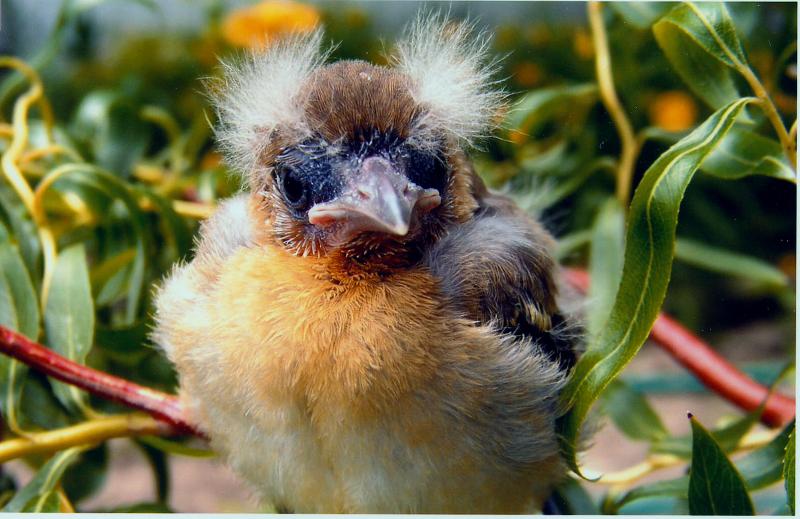
Soon we'll be seeing baby robins
with their funny little tufts

Even though the dandelion is considered a weed by many and a lowly plant by most, I still welcome these sunny yellow buttons every spring and always have the urge to hold a dandelion flower under someone's throat to look for "butter".

Weeping willows are my favorite trees in April. That's because they are such a lovely, pale light green at this time of the year. In a light breeze, the flexible branches undulate like curtains.

And finally, it absolutely could not be spring in North Dakota without meadowlarks and their melodious song. When I was growing up in my little village we could hear them when we walked out the door. Now I have to drive out to the country (admittedly that doesn't take long) to hear those precious cascading notes. These birds, with their brilliant yellow and black markings, prefer to sit on fence posts rather than high wires. They even build their nest on the ground.


Forsythia

Signs of spring in North Dakota may sometimes be subtle, but they certainly are welcome.

Saturday, April 24, 2010

IN SPRING, A YOUNG GIRL'S FANCY TURNS TO THOUGHTS OF . . .


ME, SENIOR PROM EVENING
(It strikes me that I look haughty here,
but it was nerves, all nerves)


In spring, a young girl's fancy turns to thoughts of prom. And in spring, a young man's fancy turns to thoughts of how to pay for prom.

At least that's the way it is for teens today. We've all heard about the high cost of prom these days - the elaborate themed decorating kit more suited to a Broadway musical, the expensive dress and salon hairdo for the girls and the rental of tuxes for the guys. One must hire a stretch limo, reserve a photographer for formal photos (!) and go to a fancy restaurant before the dance. And after the dance it's time to head to the all-night after prom party. 

Here are some stats from just one website: Tickets can be anywhere from $50-80, tux rental $150, dress at least $250, flowers $40, limo rental $400, total $920. Hey, they forgot the dinner! You're talking $1,000 before you can say "May I cut in?"

Prom is short for promenade, or what we used to call the Grand March. (Do they still call it that?) It's a prelude to a dance. A dance. That's all it is, gals - and guys. Just a dance, not a wedding, not a coronation.

My thoughts turn to prom today because it's Bismarck High School's prom tonight. I knew that because of a news story I saw last evening. Apparently BHS is cutting back on the cost of the prom by holding the dance "in only one gym". Only one gym? We only ever had one gym, which always smelled of old gym socks and sweaty bodies. The cost for a BHS prom ticket? A "low" $35.00 (for a single or a couple, I'm not sure.) The ticket price includes two spectator seats. Cripes, in our day the prom was free and the town bum could come in off the street, plop down on a bleacher seat and watch the Grand March.

For my junior prom, I was invited by a fellow junior, a red-headed Irishman named Tim Fay. On prom day, I washed and set my own hair. Like all the girls, I wore a long dress (maybe $30?). Short dresses were NOT an option. My dress was sleeveless with a straight-line skirt. It was pale yellow with a lace overlay and featured a deeper yellow bow at the waist with long ribbons trailing down the front. I wore "bone" colored gloves and shoes.

Tim, like all the guys, wore a suit. Like all the guys, he drove his dad's car. He wasn't a farm kid, so he didn't have to worry about showing up in a truck. Unlike the other girls, who got roses or carnations, I got orchids. I still remember their beautiful color, sort of a creamy beige with purple at the throats. I was the only girl who had a wrist corsage too.


This corsage is very like the ones I got for prom.

We raised money for the prom by holding car washes and other fund raisers. The day before prom, the girls decorated the gym with color-coordinated crepe paper, cut-out lettering and balloons. We always chose some dreamy theme like Tropical Paradise or Under the Moonlight. Even then, proms were about getting asked out by the cutest boy in class, or the excruciating fear of not being asked at all, and ultimately having the most romantic evening ever.

Back in my day, not having a date for the prom could scar a girl for life. A friend of a friend of mine still holds an annual BFFL (Big Fat F------ Loser) Party for anyone who never went to prom. 


This $1,186 Castle in the Sky theme
was not quite in our budget.


Columbus High School proms were pretty sedate, with forgettable bands hired from Minot, the typical mix of slow and fast dances, dance cards to fill out in pencil, and punch - not spiked! After the prom, the girls changed into more casual clothes while our dates waited, and then we went out for a late supper at The Portal Corner supper club, which stood in for swanky in our area. (Specialties: steak, fried shrimp and fried chicken.) After supper, we all went home. Well, I went home anyway.


The next year, very little had changed, except that a small group of senior girls determined that everyone - EVERY SENIOR at least - had to go to the prom, so they went into overdrive to matchmake. Tim had moved 100 miles away, but I was pressured into strongly urged to invite him. A good sport, he accepted. Thank goodness gas was cheap then.

I wore the SAME dress and the SAME shoes to senior prom, with maybe a different pair of gloves. Spare no expense was not my family's motto! I was again the only girl who got an orchid wrist corsage. (I bless Joan, his mom, to this day.) This time we went to the Border Triangle Club, which was located exactly one block from my house in our tiny town of Larson. However, my family rarely ate there, so it was a treat for me. And afterward I went home, removed my second orchid corsage ever, and stuck it in the fridge so it would last for days.

Tim lives in Bismarck now and I have run into him several times in Wal Mart or K Mart, and he's usually accompanied by one of his four red-headed sons as we yak about this and that.

Attitudes toward prom have changed in the last 40 years. Some kids try to see how inexpensive they can make their prom experience. Some kids - gals and guys - go stag or as a group. When it was time for Kristen's prom, she went to an anti-prom party, probably wearing her usual jeans thrift shop T-shirt. That was fine by me.

These days, my only opportunity to see prom goers is when my sister and I are out and about on a Saturday afternoon and the kids are emerging from limos for an early dinner at a nice restaurant. How beautiful they are, all dressed and tuxed, moussed and sprayed, made up and splashed with cologne. I won't be going out today so I won't see them but I do hope the rain holds off so it doesn't spoil their special day.

And for anyone not going to prom, or never went to prom, you are not, I repeat, not a BFFL.

Wednesday, April 21, 2010

GRATITUDE - IT'S AN ATTITUDE


I haven't been blogging much lately. I just don't know the direction I want this blog to go any more. I have thought about quitting blogging because I have run out of things to say and I haven't liked what I've written lately. My good blogging friend Gemma convinced me not to quit, saying that my blog is my gift to the world. I never thought of it that way.

I'm going to keep writing it, at least for now, and I'm looking here and there for topics until (if and when) I find my way again. I might use memes, or borrow a topic from another blog, or delve into my past. For example, I happened upon a gratitude journal I had written in April and May 1999 or 2000. It was interesting to see what has changed, and what has stayed the same.

(BTW, I enjoyed the ingratitude graphics way better than the gratitude graphics I found.(The gratitude ones are the least cutesy I could find.) An ingratitude journal would be so much easier to write, wouldn't it? When I started my journal, on April 23, I had no trouble finding five entries. As the days went by, the number of daily entries dropped to four, or even three. Then, I could scrounge up only one or two entries. The day before the journal completely tanked (May 17), I had "nuttin', honey"!


But even so, I did manage to find a lot of things to be grateful for in those three weeks. Because of changing circumstances, I couldn't even write them today.

"Lunch with my sister at International Stir Fry." (That restaurant folded a couple of years ago and they are building a motel on the site.)
"A friend has invited me to a stamping party tonight." (That friend has gone by the wayside, and so has my interest in stamping.)
"A warm waterbed and comforter to crawl into/under after a hard Monday." (Dan got rid of our waterbed, and I have never quite forgiven him!)
"My shaggy, smelly, stinky puppy dog, Lady." (Lady died several years ago, as did my beloved Golden, Penny.)
"Dusty, my kitty, who adores me to pieces. So affectionate, so warm and cozy (so heavy)." (Dusty has also passed away.)
"I'm grateful to have a job, even when the stress level is high and co-workers are jerks (e.g. J----, the Dragon Lady)." (I no longer have that job, or any job, for that matter.)
"The flea market! Even when it is mostly junk, as this one was, the anticipation and the hunt are still fun, and I almost always find something." (The flea market is now defunct because everyone sells their stuff on eBay anymore.)
"Peace and safety for Kristen and all the other kids at Bismarck High School. May terror never visit here." (I was referring to the massacre at Columbine. This must have been the year it happened or the year after. School shootings still go on. I don't have to worry about my daughter now, but am concerned for all teens so vulnerable in classrooms.)
"I am utterly, utterly, utterly thankful for the invitation seven years ago to join book club. It has given me wonderful friends and broadened my reading horizons." (I'm all over that now.)


There are entries so generic that anyone could have written:

"My health."
"Sunshine at last."
"The first real spring day."
"TGIF".
"Mail that's not bills."
"A car that gets me where I want to go."
"If one has to have rain, at least it's making the grass green."
"As Mondays go, it could have been worse."


Referring to the above graphic, Kristen was NEVER an ungrateful little shit. Well, maybe once, on Valentine's Day when she was 14. She made it quite clear that my gifts to her were extremely childish, silly and unwanted. She made me bawl. In her later teens and into college, she got way more tactful about her gifts. (She has seldom liked the clothes I buy her.)

Nope, I had a lot of gratitude entries about Kristen:

"Kristen winning the gold medal in the National Latin Exam."
"The big hug that Kristen gave me after running into each other at B&N".
"That I am the mother of a beautiful daughter, and I get Mother's Day presents because of it."
"My brilliant daughter has won first place in the state in the National French Exam, and is in the top 10% of the nation."
"I'm so grateful Kristen is better after being in such pain following the tightening of her braces."
"A daughter who is so enjoyable to be around."
"A daughter who scored 30 on the ACTs (97th percentile!)."

Kristen is no longer a kid - she's 27 - but she's still great. She has a master's degree in library science, has a great job at a college library, has a steady boyfriend of four years and is mom to three sweet kitties. And, she calls us every Sunday.


There are many, many entries in that old gratitude journal that I could repeat today:

"The almond trees at the Jewish Synagogue are blossoming." The only two almond trees in the city, they are blooming today as I write this.
"Friday and Saturday night special dinners with my husband: Candlelight, wine, good food."
"The sight of a blue jay in our back yard this morning. They don't visit very often."
"Fountain pens."
"Marie Callender chicken pot pie with big chunks of white meat."
"Not having to get up in the dark, and longer evenings too."
"My 1929 stucco bungalow."
"Living on this beautiful blue, white and brown marble called Earth."
"Having some spending money in my pocket."
"Chicken Carbonara from Minerva's."
"I am grateful that I have my sanity and am also pretty well-balanced emotionally."
"Mocha coffee with whipped cream."
"Books, glorious books."
"A clean house, on a weekday even."


There are new gratitude entries I could add today, ones I wouldn't have made 10 years ago:

1. Dan bought himself a used car today, through the dealership. I get my car back, yay!!
2. Bismarck's terrible economy may be improving at long last. I am getting a few more temp job offers.
3. Being able to reserve books at the library. It's so convenient.
4. Blogging and Internet friends.
5. My crazy, excitable, super-hyper Gracie dog.
6. Dan helped me get rid of a bunch of junk this morning for Bismarck's "Clean Up, Paint Up, Fix-Up Week." This is the week that our garbage men will pick up large appliances, furniture, tree branches, etc.!
7. The sweeping elm branch right in front of our deck is not dead, as I had feared, and is finally greening up.
8. Reading glasses at 3 for $10.00 so I can have a pair in every room.
9. Finding things outdoors that were hidden by winter snows.
10. Things you run across that make you smile, just because. See photo below:


Wednesday, April 14, 2010

OUT OF AFRICA, A DAUGHTER OF EVE


"THE SEVEN DAUGHTERS OF EVE"
by Ulla Ploughman-Turner

Sometime last fall, I think it was, I wrote a post illustrated with photos of my daughter, myself, my mother, my maternal grandmother and my maternal great-grandmother. Those are all the photos I have of women in my matriarchal line. And beyond that, I had only the name of the other identified woman to whom I am linked by mitochondrial DNA.

Mitochondrial DNA, or mtDNA for short, is DNA that is passed down only through the mother. (Even though men have mtDNA, they cannot pass it along to their children.) So for me, the known direct line is Kristen, Julie, Myrtle, Julia, Margrete and her mother, great-great-grandmother Margrete for whom there is no photo. Other than my sister and daughter, the only other living person that I knew of who shared my mtDNA was a male cousin, the son of my Aunt Ina.

That has changed. After I wrote my post, a blogging friend sent me a mtDNA testing kit through Gene Tree (www.genetree.com). Since the test costs $150, that was quite an early Christmas present! (Thanks, CB, for your generosity.) I took the test by swishing some mouthwash around in my mouth and spitting it into a container. I mailed it off and then sat back and waited. Usually, the test takes about 12 weeks. Unfortunately for me, there were changes at the lab and my test had to be re-done, so I had to wait five months, but late Monday evening, I received my results via e-mail!!

Here are my results: My mtDNA haplogroup is N, subgroup W. My mtTDNA markers are: 16189C, 16223T, 16292T, 16519C, 73G, 189G, 195C, 204C, 207A, 263G, 315.1C, 709A.

Oh, gobbledygook. Those numbers meant no more to me than they probably do to you. I found out that learning my mtDNA is only the beginning. Tracing my lineage is going to take a lot of study and hard work. But Gene Tree will help me, as will corresponding with other people who have been tested, and tons of research.

I did learn that I have one perfect match, meaning that there is a person out there who took the test and has my identical mtDNA from a common ancestor, probably many generations back. That person, it turns out, wishes to remain private, but he/she, I was disappointed to learn, is American with Norwegian roots. Plain old Norwegian?? I want to move away from Norway, way-far away.

I know that I originally came from Africa. We all do, there's no denying it. There was an ancestral mother there from whom we all descended. But I want to know where my people went from there. What lands, what continents did they traverse before they ultimately reached Norway?


One Theory of the Spread of  Haplogroup W

They say a little knowledge is a dangerous thing and that is probably the case with me, after having spent a couple of days perusing the Internet.

In the little bit of research I've accomplished (or understood), I've learned a few things. I learned that my haplogroup W, which Gene Tree calls a subgroup and other sources call a group, is relatively rare. (Well, I always knew I was special!) Back in 2001, a man named Bryan Sykes wrote a book called "The Seven Daughters of Eve: The Science That Reveals Our Genetic Ancestry". According to him, there were seven "clan mothers" from whom the majority (95%) of Europeans are believed to obtain their mtDNA. They were given the names Ursula, Xenia, Helena, Velda, Tara, Katrine and Jasmine. As you can see, there is no "W" name.

I learned that geneticists now believe that there were 10-12 Daughters of Eve, including a woman classified by the haplogroup W.  One site has nickednamed her Wilma and fondly uses Wilma Flintstone as a graphic for the Wilma clan mother. I am a daughter of a Daughter of Eve!

Apparently, the first Wilma was born somewhere in northwest India or northern Pakistan from 49,000 to 28,800 years ago. Her people had left eastern Africa via the southern edge of the Arabian Peninsula (there being dry land then at the mouths of the Red Sea and the Gulf of Arabia) and headed east along the coast of the Arabian Sea.

On one site devoted to the W haplogroup, I found that I am just one mtDNA marker short of being a match to a Wilma group of people who lived solely in Russia, and one marker short of a match with a group out of Poland. I also share markers with a lot of people from Finland. Does that mean my long-ago ancestors perhaps traveled west from Russia to Poland or Finland and then further west to Norway?

Or does missing that one marker totally mess up the formula and geographically place me somewhere else entirely, like Turkey, the Balkans or Eastern Europe? And if my ancestors were Russian, did they come north from Mongolia, China, Japan? When my aunt had her quintuple bypass her surgeon asked me if she was of Japanese ancestry (though she was as WASP as WASP can be). He said she had a very, very strong heart, the kind he had seen in Japanese people (strong heart, bad arteries). I laughed in his face at the time but now I wonder??

If I am understanding it correctly, this test is more anthropology than genealogy, less an indication of whom I came from than where I came from. And I want to - I NEED to - know where I came from, so I am determined to gather as much information as possible. Sigh, there is still so much to learn, and it's so complicated. I know what it means to be a "zero difference" match with another person, but what does a 1- or 2-difference match signify? My understanding of DNA sequencing, haplogroups, HVRI and HVR2, clades and subclades and all the rest is miscroscopic. And of course with a mtDNA test I still know nothing of the ancient homelands of my maternal grandfather's Scottish relatives or my father's Norwegian and Irish relatives.

But it's a start, and I'm really glad I took this mtDNA test.


I'M A WILMA!

Monday, March 29, 2010

A DAY OF FIRSTS


"I wanna hear some funky Dixieland, c'mon pretty mama take me by the hand..."

Today was the first spring day to crank down the car window and crank up the car radio, the first day to turn on the car air conditioner.

It was the first day to hit and surpass 70 degrees F. (72 degrees), the first day to open the house windows, the first day to leave the patio door open for Gracie to run in and out at will.

It was the first day (for me anyway) to go outside without a coat, first day to see joggers go by wearing only tank tops and shorts, the first day to say the snow is really gone, except for a few little icebanks left over from snowblowers or plows (they don't count!).

It was the first day to see a neighbor raking leaves, first day to hear the roar of motorcycles, first day to fire up the barbecue.

It was the first day to see (and purchase) daffodils at the supermarket, the first day to buy a Russell Stover Dark Chocolate Raspberry Creme egg (Okay, I bought lots of them. Bliss!), first day that inspired in me an urge to do spring cleaning and set out a few items of Easter decor.

And it is THE DAY of the first spring full moon (the first full moon after the spring equinox). In Native American folklore, this moon is called the Worm Moon (ick!). The name comes from increased earthworm activity in the warming soil, as evidenced by tiny, curling piles of dirt or "castings" that worms leave on the surface. As worms help prepare the soil for spring growth, this signals the growing season to come and the return of the robin.

Nicer names for the first spring moon are the Grass Moon (self explanatory) and the Egg Moon, because of all the birds laying eggs and animals giving birth. It is also called the Paschal or Easter Moon, because Easter always occurs on the first Sunday after the first full moon after the vernal equinox.

The more northern Native Americans knew it as the Crow Moon, when the cawing of crows signals the end of winter, or the Crust Moon because the snow cover becomes crusted from thawing by day and freezing at night. The Sap or Maple Sugar Moon, marking the time of tapping maple trees, is another variation.


The moon turns precisely full tonight at 9:35 p.m. in my time zone, Central Daylight Time. If it stays clear outside, it will beam between the golden planet Saturn and sparkling blue-white Spica, the brightest star in the constellation Virgo the Maiden.

In the northern hemisphere, the first full moon of spring always takes place in front of the constellation Virgo. Moreover, Virgo is first seen at nightfall in early spring. It will continue to come out as darkness falls all through spring and summer. However, by the time the leaves turn color and start to fall, Virgo will disappear from the evening sky – not to appear at nightfall again until the following spring. No wonder people in the northern hemisphere associate Virgo with the goddess of fruitfulness!

You probably will not see much of Virgo except for Spica. However, the early Greek stargazers saw these stars as Demeter, their goddess of fruitfulness. It was said that the god of the underworld, Hades, fell in love with Demeter’s daughter, Persephone. But Demeter didn’t approve and refused to allow them to marry. Eventually, Hades’ passions got the best of him. He swept Persephone away in his black chariot and took her to the underworld to live.

Demeter is said to have roamed the Earth searching for her daughter, neglecting her duties as Earth goddess. Seeds didn’t sprout, trees didn’t bear fruit, and a famine hung over the land. Finally, the king of the gods, Zeus, forced Hades to let Persephone go. Zeus had warned Persephone not to eat anything while in the underworld, but she, overcome with hunger, had eaten six pomegranate seeds. As a result, she could not return to her mother permanently. She would have to spend six months with her husband and then six months with her mother each year.

According to the legend, when Persephone is spending her six months in the underworld, Demeter grieves and we have fall and winter. Then when Persephone comes back to Mount Olympus, spring arrives!


"PERSEPHONE" by Meredith Dillman
 
By the next full moon, on April 28, we in North Dakota will have experienced many more "firsts" of spring. We will have had green grass and dandelions. We will have heard meadow larks. The leaves will have unfurled. Perhaps the earliest of the flowering trees, the almonds, will be in bloom. By the full moon on May 27, we will have had apple blossoms and maybe even lilacs. People will be setting out their bedding plants and finalizing plans for Memorial Day.
 
But for now, what we have of spring is more than sufficient unto the day.