Saturday, October 13, 2007

HAPPY BIRTHDAY, PEA


Please go over to my friend Pea's blog and wish her a happy 50th birthday and attend her wonderful fairy birthday party.
It's not every day a gal turns 50, Pea. Enjoy every single minute of your day. I had so much fun at your party that I hope you invite me every year. It was a blast!

Friday, October 12, 2007

a GUID HALLOWE'EN TAE YE

You seem to have enjoyed my posts regarding Halloween postcards and the stories behind them, so here are a few more. I hope I am not boring you with these.

I wrote in a previous post that Irish and Scottish immigrants brought Halloween to America. In these cards with Scottish themes, one can see the fortune telling games they brought with them as well. Besides the obvious tartan and kilts, these cards feature Scottish thistles, heather, the words "Auld Lang Syne" and "October 31st." In fact, I have seldom seen a Halloween postcard with "October 31st" on it that wasn't a Scottish card.

The first three cards in this post all center around bobbing for apples. In the card above, several young people test their apple bobbing skills. The first person to catch the extremely elusive apple would be the first one to marry.


Here, a lady tries her luck all alone (except for her cat) at the stroke of midnight. If she captures an apple on her first attempt, her love will be returned in kind. Apples nabbed on subsequent tries represented fickleness, or ultimately, a sign from Fate to pursue a different suitor.

This variation on apple bobbing, in which an apple is hung from a string, is much more appealing in my mind. When I was a kid we always bobbed for apples at our school Halloween parties, and I have attended adult parties in which guests bobbed for apples. Adult or child, I hated it. I cannot stand putting my head in water and was always a spoilsport when it came to this "fun" game.

I wrote about this ritual in my post on the Victorian ladies' party. This time, gentlemen are included when the young lady tries to divine her future by choosing from three bowls containing clear water, "cloudy" or soapy water or nothing (the luckiest). These were often called "luggie" bowls, although the traditional Scottish luggie bowl had handles.

In this ritual, a person throws a ball of blue yarn into a lime kiln and recites a rhyme. The voice of one's future intended will emerge from the depths of the kiln. (Lime kilns were used to make quicklime, which had many uses, including mortaring and waterproofing buildings and whitewashing interiors.)

This Scotswoman is performing a ritual called "Raking the Rick", in which seeds are raked on Halloween night. Supposedly, the woman's future spouse will appear to gather the seeds. I have seen at least three variations on this card, and in each the man has a pumpkin head. He wouldn't be an ideal spouse in my mind!

A lady pulls a straw from a haystack in this card. Apparently, what she sees in the straw tells her if she will be a virgin on her wedding night. If it were me, I would do this without an audience!

The symbolism behind this postcard is unclear, but it may have to do with divining the future from a stalk of thistle.

In this fortune telling game eggs are broken into a bowl of water. Supposedly, one could read the future in the pattern of the yolks as they swirled in the water. Sometimes candle wax or melted lead was substituted for egg yolks.
(I gathered a lot of this information from the writings of Lisa Morton, author of "The Halloween Encyclopedia." Because I am of Scottish descent I love collecting these Scottish postcards. I own most of the ones shown here; the rest were taken from the Internet.)

Wednesday, October 10, 2007

ANOTHER LADIES' NIGHT OUT


The ring for marriage within a year;
The penny for wealth, my dear;
The thimble for old maid or bachelor born;
The button for sweethearts all forlorn;
The key for a journey to make all right;
And this you will see next Halloween night.

In my previous post I wrote about the Will Moses poster "Ladies Night Out." Back in Victorian times, women celebrated another kind of ladies night out on October 31. They would gather at parties to participate in rituals of a romantic nature. This event was sometimes called Witch Night.

I condensed the following "Witch Night" information from an article called "Halloween Fortunes" by Satenig St. Marie which appeared in the summer 1990 issue of Victorian Homes magazine. (Yes, I'm an article clipper.)

The hostess for the party would make handwritten invitations lettered with broomsticks, witches, a new moon and branches of witch hazel, for witch hazel is the sacred flower of Halloween. The day of the party, witch hazel branches were gathered for decorating the house.

The first event of the party, which would begin at 9 p.m. sharp, was the ceremony of cutting the Halloween Cake containing charms of fortune. One lady, designated Dame Halloween, had the responsibility to make the ceremony meaningful. Of course, the lady who found the ring in her slice of cake was the luckiest of all, for she would be married within the year.

Next, at 10:00, came the apple hunt. Earlier in the day, the hostess had hidden an apple for each lady throughout the house. When all the apples were found, the ladies gathered in front of the fireplace to again test their luck. First, they pared the apples, hoping to maintain one long unbroken peel which they then threw over their shoulders to determine the initial of their true love.

Next, they counted the seeds in their apples:

**********
One, I love;
Two, I love;
Three, I love, I say;
Four, I love with all my heart, and
Five, I cast away.
Six, he (or she) leaves;
Seven, he (or she) loves;
Eight, both love;
Nine, he (or she) comes;
Ten, he (or she) tarries;
Eleven, he courts; and
Twelve, he marries.
**********

The third destiny-testing activity was the burning of the Halloween nuts. Each young lady placed two nuts (often hazelnuts) side by side on the glowing coals of the fireplace, naming one for herself and one for the one she was dreaming of. If the nuts burned together, it was a sign that all would be well. If they snapped apart, or did not burn at all, the friendship would be tested.

Next, three bowls were placed on the table, one empty, one full of clear water, and one full of soapy water. If a blindfolded lady placed her hand in a bowl of clear water, she would be rich; if the bowl was full of soapy water, she would lose money, and if the bowl was empty, she would be a bride within the year.

Finally, each young lady, armed with a lighted candle given her by Dame Halloween, would go into a darkened chamber to find a package with her name on it. Would she encounter ghosts, or emerge safely with her package?

After the young ladies all returned to the drawing room, hopefully with their favors safely in hand, they would have a midnight supper. The party ended with them joining hands and singing.

"By then, the hour of ghosts was past, a glimpse of their destiny had been foretold, and for those who did not have their romantic wishes fulfilled, there was always next Halloween to test their luck again."

Above: What initial will the apple peel reveal?
Below: Another variation on burning the hazelnuts in the coals:


A hazel nut is named for you
And dropped upon the coals,
If it burns and burns to cinder
There's nothing more to hinder
For my love burns true.
**********
I finished writing this post and then went to check out other posts. Imagine my surprise when I found that Leanne (www.somersetseasons.blogspot.com) wrote a post today about Apple Lore.
Here's what she said about tossing the apple peel over one's shoulder:
St. Simon and St. Jude,
on you I intrude,
By this paring I hold to discover,
without any delay, tell me this day,
the name of my own true lover.
Poor lady - if the paring broke on impact, she would NEVER marry.

GIRLS NIGHT OUT


I bring out this poster "Girls Night Out" by Will Moses every Halloween. I place it on an easel so it really stands out. I mail ordered the unframed poster and had it framed locally, in an orange metal frame!
Moses, the great-grandson of the famed painter Grandma Moses, follows her primitive style. His other fall and harvest scenes are among my favorites, but he also features the New England of yesteryear in all seasons. You can check out his other work and/or order this poster by googling Will Moses or Mt. Nebo Gallery.
I always think of my book club friends when I see this print. We consider ourselves to be witchy women because we often conjure up (unknowingly) some stunningly bad weather during our meetings - we've had micro bursts, extremely fierce thunder and lightning storms, flooding, you name it, we've created it. (It's all that mental activity that does it.)
This poster makes me smile because when I see it I think "these ladies are going to have a great time". Who wouldn't - meeting up with your friends on a crisp fall night, getting away from the men, the kids and the house for a while. They're going to do a little gossiping, a little drag racing on their brooms, practicing their spells and sampling some hot apple cider. Yeah, that's all that's in the cauldron - what did you think it was?
They've even invited their ghostly friends to take part. Of course, they wouldn't go anywhere without their familiars, their black cats, who are content to stand on the sidelines and watch the festivities. And, as usual, there are one or two ladies arriving late.
While we don't don black robes and hats, the ladies of my book club always have great fun on our girls nights out. I hope you have a fabulous girls night out this Halloween season!

Tuesday, October 9, 2007

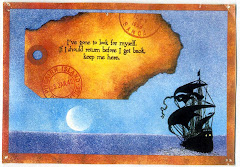
THE MOON IS WANING


COME, CLIMB ABOARD
THE CRESCENT MOON BOAT
AND RIDE ALONG WITH ME
OH WHAT WONDERS ARE AFLOAT
JUST WAITING FOR US TO SEE.

Sunday, October 7, 2007

SEPTEMBER BOOKS PART III

I decided that my final September book deserves its own post too, and I am getting up on my soapbox to discuss it. Our book club selection for September, it was written by North Dakota's junior senator, Byron Dorgan. I don't think I have ever gotten political in this blog, but there's a time for everything.

**********

**********

" Take This Job And Ship It" should be read by every single American man and woman. It's that powerful. I don't know that I have ever said about a book that it changed my life, but this one already has and will continue to do so.


After reading this book, I finally understand why a senator from my state was against NAFTA, the North American Free Trade Agreement. Americans may have free trade, Dorgan says, but he insists that we don't have FAIR trade. I learned so much about our huge trade deficit (it increases by $2 billion a day), about companies taking good jobs from Americans and outsourcing them to other countries, about corporations so greedy that they locate subsidiaries in countries where they find tax shelters. Did you know that such venerable American companies as Fruit of the Loom, Fig Newton and Radio Flyer have gone overseas? Did you know that we lost three million jobs in five years?
I understand why Dorgan is anti pharmaceutical industry and pro-union. and why he praises the economic theories of Warren Buffet. But most of all, I understand that the baddest of all the bad big box stores is Wal Mart. Here's where I step on that soap box.
I will never shop at a Wal Mart again. My friend Jude kept trying to tell us book club members about Wal Mart, but I never got her point. I get it now. Wal Mart is so large and powerful that it can force manufacturers to lower their prices. Because of this, they take their manufacturing plants to places like Mexico or China, where they can find cheap labor.
Wal Mart, in turn, acts like it's doing Americans a favor by offering them low-priced goods. My friends, Wal Mart is doing you no favor. It has taken good, solid, well-paying jobs out of your communities. One example Dorgan used is that of the closing of a certain American plant. On the last day, each worker left a pair of his or her shoes in the parking lot. Their message: "You will never be able to fill our shoes."
Although unions may have shady pasts, they built America. They got us fair wages and safe working conditions (remember the young girls in the woolen mills on the Eastern Seaboard in the 1800s?). Workers at a Canadian Wal Mart tried to form a union, and Wal Mart shut down the entire store.
Wal Mart has led to the deaths of Main Street businesses as well. A very good example is Williston, North Dakota. When Wal Mart opened at the edge of town it was the death knell for Williston's downtown. First the Woolworth's went, then Ben Franklin. Pretty soon, people couldn't seem to find a reason to go downtown anymore. The cafes closed, then other businesses. There is a definite ripple effect when a Wal Mart comes to town.
As well, Wal Mart is offering you goods made in sweat shops, hellholes that work people - children even - literally to death, for just pennies a day. Low-income people look to Wal Mart as their savior. But, says Dorgan, picture this: A woman is standing in line with her two daughters, proud that she can afford to buy her girls the colorful t-shirts she has in her hands. But what if someone came up and grabbed her daughters and put them to work at a slave-labor factory, starving and mistreating them? No, it's not her daughters being forced to do that, but it's some woman's daughters.
Wal Mart is ruining our standard of living, destroying American prosperity and dooming the American working middle class. Soon we will all be either rich or poor. And I know I won't be one of the rich.
As I said, this book has changed my life. I will try to look for the Made in America label, although it will be difficult to find. I buy a lot of clothes at resale already so at least I won't be directly contributing to the demise of American clothing manufacturers.
If I can afford an item only at the Wal Mart price, I'll wait until I have the extra dollars to buy it somewhere else, or do without it entirely.
If I need a pretty trinket, I don't have to buy something new made in China. I can always go to a thrift shop, flea market or antique shop, knowing that what I purchase was either made in America or that I, again, did not contribute directly to a company's death.
I note, sadly, that although Dorgan's book was a New York Times bestseller, it hasn't made much of an impact. I know for certain we will end up with a Democratic Congress after the next election. Hopefully, Dorgan can then do something about those "brain dead politics." At the end of the book, he offers specific solutions to each of the problems he outlines in the book.
I am proud of Senator Dorgan for taking up the challenge of writing this book that needed to be written. He is one elected representative who gives a damn.
By the way, I am also proud of our other North Dakota Congressmen. Our senior senator, Kent Conrad (below) was named by Time Magazine as one of the 10 best senators. Not bad for a sparsely-populated, backward state, eh?


And our lone representative to Congress, Earl Pomery (below), made news a couple of months ago when caught on video phone calling President Bush a "clown". Yes, I'm proud of that. Bush is a clown. Let's not beat around the Bush about. He is an embarrassment to our country, an incompetent, bumbling fool, and much worse, a danger to our country.

North Dakota, a redder-than-red Republican state, consistently re-elects these Democrats. They must be proud of them too.

Well now you know my political leanings, for better or worse. It's time for me to get off my soapbox. It's not a comfortable place for this girl to be. But sometimes a girl's just gotta do what a girl's gotta do.

SEPTEMBER BOOKS, PART II

I ranted so much about one book in my previous post that I though I had better open a new post for the rest of the books I read in September.

I walked into Barnes and Noble one day recently to find an entire display devoted to the book shown above, by Sarah Addison Allen. They are promoting highly and have it on sale for a low price (as hardcovers go). I remember seeing it and liking the description in my One Spirit book club offerings, and the price was certainly right, so I bought it. It's about the Waverly sisters who have peculiar gifts that make them outsiders in their hometown. Even the apple tree in the backyard behaves strangely. This book reminded me a lot of Alice Hoffman's "Practical Magic" book and movie with Nicole Kidman and Sandra Bullock. If you loved "Practical Magic" you'll love "Garden Spells." I did.

I have said before that I plan to read or re-read at least one classic a month. This month, I re-read "The Good Earth" by Pearl S. Buck. In this time in my life, when I am trying to re-build my connection with Mother Earth, it is good to read a book about a man so completely tied to the land and so dependent upon it.

Another book I loved this month was "The Observations" by Jane Harris. Set in Scotland in the 1800s, it tells the story of Bessy Buckley, an Irish maid who goes to work at a grand country house for Arabella Reid, a wealthy Scotswoman, and her husband. Bessy discovers that Arabella is writing a book of observations about her and the other servant girls who preceded her. Incensed, Bessy plays a trick on Arabella, and all hell ensues. I loved this book so much because it is written in the voice of Bessy, an earthy, unintentionally humorous, sharply observant, very likable girl. Without Bessy, it would have been a quite ordinary mystery story about what happened to the servant girl before Bessy. Thanks Barb N. and Judy for recommending it.

I started out liking "The Wonder Spot" by Melissa Banks. I had enjoyed her "Girls Guide to Hunting and Fishing" and enjoyed the first chapter, in which our heroine attends her cousin's bat mitzvah. But the ensuing chapters turn out to be about her relationships with the various men who wander in and out of her life. I became as irritated with her as did her Jewish relatives who wondered why she didn't stay with the nice Jewish doctor. His only fault seemed to be that he name dropped the names of famous patients. At the end, our heroine has found a great guy younger than herself. But will he be the last? I doubt it.

SEPTEMBER BOOKS, PART I

I bought this book because it is set in (fictional) Buffalo Valley, North Dakota. "Like so many Midwest towns, it's dying. Stores are boarded up, sidewalks cracked, houses need a coat of paint. But despite all that, there's a spirit of hope here, of defiance. The people still living in Buffalo Valley are fighting for their town."

That sounds like so many North Dakota towns. In fact, I have never gone back to northwestern North Dakota after the last of my relatives died. It's just too depressing for me to see a thriving town like Crosby with closed storefronts, the high school at Columbus, which I attended, torn down and little villages like my Larson slowly being taken over by the prairie from which they sprang.

One of the things the people in Buffalo Valley are fighting for is to keep their school open. They need a new teacher, and they find her in the person of Lindsay Snyder, who has North Dakota roots. There's where the story veers off the reality path and goes right over the cliff. The people of the town are looking for one teacher - the SOLE teacher, for their high school. One teacher, expert in teaching all the subjects of a modern high school, in a one-room school. Yeah, right.

Shame on you, Debbie Macomber, since you supposedly have North Dakota roots too. Our state is already seen as backward. You didn't have to contribute to that image. To anyone who has read this book already, know that North Dakota high schools are consolidated when one or more in the district are forced to close. North Dakota students still receive good educations from teachers trained in specific fields like chemistry, history, English and math.

Yes, there were one-room schools in North Dakota. I went to one, which I will write about sometime. And I think there are a few still out there. But there were never one-room high schools. It's a shame Macomber couldn't have written a book closer to the truth of the North Dakota out migration problem. She is apparently a popular author in the mass market paperback trade.

Saturday, October 6, 2007

PIXIES, ELVES, BROWNIES AND SPRITES

The Pixie sez to the Jack O'Lantern...
**********

"Beware of a witch and a black hoodo
For they are a-coming to
capture you
If you cross your fingers
and count thirteen
They won't touch you on
Hallowe'en"
**********

I mentioned in the previous post that the Irish, along with the Scots, brought Halloween to America. Irish legends of pixies, brownies, elves and sprites found their way into early 20th century postcards. Here are some examples. Enjoy!


What are those elves brewing up?

Dueling Brownies
And some Irish turnip Jack O'Lanterns!


"There are elves and
black cats all about
Pip! Pip!
You'd better look out!"


But they seem pretty friendly!


These brownies don't look very scary to me!

THE HISTORY OF THE JACK O'LANTERN

Did you know that the Scots and the Irish brought Halloween to America? As a person who is half Celtic (1/4 Scottish, 1/4 Irish), that make me proud indeed. And it was the Irish who introduced Halloween's most enduring symbol - the Jack O'Lantern.

History of the Jack O'Lantern
(copied from www.pumpkinnook.com)

The Irish brought the tradition of the Jack O'Lantern to America. But, the original Jack O'Lantern was not a pumpkin.The Jack O'Lantern legend goes back hundreds of years in Irish History. As the story goes, Stingy Jack was a miserable, old drunk who liked to play tricks on everyone: family, friends, his mother and even the Devil himself. One day, he tricked the Devil into climbing up an apple tree. Once the Devil climbed up the apple tree, Stingy Jack hurriedly placed crosses around the trunk of the tree. The Devil was then unable to get down the tree. Stingy Jack made the Devil promise him not to take his soul when he died. Once the devil promised not to take his soul, Stingy Jack removed the crosses and let the Devil down.
Many years later, when Jack finally died, he went to the pearly gates of Heaven and was told by Saint Peter that he was too mean and too cruel and had led a miserable and worthless life on earth. He was not allowed to enter heaven. He then went down to Hell and the Devil. The Devil kept his promise and would not allow him to enter Hell. Now Jack was scared and had nowhere to go but to wander about forever in the darkness between heaven and hell. He asked the Devil how he could leave as there was no light. The Devil tossed him an ember from the flames of Hell to help him light his way. Jack placed the ember in a hollowed out Turnip, one of his favorite foods which he always carried around with him whenever he could steal one. For that day onward, Stingy Jack roamed the earth without a resting place, lighting his way as he went with his "Jack O'Lantern".
On all Hallow's eve, the Irish hollowed out Turnips, rutabagas, gourds, potatoes and beets. They placed a light in them to ward off evil spirits and keep Stingy Jack away. These were the original Jack O'Lanterns. In the 1800's a couple of waves of Irish immigrants came to America. The Irish immigrants quickly discovered that Pumpkins were bigger and easier to carve out. So they used pumpkins for Jack O'Lanterns.
Below: a turnip JOL


Below: 19th Century Americans find that pumpkins
make better Jack O'Lanterns than does a turnip.


"THE PUMPKIN"
Oh! - fruit loved of boyhood! - the old days recalling
when wood-grapes were purpling and brown nuts were falling!
When wild ugly faces we carved in its skin
Glaring out through the dark with a candle within
**********
John Greenleaf Whittier, 1850.