Monday, July 20, 2009

WHERE WERE YOU THE DAY MAN LANDED ON THE MOON?

The Pyrenees Mountains are home
to the Basques of France and Spain.
**********
The night before Apollo 11 launched into space, David Brinkley, host of the NBC Evening News, remarked, "If this (the moon landing) is not a permanent and enduring event in history, then nothing is."
Most of us oldsters remember vividly where we were when we learned of momentous historical events like John Kennedy being shot (9th grade algebra class). Do you remember where you were when Neil Armstrong stepped onto the moon on July 20, 1969? (OMG - 40 years ago today!) As for me, I was in France!
On July 14, 1969, two friends and I arrived in Pau. Tired and worn out after traveling via Eurailpass to this southwestern French city, we discovered it was Bastille Day. We were definitely re-energized by the feasting and fireworks celebrating the beginning of the French Revolution of 1789.
Just six days later, these same French celebrants happily joined in observing a historic event for us Americans (and the entire world) - the landing on the moon of Apollo 11 (or as it was known there, Apollo Onze).


Our first glimpse of the chateau, on Bastille night.
**********
We came to Pau so I and fellow French student Jo could attend school at the Summer Universite de Bourdeaux et Toulouse. Mitch (Michelle), another UND student, stayed in Pau with us for a few days before boarding a train to her school in Germany. We were window shopping downtown one day when we began to be harassed by several French youths.
The little old shop owner shooed them away ("Nasty boys" seemed to be what she was saying) and invited us "petites Americaines" in for some Jurancon wine, the region's famous sweet white wine. She got us just tipsy enough so that we were giggling and lagging behind the group when we later toured the chateau, birthplace of King Henri IV (Henri de Bourbon, who promised the French "a chicken in the pot every Sunday"). Legend has it that Henri was christened with Jurancon, and we were certainly "baptized" with it that day.
The momentous moon landing happened just a few days after school began. I can't remember whether we saw TV coverage at the school, or in some restaurant/bar. I do remember, however, that the newspaper headline read "Ils sont sur la lune!" (They are on the moon.)
We had continued to visit Madame at her shop. (How I wish I could remember her name, but my travel journal - and that French newspaper - were lost when my home burned.) The day after the moon landing, we dropped by the shop. Madame and her friend - equally ancient and tiny - were discussing the merits of the American astronauts. "I like Neil Armstrong", said Madame, but she (pointing to her friend) LOVES Buzz Aldrin!"


Le Boulevard des Pyrenees, the best view in town
**********
So that's my moon landing memory. Reminiscing about it reminded me of our days in France. I had never heard of Pau until the spring before when Jo and I, having won language scholarships, were choosing a university to attend. (Not everyone goes to the Sorbonne!)
Jo, Mitch and I traveled around Europe and other parts of France before landing in Pau. It was a wonderful place - Mediterranean, semi-tropical, with lots of palm trees and a magnificent view of the nearby Pyrenees Mountains. The entire time we were there, the air was permeated with the scent of flowers. I'm not sure what they were, but they were heavenly. That scent, and the smell of diesel (which I love) are definite sense memories of riding the bus to school every morning.
Pau, located in Basque country (I'd never heard of the Basques either) is a city located on two levels. The two are joined by a funiculaire (a funicular - or inclined - railway, on which tram cars on rails move up and down steep slopes or cliffs.)
Le Bon Roi Henri
**********
After riding the funiculaire, Mitch, Jo and I met some sightseeing French sailors. It was all very innocent - just talking - but one, Daniel, gave me the red pompom from his hat. I kept it until I lost it in the fire as well.
The city of Pau may have been balmy and pleasant, but the accommodations were smelly and unpleasant. The university classes were held at the local boys' school, L'Ecole Normale. The bathrooms had no toilets, just impressions on the floor for feet. Yeah, we didn't go to the bathroom while we were at the school.
The girls stayed at a building that housed female teachers during the regular school year. We had little cubicles for rooms, with curtains drawn across the doors. The showers were cold and there were bedbugs in the beds. We always slept on top of the covers.
The meals at the school were generally awful too, especially the day I found a worm crawling across my slice of meat. There were two bottles of wine on each table, noon and evening. I had just turned 20 a few weeks before arriving at Pau - and had only sampled some beer in Germany and a bit of wine in France - but found myself drinking wine at every meal to wash down the nasty food (the only good menu item was pommes frites - French fries).

The pompoms on French sailors' hats
are interchangeable and held on with brass fasteners!
**********

We had taken written placement exams our first day, and I was placed in the superior level, though I had taken less French than Jo. I was so lost in my classes, and hated them, especially my pronunciation class. A she-ogre with bad breath was always hissing in my ear, "Ca ne march pas! Ca ne march pas!" which I took to mean, "You really suck at pronunciation."
I finally asked to move to the moyen, or middle level. Even though the administrators told me I was too "modiste", they let me transfer, and thereafter I was much happier studying with Jo and the other students. However, Jo and I and our pals always skipped the boring afternoon lyceum programs. Instead, we explored the city - the shops, the supermarket, the swimming pool - and I think we probably learned a lot more French that way. We also ate a lot of sandwiches de jambon (ham) and drank a lot of warm Cokes.
It's been 40 years since I was in France and man first landed on the moon. So when will the first woman land on the moon? Oh, that's right, there's always been a lady on the moon.

Beautiful Pau

NOTE: I wrote this post last Thursday, before Walter Cronkite died. I vividly remember his superior coverage of America's first early ventures into space (and other momentous events, such as the assassination of JFK). He truly was "the most trusted man in America." Goodnight and Goodbye, Mr. Cronkite.
"And that's the way it is," Monday, July 20, 2009.

Thursday, July 16, 2009

WHERE IS THAT GIRL?

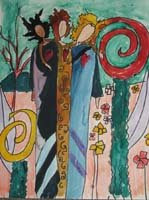
I first saw this painting on my friend Gemma's blog ("Gemma's House"). I fell in love with it and asked her to sell it to me. As it turns out, she gifted me with it. Thank you, Gemma!

I fell for this painting for its colors and because I immediately thought the girl portrayed was me. That was the color and length of my hair in my 20s, and I have always envisioned myself as a free spirit who would dance by the light of the moon.

Since Gemma is from Arizona, she was probably drawing her vision of some desert landscape. But when I look at it (especially after I received it), I see myself standing on our short-grass prairie with one of southwestern North Dakota's landmark buttes in the background. (It could be Black Butte near Regent.)

Do you see something else? I didn't see it at first - and Gemma DID NOT add it deliberately. Another reader of Gemma's blog spotted it. See it now? It's a hand - with the thumbnail on the left and the forefinger on the right, holding up the lady.

Somehow, unconsciously, Gemma gave this lady a hand to support her when she falters. Such are the powers of art! Gemma, I love it better in person - even without the moon and the first evening star (via the magic of computers, she darkened the edges and added the moon and star when she posted the picture.)

Looking at that girl in the painting who could be me, I wonder where that girl went. That girl who:

Danced by the light of the moon.

Read poetry aloud.

Wrote poetry.

Made snow angels in the park. At midnight.

Waded in a Colorado stream in her underwear (navy blue set that passed for a swim suit).

Wore bell bottom jeans.

Turned somersaults.

Wore chokers.

Did "the butterfly" mime.

Picked the petals off a daisy.

Had a black light.

Daydreamed about the Beatles.

Looked for shooting stars.

Watched for shapes in clouds.

Knew all the radio hit songs.

Had long, long hair and then cut it into a pixie haircut.

Was shy.

Dressed like a bohemian.

Stayed out all night talking and watched the sun come up.

Made things from macrame.

Wore a silver ring with fleurs-de-lys.

Discussed literature.

Went to avant garde films.

Flew a kite.

Sported a peace sign.

Clipped pretty, romantic pictures to put on my bulletin board.

Went to bonfires on the beach.

Chased fireflies.

Played Frisbee in the rain and mud.

Wore a floppy felt hat and a fringed suede jacket.

Had goals and dreams.

Monday, July 13, 2009

FAIRY TALES, FAERIES AND A FORGOTTEN GARDEN


Armed with birthday money from Kristen, I was browsing the new hardcovers section at Barnes & Noble. I seldom go into B&N anymore, and if I do, it's only to browse - not buy.

I haven't stopped buying books - I don't think I could. I've just stopped buying NEW books. I gave up my B&N discount card some time ago. I come in to scout out books, then purchase them used on amazon.com.

But this visit I had some mad money, and I found a big fat book - 550 pages! On the cover of "The Forgotten Garden" is a painting of an old English cottage - very like the cottages I had recently seen in "Lark Rise to Candleford".

I opened the book and saw that the end papers were a reproduction of Arthur Rackham's brown-toned painting of faeries being blown about by a brisk autumn wind. Because of the cover and endpapers, I was nearly sold on the book right then and there. Reading the dust jacket flap completed the sale in my mind.

That was a few days ago, and I have finished the book. I heartily recommend it. It was all I expected it to be, and more: it's part Gothic mystery novel, set in Victorian and Edwardian England, and part modern mystery, set in present day Cornwall and Australia.

It's also part romance and part fairy tale. There are several actual fairy tales incorporated into the book, which is about - among other fascinating characters - "The Authoress", who is a writer of fairy tales, and a painter who illustrates fairy tales in the style of Rackham.

And - ta da! - it has a secret walled garden, much like Mary Lennox's secret garden in the much-loved book by Frances Hodgson Burnett. In fact, the secret - or hidden - garden of the book is a homage (an homage?) to Ms. Burnett, who makes an appearance in the book as herself, a party guest at Blackwell Manor, the Montrachet family estate in Cornwall.

This book is nearly perfect, as a birthday book should be. I say nearly because it does skip around in time and place. At first it was a bit difficult to follow, not because I could not immediately sense the era or the setting, but because I got the girls/women confused. For this book follows the lives of four women of one family: Georgiana, Eliza, Nell and Cassandra. Read this book and you will love them all, and remember them for a long time.

"The Hidden Garden" starts with a four-year-old girl, later to be named Nell, found alone and abandoned on the docks after her ship has arrived in Australia from London. A dock worker and his wife "adopt" the girl. Only as an adult does she learn her true circumstances and, later, returns to England to discover who she is.

Nell comes close to unraveling the mystery, but has to stop searching to assume responsibility for her granddaughter, Cassandra. It is up to this granddaughter to travel to Cornwall and finally learn the circumstances of "Nell's" birth.

I had never heard of author Kate Morton before, but I've learned that she wrote another book, "The House at Riverton", a bestseller in her native Australia and in England. I'm off to locate a used copy of that book now!


"JOY OF A FALLEN LEAF" - Arthur Rackham

Thursday, July 9, 2009

HAPPY BIRTHDAY TO KRISTEN!!

Today, July 9th, is Kristen's 27th birthday. Happy Birthday to my Darling Daughter! The last time we were able to celebrate Kristen's birthday with her in person was her 21st birthday. She now lives in Virginia (metropolitan Washington, DC). It's been hard being away from her and seeing her so seldom (only at Christmas, usually). It's especially hard to be separated on the special days.

So today I celebrated the day by remembering the day of her birth, as much of it as I can. Because she was a footling breech, I had a scheduled Cesarean, so I wasn't in pain before the birth, and was awake for it, but shortly afterward (still during surgery), the saddle block anesthetic wore off, so the rest of the day was spent in a haze of pain.

Subsequent birthdays were much better for me, LOL! I looked through a bunch of early birthday party photos today. The photo above is of Kristen's first birthday, with me, her cousin Nick (second from left) and his friend John. I also made a large cake, and we have the requisite photos of her with a face full of chocolate cake. (We had no idea how to celebrate a first birthday! That evening we had another couple over for dinner and they brought her a card with a dollar. She, of course, had no idea what it was all about.)

This is her second birthday, at Grandma and Grandpa Fredericksen's house - Grandma and Grandpa spoiled her with many presents. Grandma Lil made an angel food cake with butter creme frosting. This was the traditional birthday cake in the Fredericksen Sr. family and I continued the tradition in our family.


From the third birthday on, I would make an angel food cake for the family, and get another cake for the party. The third birthday party featured a Smurf cake. This was the first birthday we invited a bunch of kids to.


For the fourth birthday, we went to Happy Joe's pizza and ice cream parlor. I don't know that I would do THAT again (I was the chauffeur/chaperon for all the half dozen kids who attended!) Kristen is sporting what I call her "Cheesy Grin", which she always produced when I told her to "Smile".


For the fifth birthday, we were back to celebrating at our house. It was a gorgeous day and we put the folding table out on the lower deck. I think the cake for this one was a "My Little Pony" ice cream cake. This is the only birthday we recorded with a video camera. Well, partially recorded. The "On" button was left on while the camera languished on the deck, and so we got a lot of "dead" film.
The little girl on the right in the photo had long, long dark hair and bangs too, and looked very much like Kristen. It so happened that they had the same tops, and sometimes, from the back, you couldn't tell one little girl from another.


We had a tropical theme for Kristen's sixth birthday. All the kids were asked to wear tropical type clothing, if they could, and bring swim suits. Once again, it was a beautiful day and the party was held outside. That's the nice thing about summer birthdays - you can fill up the kiddie pool or turn on the sprinkler and let them run and scream to their hearts' content.
Kristen, I hope you are having a wonderful day and received our presents.
All our Love,
Mom, Dad and Gracie

Friday, July 3, 2009

A LARK RISE SUMMER

"COTTAGE NEAR WELLS" - Helen Allingham
**********
How is your summer going? I can't believe June is already over and tomorrow is the Fourth of July!
After a bitterly cold and extremely snowy winter, flooding in the spring and unusually cool temperatures and torrential rains through the first two weeks of June, summer is finally here.
The prairie is as green as the hills of Ireland, the temperatures are balmy, the air is laden with the scents of my hardy shrub roses and the breezes are mere zephyrs. The mosquitoes have made their presence known only in the past few days.
"THE GIRL AT THE GATE" - Sir George Clausen
**********
So far this summer I have marked my 60th birthday and observed my 35th wedding anniversary. I am still processing these two events and will mark them as milestones in a later post. Note that I did not write "celebrated". Dan forgot my birthday, so he has been in the dog house for a week.
Gracie is out of the dog house, as she has been very good lately. Now that the weather is nice she spends most of the time outdoors. She has worn paths all along the perimeters of the yard. There is Maggie the mutt to run the fence with on the north side, Daisy the golden doodle to bark at across the alley to the south, and Ollie the golden retriever and his springer spaniel pal to sniff noses with at the west fence.
Gracie also has established sentry posts at the two east gates which face the street. When the patio door is open, she can spot a passerby at the southeast gate, tear into the house to view him or her passing the living room window, tear to the bedroom to view that passing, then tear out of the house to the northeast gate for one final look before the person passes out of sight. All this is accompanied either by barking or else by a nervous, agitated moaning which I find hilarious.

"COTTAGE AT CHIDDINGFORD" - Helen Allingham
Note the older lady on the left spreading linens on the hedge. (Click to enlarge.)
**********
And me, I'm reading like a fiend and have been going through books at a rate of one every day or two. If the afternoon is fair and Dan is working late, I can sit on the deck and read until 9 p.m. with only a break for a sandwich. Occasionally I will lift my eyes to watch the sun slanting through the greenery, listen to the neighborhood kids or check on Gracie. When she has tired herself out from tearing around the yard, she naps on the deck by my feet.
In my efforts to be thrifty, I have re-discovered the joys of finding second-hand books. I can usually find a book for $3.00 or less at a used bookstore, and thrift store books are even cheaper - as low as 50 cents.
In recent years, I have been reading mostly trade paperbacks. I know I will seldom be disappointed with a trade, and I still look for them at the above-mentioned places, as well as rummage sales. But I've also discovered books I would have otherwise overlooked. Two such books I just finished reading are "Thale's Folly" by Dorothy Gilman and "Shadows on the Ivy" by Lea Wait.
"Thale's Folly" is written by the author of the Mrs. Pollifax series, which I have known about forever but never read. Because I enjoyed this book so much, I will be looking for a Mrs. Pollifax book. "Shadows on the Ivy" is "An Antique Print Mystery", in which the main character is a antiques dealer who specializes in old prints. At the time this book was published, Wait had also written two other antique print mysteries, "Shadows on the Coast of Maine" and "Shadows at the Fair." I'll be looking for those too.

"THE EDGE OF THE WOODS" - Elizabeth Stanhope Forbes
**********
Last December, when I was ordering books for Christmas gifts on amazon.com, I found an inexpensive hardcover copy of "The Illustrated Lark Rise to Candleford" and snapped it up. I already had the Penguin Classic paperback of LRTC, but I just had to order the illustrated copy because it features some of the best Victorian paintings of a bygone era. (All of the paintings on this post are from the book.) When the book arrived, I put it aside, as I knew this was a book to savor in the summertime.
LRTC is actually a trilogy of three books written by Flora Thompson: "Lark Rise", "Over to Candleford" and "Candleford Green". The illustrated edition condenses the second and third books, but since book one is my favorite, this did not bother me. (What does bother me is that the paintings - and actual black and white photographs - aren't attributed until the end of the book, and since there are dozens of them, one has to continue flipping to the back page to find the information.)
"LEAVING HOME" - Henry Herbert La Thague
(Above: People usually walked everywhere. The rare sight of a pony and trap attracted many onlookers!)
**********
LRTC depicts the life in the English countryside in the bucolic, pastoral days before the Industrial Revolution changed the face of England forever. And thus its attraction for me, an Anglophile who is drawn to those times. The frontispiece of the book calls Lark Rise "Perhaps the most vivid, detailed and immediate portrait of country life ever written." The book is largely autobiographical, although Flora calls herself Laura in the book, and has changed the name of her Oxfordshire village of Juniper to Lark Rise.
In LRTC, the cottagers are poor, but not impoverished. Thompson describes the children as sturdy and healthy, though few (unlike Laura) are ever given milk to drink. She also describes the inhabitants as almost universally happy. (I did take her writings with a grain of salt. Thompson wrote the book when she was older, and age may have lent a rose-colored tinge to her memories.)
"GATHERING FIREWOOD" - Helen Allingham
**********

In addition to the text, paintings and photos, the pages include old woodcuts, and facsimiles of pressed flowers, herbs and leaves. The paintings of Helen Allingham, perhaps the best known English cottage/garden painter, are heavily featured. These cottagers, with very limited resources, grew front-yard gardens more beautiful than we modern-day gardeners could hope to imagine.
Most likely, Thompson's descriptions of the homes, gardens, local flora and fauna and landscapes are what drew me to the book in the first place, but she also outlines the daily life of the villagers as they go about farming, housekeeping and cooking, visiting, celebrating holidays and going to "town". She also peppers the book with interesting "characters" of all sorts.


"THE MOWERS" - Sir George Clausen
**********

I would have liked to find more paintings to illustrate this post, but searched the Internet in vain. With the exception of Helen Allingham paintings, the publishers must have used works by lesser-known painters, or else lesser-known works of famous Victorian painters. I would have loved to have included "The Lacemaker", showing a young girl plying a craft now all but forgotten, and "Scaring Birds", a funny painting of a young boy trying to smoke out pesky birds from garden or field.


"MAY DAY GARLANDS" - T. F. Marshall
**********

I wish I would have been able to see England in that long lost time, to have tea with the cottage women, walk the woods for wildflowers, sit by a pure babbling brook or visit with Old Sally, Miss Lane and Sir Timothy. I would like to make May Day wreaths with the children and romp with them as they spent all day outdoors (unlike our kids), and watch the grain being reaped and harvested by hand in the haze of a late summer day.


Thompson was called "a dunce" by her country school teacher, but, as the book jacket says, "Flora possessed the literary gifts, the eye and memory, for everyday detail and the intimacies of experience, which would one day combine to produce this gentle masterpiece."
Lark Rise was made into a miniseries by the BBC, but I have not viewed it. I understand there is also a "Lark Rise Recipe Book" with accompanying "Cook's Notebook".

Thompson as a young woman
**********
Flora Thompson was born in 1877. LRTC is set mostly in the 1880s and 1890s, as Laura grows from child to young woman. As the books progress, the scope enlarges from the village to encompass the hamlet, setting of the the village school, and the market town, where the post office was located. (Like Laura, Thompson went to work at the post office at age 14.)
During this remarkable time, there was a great transition in the English countryside. Home life, methods of schooling, work and social interactions all changed drastically in the last years of the 19th century.
Thompson married young and later wrote mass-market fiction to help support her family. She wrote the LRTC trilogy while in her 60s, from 1939-1943. These were the worst years of WWII for British people. I think that it is no coincidence, therefore, that Thompson may have romanticized that lost world of rural Victorian England. But I also think she was the keenest of observers with the strongest of memories, and well worth reading.

Saturday, June 27, 2009

PRAYERS FOR ANNA


"EARLY MORNING", Copyright by Naturegirl, 2009
**********
Please pray for my friend, Anna (Nature Girl) of Ontario, Canada. This very week, when she expected to be celebrating five years free of breast cancer, she has learned that she has lymphoma, a cancer involving the cells of the immune system.
So, instead of working with and photographing the flowers in her lovely, sunny garden, she has been thrust into the cold, sterile and scary world of hospitals, clinics and labs.
A couple of years back, when she had ankle surgery, she said she could feel the loving arms of her friends envelop her as she lay on the operating table. She needs those comforting arms around her more than ever. As I think of her, I am visualizing a white, healing light streaming her way.
If there ever was an appropriate name for a blogger and a blog, it's hers: Nature Girl and Nature Trail. Over the years, Anna has taken us along on that trail, a journey of the glories of this natural world. Having gotten to know her through e-mails, I have learned that she is a lovely and gracious lady. She was so kind to me when I lost my Penny last winter.
Most of all, Anna is a strong woman. She not only had to face her breast cancer, but also her husband's and daughter's cancer diagnoses. Anna has beat cancer once and I know she will beat it again.
She is a warrior who, in a post today, said she will again put on her armor and "fight this cancer by choosing to see the possibility of a bright future."
To read the entire post for June 27, 2009, go to: http://www.nature-trail.blogspot.com/

Tuesday, June 23, 2009

HEALING A BROKEN HEART

WILD PRAIRIE ROSE

The wild prairie rose is my absolute favorite North Dakota wildflower. It has a wonderful scent, and is always in bloom on my birthday. One of my most treasured possessions is a dried prairie rose in a glassine case, with a note written by my mother, dated June 23, 1959: "Julie just brought me this rose. She certainly does love flowers."


**********

I have a broken heart. Something that I desperately wanted - no, desperately needed - at this time of my life has been taken away from me. Rather, I should say, denied me, because it wasn't really mine in the first place.

I won't go into details about the situation, but I do want to tell you how it has left me feeling: tearful, unwanted, old, useless, insignificant, stupid, inferior, powerless, naive, broken, defeated, hollow, hopeless, set adrift, second class, disrespected.

That is a whole bundle of bad emotions - really some bad juju to be carrying around. Fortunately, after a few days I am past the worst. I'm not crying any more: There aren't any tears left to be shed at the moment.

Of course, I have had way worse things happen in my life. My family is fine, and Dan is not divorcing me! Compared to the deaths of loved ones, this doesn't even place very high on the list.

But with each sorrowful event I've lived through, I have discovered that there comes a time when one cannot stand the intensity of the emotions. The more intense the emotions, the less the body can take it, and has to begin to return to normal.

That's the point I'm at now. So how do I begin to recover? Funny as it may seem, I have been receiving solace from a poem. It's "What is so rare as a day in June?" which I printed in my post of June 10. To be sure, it has been resonating with me. I originally used it to illustrate the rare beauty of June days, but now I am recalling lines that remind me of the healing powers of nature in the summertime.

How about:

"Now the heart is so full that a drop overfills it, We are happy now because God wills it; No matter how barren the past may have been, 'Tis enough for now that the leaves are green."

Or:

"Who knows whither the clouds have fled? In the unscarred heavens they leave not wake/And the eyes forget the tears they have shed, The heart forgets its sorrow and ache."

Is it really true, could immersing myself in the natural world this summer restore my soul and replenish my depleted sense of self?

If I sit every fair evening under the old elm tree that shades my deck, as I have for the past 26 years, will I again regain the happiness I have found there? When the thick leaf canopy blocks the rain, when the branches sough as a cooling breeze springs up, when the leaves are silhouetted black before the full white moon, will I feel a surge of pleasure and forget my tears? Will I then go to bed and sleep deeply and well?

If I sit by the Missouri River and try to follow the course of one drop of water, will I realize that life flows on, and that like rain and evaporation, it is part of a great cycle that usurps you and me?

If I drive up the hill to the lookout blockades at Fort Abraham Lincoln, will I remember the struggles of those people who lived here long before me - both the Native Americans and the soliders of Custer's Seventh Cavalry?

If I listen to bird song, will I allow my precious "illumined being" to be "o'errun with the deluge of summer it receives"?

If I watch waves lap against the lake shore at the immense Lake Sakakawea, will I realize that "whatever life has ebbed away, comes flooding back with a ripply cheer, into every bare inlet and creek and bay"?

If I sit "in the warm shade" on newly-cut grass, will I "feel right well"? Will "the heart in my dumb breast" flutter and sing?

If I drive out of town in order to look up at a night sky undimmed by city lights, will I realize my insignificance - and at the same time, my greatness? After all, said Carl Sagan, "We ourselves are made of star stuff."

If, having written about the wild sweet rockets and recalled other beloved North Dakota wildflowers, will I re-discover the joys of my childhood?

That's yet to be seen. Reminiscing about my favorite wildflowers is my first step in the healing.

North Dakota wildflowers aren't terribly showy. We don't have meadows full of fireweed or bluebonnets, rivers of California poppies, hills of golden daffodils. No, North Dakota wildflowers are usually quite small, low to the ground and hard to spot. They may be insignificant, humble and fragile, they may stand alone, they may be battered by rain and winds, but they survive, and maybe, just maybe, I will survive this too.


WILD ASTER

The New England wild aster may have had its beginnings in the East, but now it is common across the US.
WILD FLAX

Individual flax plants are not very striking, but a field of flax resembles an ocean - a true blue ocean on the prairie.
SCARLET GAURA


These tiny flowers are actually more white and pink in color than scarlet. These are very delicate and lacy plants, only a few inches tall.

LOCO WEED

Loco is "crazy" in Spanish and describes the erratic actions of horses and livestock that eat this poisonous plant. As a child who was known to sample the nectar of flowers like lilac, honeysuckle and bluebells, I am so glad I did not sample this one.

PASQUEFLOWER (ANEMONE PUSILLATIS)

The pasqueflower, which everyone around here called crocus, is the first prairie flower to appear in the spring. Like other flowers we discovered as kids, crocuses grew along the tracks in Larson. That's because land next to railroad track is virgin soil - undisturbed prairie. The insides of the petal cups are the palest, faintest lavender - almost white - and the outsides are a darker lavender.

PURPLE PRAIRIE CLOVER

YUCCA


The yucca is usually associated with the Southwestern US, but it grows here too! It's one of the more outstanding ND wildflowers.

COMMON MILKWEED

I am violently allergic to this beautiful, Monarch-butterfly attracting plant. One time I was at the river bottoms south in Bismarck when entire meadows of milkweed were in full bloom. By the time we went home, I had the worst headache I'd ever had in my life, and had other symptoms which lasted more than a week.


PRAIRIE BLAZING STAR,
OR KANSAS GAY FEATHER

This is the wild equivalent of the garden flower liatris.


COMMON YARROW

I don't think common yarrow is common at all. It is a wonderful medicinal plant. Native Americans made extensive use of yarrow, including employing it to stanch wounds.


HAREBELL (ALSO CALLED BLUEBELL)

These are among the most delicate of plants, their stems whisper thin.


YELLOW PEA OR YELLOW WILD INDIGO (BAPTISTA)

The railroad tracks were just a block south of our house, and we often walked on them for miles, either east or west of town. We found these flowers as we headed west. We called them sweet peas and picked them by the bunches.


BLUEBELLS (MERTENSIA ROTH)

These are the wild equivalent of the cultivated Virginia Bluebell. I could always count on finding a clump of them near the old abandoned Railroad Superintendent's house adjacent to the tracks.

YELLOW SWEET CLOVER

This plant is terribly invasive, but oh, the wonderful smell, especially as the evening draws near and the flowers release their scent.

PURPLE PRAIRIE CONEFLOWER (ECHINACEA)

These aren't as dramatic as the cultivated purple prairie coneflower, but I like them better. The pink petals look like ballerina dancers' skirts to me. When echinaea was all the rage as a cold remedy a few years back, people were digging up and destroying these plants to sell.


YELLOW CONEFLOWER

WOOD LILY

These lilies seem to be almost too bright and exotic to be North Dakota wildflowers.

ORANGE GLOBE MALLOW

These flowers are only a couple of inches tall and are hard to spot. Because of this, kids are the best people to find elusive wildflowers. These grew in only one place that I knew about - under huge twin cottonwood trees on the southwest edge of town.

PRAIRIE SMOKE

Airy, delicate, fragile - beautiful in both bud and bloom.

GOLDENROD

This beautiful fall flower has been accused of bringing on hay fever, but the actual culprit is ragweed!

INDIAN PAINTBRUSH

I never saw this flower growing around Larson, but when I visited friends on their farm not that many miles south of town, they had them in their pastures! I was so envious!

CHICORY

During times when coffee is unavailable or has become too costly, people have used chicory as a coffee substitute, and this is what the settlers on the prairie did.


GUMBO LILY ( WHITE EVENING PRIMROSE)


YELLOW SALSIFY

I did not pick this flower, but left it where it grew. It is both stinky and sticky, making it undesirable as a cut flower. (But still pretty!)

CANADA TICK TREFOIL