Friday, August 13, 2010

THERE'S STILL TIME FOR SUMMER


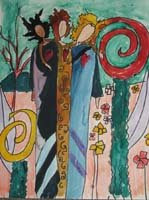
"SUMMER'S AFTERNOON AT MINCASTER" by Dot Gould

Summer 2010 has been wicked for North Dakota. In August alone, we've had many days of temperatures in the low to mid 90s accompanied by very high humidity. This combination makes for an extremely unsettled atmosphere, and we have had numerous thunderstorms. This summer the weather service has issued twice as many severe T-storms warnings as it did last summer  - over 300.

We've had a number of nasty tornadoes across the state too. Just in the past week or so, we've had three F-4 tornadoes (F-5 is the highest on the Fujita scale) that destroyed farmsteads in eastern North Dakota and western Minnesota. Here in our TV viewing area, we've had three deaths from tornadoes this summer. That's almost unheard of.

We've also had many severe hailstorms with large hail. I mean, very large hail! A storm this summer in South Dakota produced the world's largest hail stone ever! (Link here:
http://www.newsnet5.com/dpp/weather/weather_news/Big-hail-Largest-hailstone-ever-found-in-South-Dakota-this-week.)


"POLOMOLOC FRUIT STAND" by Rob Hare

Our meterologists tell us this violent weather is due to a devilishly capricious La Nina. All this steamy weather, more suited for Louisiana than North Dakota, has led many of our residents to wish summer was over already. But I would never wish such a thing. Really high temps and high humidity - leading to "The Sticky Factor" - those I can definitely do without. I can't sleep at night, I feel sick to my stomach and my knees hurt. But wish summer over? Never!

What is the rush to usher summer out so quickly? We Nodaks pined, we ached for summer last January and February. We greeted it with enthusiasm when it arrived in June, delayed as it often is. Aside from storms, July was heavenly. And now, in August, people want to boot summer out the door. It's as if we anticipated getting together with a warm, carefree, tender, casual lover for months. But now we're already tired of her and want to get replace her with autumn. Sure, summer was tempestuous at times, but what sensuous, voluptuous, passionate female isn't?

Although she is a vibrant and glamorous seducer, autumn is more austere, way cooler in demeanor and sometimes quite harsh in aspect.


"SUMMER VACATION" by Edward Potthost

So here we are in August, which people (mostly advertisers) have conspired to turn into a lame duck month. It's as if August can't be a summer month any more. The newspapers and TV bombard us with back-to-school ads. There are already football games on TV. We have to endure yet another silly season of Bret Favre toying with the Minnesota Vikings.

The stores are jammed with fall and Halloween merchandise.  You can't find any summer clothes on the racks - they're full of jackets and sweaters. Ads for air conditioners have been replaced by ads for furnace checkups, ads for lawn mowers by ads for snow blowers. I really feel as if I am being bashed over the head by the harbingers of fall.

Yes, there are signs that fall is on the way, but they are more natural, and subtle.

There are a few yellow leaves scattered across the lawns.
The evenings are cooler.
Darkness descends sooner.
You can't eat outdoors without being bothered by yellow jackets and flies.
There is mist on the car windows some early mornings.
The cricket orchestra tuned up about the first of August.
Apples and grapes are ripening.
The zucchini - like kudzu vines in the South - are taking over the world.
The goldenrod and asters are in bloom.


"SUMMER AFTERNOON TEA" by Roxanne Steed

But like I said, these are subtle signs, and I wish they were the only signs being transmitted to us.

I say it's time to rebel against the fabricated onslaught of autumn! There is still time for summer, still time to let August to be August.

There is still time to:

Bring your sand pails along to the lake.
Enjoy an inexpensive smoothie at Mickey D's. It won't sound so appealing in November!
Go to the beach a few more weekends.
Find a shady nook in the back yard and read a book.
Fix up a little table with a colorful tablecloth and set out lemonade, cookies and fancy sandwiches (the kind you usually never make).
Cut an ice cold watermelon into semicircles, dive in up to your nose and chomp away, letting the sticky juices run down your chin.
Slice some lush, ripe peaches and drizzle them with cream and sugar.
Take your kids fishing for crappies. It doesn't matter to them what they catch, it just matters that they catch something.
Attend a craft fair or summer festival.
Go out into the country and pick a big bouquet of wildflowers. (See Re: goldenrod and asters.)
Visit a farmer's market or fruit stand and buy as much as you can comfortably afford. Make a meal entirely out of fresh fruit and veggies!
Give your tired flowers some fertilizer and the tender loving care they deserved ALL SUMMER LONG.
Go to a state fair (ND's is over but the huge Minnesota State Fair is over Labor Day Weekend). It's the best picture of Americana you can find these days. Have a deep fried Snickers on a stick - or anything on a stick - on me!
Take a drive through the countryside and just inhale the scent of crops being harvested.
Find a pool of water and immerse yourself in it.


"SUMMER STORIES" by Carol Arnold

Don't let August be a lame duck. The Victorians used to rent beach cottages for the entire month, with the wife and children staying there the whole time and the busy husband relaxing there on the weekends. As far as I know, France still practically shuts down for vacation in August.

Ironically, I have been unemployed most of the year but am now working this month. But I am still finding time to savor the gifts of summer before they fade away. Because I know that it won't be all that long now before I'm gazing out my patio door at a world made entirely white, and dreaming of that same view when it was a wall of green.


"SUMMER AFTERNOON OLD GREENWICH"
by Sally Swatland

Sunday, August 1, 2010

HAPPY LUGHNASADH


"LUGHNASADH" by Ruthie Redden

Having written three posts about Lughnasadh already, it's hard to come up with something new to celebrate this August 1 holiday. (One of the eight Celtic holidays of the year, Lughnasadh - or Lammas - celebrates the beginning of the harvest.) I was especially greedy with using Internet images in my posts and haven't been able to find any new images that I liked for Lughnasadh 2010.

That is, until I came across this "Lughnasadh" portrait by my Scottish blogging friend, Ruthie Redden. Ruthie paints "tales of folklore and myth, traditions and custom steeped in the Scottish and the Celtic". And, she has just opened her own website through which to sell her art! I am so pleased to use this Lughnasadh Day post to introduce you to her site, "Ruthie Redden": http: http://www.ruthieredden.com/.

Ruthie offers prints and originals of paintings in these themes: Celtic, Fantasy and Fairy, Folklore and Myth, Nature, Creatures and Bits and Pieces, and also offers prints of her fine photography. She also has a "bespoke" design service, for which she does portraits, calligraphy and stationery, including birth and wedding announcements.

Ruthie hasn't added a dollars-to-currency conversion to her site yet, but a British pound is approximately $1.57.

"CARRICK MERMAID"

Ruthie paints beautiful red- and auburn-haired ladies, and this mermaid is no exception. The painting was inspired by "dusky, evening walks along Carrick shore, Kirkcudbrightshire, when sunsets glinting on swirling sea set imagination alight."


"CARDONESS CASTLE HARE"

My witch's purse seems to be unexpectedly empty right now, but as soon as it refills itself again, I'm ordering this print. A Celtic totem (hare), Scottish thistles and a castle - What more could a Scottish lass ask for? "Cardoness Castle, Gatehouse of Fleet, Dumfries & Galloway, is the 15th century ruined tower house of the McCulloch family".


"MUSIC IN THE FOREST"

Ruthie's paintings speak to my love for Celtic fantasy art. This one was inspired by "walks in the ancient Castramont Wood, Gatehouse of Fleet, listening to the music of the trees."


"COMING HOME"

This painting makes me think of the Scottish tinkers and travelers (sometimes also called gypsies) that I have written about in this blog and my book blog. In fact, it was through Ruthie's blog that I first found some information I had been searching for on the subject of tinkers. This is a portrait of "A gypsy girl amongst the Galloway Hills."

Ruthie's blog, "5 Precious Things" is also delightful. Here is the link: http://5preciousthings.blogspot.com/

Here are my Lammas posts for 2007, 2008 and 2009:


http://celticanamcara.blogspot.com/2007/08/lammastide.html

And here is a Lammas poem:

http://celticanamcara.blogspot.com/2007/08/lammas-poem.html

Friday, July 16, 2010

A MILESTONE


Fifty years ago, on July 11, 1960, a book was published that came to have enormous impact on millions of Americans and indeed, on readers worldwide. The book was "To Kill A Mockingbird", by Harper Lee.

I can't remember when I first read the book, although I do know it was not for a school assignment. And I don't know how often I have re-read it. But I do know I have been touting it as my favorite book ever for a good 40 years. It has been called "America's novel".

Reading TKAM gave me my first exposure to great Southern literature. My first exposure to the character of a plucky young Southern girl. My first exposure to a "Southern Eccentric" (Dill). And most importantly, a first exposure to the hard cold fact that justice is not aways served.

Bookstores around the country have planned anniversary celebrations this summer, some including showings of the eponymous 1962 film. Harper Collins has put out a 50th anniversary slip cased edition for a surprisingly low price of $25.00.

Harper has also created a special website for the celebration - http://tokillamockingbird50year.com/ - which includes a chance to win a 50th Anniversary Prize Pack of books and DVD (easy online entry!), suggestions for book club discussions, resources for teachers and a listing of events (although many took place on July 11, there are still a lot scheduled for the remainder of July and August).

(Lee, who is now 84 and famously reclusive, is not involved in any of the anniversary events.)


"Mockingbird: A Portrait of Harper Lee"
by Charles J. Shields

For anyone re-reading TKAM this summer (or reading it for the first time ever!), here are a couple of books to read along with it:

I have read and thoroughly enjoyed "Mockingbird", Lee's biography, in which I learned these facts: that her full name was Nelle Harper Lee (she was called Nelle by friends and family) and that she was robbed of a well-deserved co-authorship of "In Cold Blood" by her "supposed" longtime friend Truman Capote ("Dill" in TKAM).


"Scout, Atticus and Boo: A Celebration of 50 Years of
To Kill A Mockingbird" by Mary McDonagh Murphy

Our library doesn't have this book yet but I have put it on reserve. In it, such famous people as Tom Brokaw and Oprah Winfrey share the impressions and effects the novel has had on them. I am sure I will find that they will describe their feelings way more eloquently than I can.

I think my experience of the book is summed up by the cover blurb on the edition shown at the top of this post: "The timeless classic of growing up and the human dignity that unites us all."

I read a comment somewhere on the web by a woman who, although she liked TKAM, declared that it was not a perfect book. I disagree. I think it is as close to perfect as a book can be. There is not one sentence, not one word, that does not serve a purpose or help to bring the book forward.

TKAM can be read on so many levels. On one level, it can be seen as a rousing good story, but it is also a classic example of a coming of age book. It slides effortlessly into another time (1930s) and place (the Southern U.S.) as easily as slipping into a river on a blistering summer's day. It contains some of the most fully-limned characters ever put on page. It is an affecting portrait of an upstanding man, whether he is being the lawyer or the father. It is a blistering commentary on (the lack of) civil rights in America.

I didn't know if I would re-read the book this summer or not. I didn't have to re-read it to perfectly remember the first line: "When he was nearly 13 my brother Jem got his arm badly broken at the elbow."

I didn't  have to re-read it to conjure up the sleepy town of Maycomb, Alabama, or the characters of Scout and Jem, Atticus and Calpurnia, Miss Maudie Atkinson and Miss Stephanie Crawford, Dill and Boo Radley. They are my neighbors, Maycomb is my town.

I didn't need to re-read TKAM to remember Scout finding little gifts in the knot hole of the tree on the corner, or her hilarious late appearance on stage dressed a cured ham, or her taking that sickening tire ride up the sidewalk to Boo Radley's front steps. I vividly remember the night Jem had to leave his pants snagged on a fence, and the children sitting in the colored gallery at the courthouse. I'll never forget the benighted walk from the high school to home on that memorable last night.

I think the main things I came away with after all my readings of TKAM are that class has nothing to do with money, but with "the way we conduct ourselves when the chips are down", in other words, acting with grace under pressure. And that the definition of courage is "when you know you're licked before you begin with but you begin anyway and you see it through no matter what." And most of all, that it is a sin to kill a mockingbird, a creature that does nothing but please us with song, or another creature who only watched over "his children".

In the end, I did re-read it again, yesterday, just so that I could spend some more time in that world where it was hotter then that it is now, and when people moved slower than they do now. The world of scuppernongs and azaleas, barefoot overalled children and tin bucket lunch pails, of Miss Rachel's "Do-oo Je-sus" and Atticus' dry wit, Calpurnia's colored church and children playing outdoors from morning 'til night. I had forgotten a few things, such as how unintentionally funny Scout was, and that even a confirmed tomboy can learn when it's essential to behave: "After all, if Aunty could be a lady at a time like this, so could I." 


Mary Badham as Scout and Gregory Peck as Atticus

TKAM the movie was made with much care and sensitivity, and is an excellent and faithful companion piece to the book. I understand that Lee herself wanted Peck for the role, and as we all know, she made a fine choice.

I have often wondered why Lee never published another book (she worked on at least one other for years), but then again, when you write a near-perfect book on your first try, there's no need to write another.

Friday, July 9, 2010

DOLPHIN GIRL


Dolphin Girl

A very Happy Birthday to my daughter, Kristen, who is 28 today! I hope you have a great one, honey!

The photo shows Kristen cradling a dolphin in her arms. She went swimming with the dolphins during a trip to Cozumel this spring. 

Friday, June 25, 2010

THE FULL STRAWBERRY MOON AND A BIRTHDAY


"FULL STRAWBERRY MOON" by Sandra Pond

I was looking at the moon Monday evening, the night of the summer solstice, and was wishing it was a full moon to make it an extra special observance. Well, little did I know that the full moon is tonight, on my birthday, making it an EVEN MORE SPECIAL full moon! (Technically, the calendar says it won't officially be full until 6:30 a.m. tomorrow morning. However, the moon counter on my sidebar says it is 100% of full right now, so close enough!)

Because the relatively short season for harvesting strawberries comes each year during the month of June the full moon that occurs during that month was christened the Full Strawberry Moon by the Algonquin Indians of North America. However, in England they call it the Rose Moon or Flower Moon. Other names are Honey Moon, Hot Moon and Planting Moon.

This has been the longest break from blogging I have ever taken. My long absence has been due to a dearth of subjects to write about, and a general dissatisfaction with my blog. However, Lila at Indigo Pears insisted I had to at least write a post on my birthday!! So I come here today to say:

Thanks to all of you who sent e-cards and e-mail greetings, snail mail cards and the birthday greetings on Facebook. Facebook - who knew? I never hang around there, but I still managed to receive the messages on my wall from all you nice ladies who posted wishes for me.

Special thanks to Gemma for also letting me know it is the Full Strawberry Moon.

Special thanks to Sherry Massey of "Of Mice and Men and Cabbages and Kings". I learned just today that we share a birthday. Isn't June 25 THE best day to have a birthday, Sherry?


Special thanks also to my Bismarck friend Judy, whose birthday is tomorrow. June 26 is almost as good as June 25, isn't it, Jude?

Thanks to Kristen for Volumes 2 and 3 of the Stieg Larsson mysteries set in Sweden. I waited until today to open my packages! (I highly recommend Book 1, "The Girl With the Dragon Tattoo".)

Thanks to my Sis Glori for treating me to Chinese buffet last Saturday, as well as giving me a beautiful hanging lobelia and verbena basket and a heart-shaped white and black "diamond" necklace.

Thanks for Dan who has left me a special envelope on the dining room table and a promise of a gourmet birthday dinner.

Now I'll close by regretfully saying that my break is going to be extended due to my not having Internet service. I am writing this at the library and cursing the defective cursor, while a booming thunderstorm rages overhead. My mama told me I was born during a thunderstorm so how fitting to see another one on my BD!

I'll try to get back every few days to check my e-mail and maybe write a few lines now and then. Until then, thanks so much.

Monday, May 31, 2010

A CORNER OF A FOREIGN FIELD THAT IS FOREVER SCOTLAND


William Munro, left, and Jack Munro, right


THE SOLDIER

"If I should die, think only this of me;
That there's some corner of a foreign field
That is for ever Scotland. There shall be
In that rich earth a richer dust concealed;
A dust whom Scotland bore, shaped, made aware, 
Gave, once, her flowers to love, her ways to roam,
A body of Scotland's breathing Scottish air,
Washed by the rivers, blest by suns of home.

And think, this heart, all evil shed away,
A pulse in the eternal mind, no less 
Gives somewhere back the thoughts by Scotland given;
Her sights and sounds; dreams happy as her day;
And laughter, learnt of friends; and gentleness,
In hearts at peace, under a Scottish heaven."

(With apologies to English Poet Rupert Brooke for changing the poem a bit.)

Long before I knew the story of my two Scottish great uncles who were killed in France in WWI I wept when I first read these lines: "If I should die, think only this of me; That there's some corner of a foreign field/That is for ever England. There shall be/In that rich earth a richer dust concealed.

For me, there are two corners in foreign fields that will be forever Scotland.

William Munro, a sergeant in the Seaforth Highlanders, died Nov. 13, 1916, at the age of 26. He is buried in the British Cemetery at Mailly Wood, France.

His little brother John Alexander (Jack) Munro, a regimental sergeant major in the King's Own Scottish Borderers, died just four months later, on April 12, 1917. He only 24 years old. He is buried at Feuchy Chapel British Cemetery, Waincourt, France.

I don't know exactly where John Alexander died, but William died in the hellish battle that became known as Beaumont Hamel. A fellow member of the Fifth Seaforth Highlanders wrote this poem about Beaumont Hamel:

"In the cold of the morning
A grey mist was drawn
Over the waves
That went up in the dawn
Went up like the waves
Of the wild Northern Sea
For the North has arisen
The North has broke free

Ghosts of the heroes
That died in the Wood
Looked on the killing
And saw it was good
Far over the hillsides
They saw in their dream
The kilten men charging
The bayonets gleam."

From the Diary of The Fifth Seaforths by Lt. E. A. Mackintosh


A memorial to the 5th Seaforth Highlanders
at Beaumont Hamel

William's Gravestone


Twilight at Feuchy Chapel, where Jack is buried.


Jack's Headstone. MC means
Military Cross. It was  awarded to
Jack posthumously, for conspicuous gallantry


William's Dead Man's Penny
It was decided during World War One that all next of kin of service personnel who lost their lives as a result of the war would be presented with a memorial plaque and commemorative scroll from the King and country. The plaques were cast in bronze and were approximately five inches in diameter. On the plaque itself no rank was recorded as the intention was to show equality in their sacrifice. The troops referred to them as "The Dead Man's Penny". 

The stories of William and Jack, and their older brother Archie, who was gassed and taken prisoner at the first battle of Ypres in April 1915, are here: http://celticanamcara.blogspot.com/2009/11/lest-we-forget.html

Photos of the French graves and cemeteries, and the Dead Man's Penny are courtesy of my second cousin, Shirley Sutherland of Golspie Scotland. She also helped design the e-greeting card shown at the top of this post.
I hope someday to be able to follow Shirley's footsteps and visit these cemeteries. Until then, today, Memorial Day, I salute William, Jack and Archie. (Archie - barely - survived the war, was repatriated and returned home. However, he lived only until 1920, his death directly attributable to the grievous damage to his lungs.)

~~~~~~~~~~~~~~~~~~~~~~~~~~~~~~~~~~~~~~~~~~~~~~~~~

Rupert Brooke, who wrote "The Soldier", died of sepsis on April 23, 1915 on a French hospital ship on his way to what became known as the Battle at Gallipoli. He was buried in yet another corner of a foreign field, in an olive grove on Skyros, Greece. He had not yet experienced battle.

~~~~~~~~~~~~~~~~~~~~~~~~~~~~~~~~~~~~~~~~~~~~~~~~~~

NOTE: Comment added by Cousin Shirl on 6/1: John Alex died during the Battle of Arras which began on 9 April 1917 - The following is a paragraph from the book - A Border Battalion, The 7/8th King's Own Scottish Borderers - "Sergeant-major Munro, after carrying away Private Morrison, who had been wounded, was mortally wounded when returning to Battalion Headquarters with the Signalling Officer, Lieut. Reay".

Wednesday, May 26, 2010

"LOST" - MISSING YOU ALREADY


Back to the beginning: Except for Rose and Bernard,
here's the original cast we came to love so much:
Front Row: Charlie, Jack, Kate
Second row (on the right): Sawyer, Sun, Jin, Walt, Michael
Back row: John, Hurley, Boone, Shannon, Sayid, Claire


Dear "Lost":

It's taken me a few days to absorb and process the ending of my favorite TV series ever. The initial episode was love at first sight for me, and I followed you faithfully for season after season, even when you kept me in the dark at times. But the plot was ever secondary for me. It was your characters I loved: Jack, the reluctant hero; Kate, the beautiful, strong, kick-ass girl; Sawyer, bad boy with a mile-wide good streak. You had affable, lovable Hurley; enigmatic John Locke; handsome Boone and pretty Shannon, his step sister; troubled couple Sun and Jin; ever-loving couple Rose and Bernard; father and son pair Walt and Michael; very-pregnant Claire; rock star/drug addict Charlie; and Sayid, whom we knew to be a stand-up kind of guy, good to have on your side, even if he had been an Iraqi "interrogator". I stuck by you even when you killed off some of my favorite characters.

Then, toward the end of Season Five last year, we were separated by circumstances beyond my control and I missed at least three episodes. So when you returned in February (PS - I never did like it when you started showing up for the spring season only) I was a little cold toward you because when I paid my eagerly-anticipated first visit I saw people there I didn't know. Like you, I was "Lost". I didn't know who Jacob was. I had a hard time remembering that John's body was being inhabited by The Smoke Monster. I couldn't get into the back story of Richard Alpert, the guy with eternal life. And I was totally at sea with the episode "Across The Sea". I'm ashamed to admit it but I was unhappy and consequently cheated on you with "American Idol" several times.

But in the end I came back to you, and I'm so happy I made it for the finale. Unlike a lot of people, it didn't really bother me that all the questions about the island were not answered. No, not even when you promised they would be answered. It didn't matter that you never explained why the characters time traveled to the 1970s, or how Ben could move an entire island by turning a giant wheel, or what Eloise Hawking was doing with that pendulum and circle. I don't even care that it never made sense that Hurley didn't lose weight on a diet of fruit and roast wild pig and all the exercise he got.

Daniel Faraday's equations, the polar bear, the hatch, all that button pushing, the "golden light" with its genie-in-a-bottle stopper, the Dharma Initiative, the hydrogen bomb, The Others, Dogen and the Temple People, ... what were they all about? We'll never know, although I suspect people will be speculating for a long, long time.

But I don't really care. No, all I cared about were things like, would Jack and Kate ever get together? I was rooting for them. I liked Sawyer too, and didn't want him to be left out in the cold, romantically speaking, so I'm happy about him and Juliet. I smiled when I saw Boone again after all this time, and I cried when I saw Charlie again. Dear, dear Charlie. You know me, I am the Queen of Denial and never really believed that Boone, Charlie or even John Locke were dead. I mean, dead for good. After all, the island was magical - it cured Rose's cancer, it fixed Locke's legs, why couldn't it resurrect the dead?

It was really nice to see Rose and Bernard one more time. And Vincent the dog. We all wondered about Vincent. It would have been nice to see Michael and Walt again but I guess Michael's spirit is trapped on the island and Walt is happy back home in New York. Whatever.

And Jack. Valiant Jack, who made the ultimate sacrifice. I would really, really have been pissed off if you left Jack to die all alone there in the bamboo grove. But then, Vincent showed up and lay down next to him. How fitting that the series began with Jack opening his eyes and ended with him closing them, coming full circle.

Just to let you know, I would have been heartbroken if you had left Jack dead on the beach and not explained the flash sideways story. Thank God (Christian Shepherd?) for showing us The Afterlife. Sorry about all the dim bulbs who couldn't comprehend it, even after Christian explained it very well to Jack: It was "the place they made together so they could find each other."


All those beautiful beaming faces, together again at the end! Claire and Charlie finally sharing a kiss. Hurley the good No. 1 Island Protector and Ben (!), his good No. 2. Desmond the  - what? The reunion organizer, the spiritual mother hen, an angel gathering the shepherd's flock? Jack, the savior of mankind? That was closure, and it enabled me to leave you on a joyous, rather than sorrowful note. 

Thank you "Lost". You showed me believable, beloved characters, people who fought the good fight against evil, to the bitter end. You made me think about science versus faith, about destiny versus free will, about regret and redemption, about atonement and sacrifice, about love and abiding friendship. That time on the island WAS the most important part of all those lives, wasn't it? It was a big part of my life too.

I'll be "Lost" without you, but there's always the DVD collection!

Thank You,

Love, Julie

~~~~~~~~~~~~~~~~~~~~~~~~~~~~~
For anyone who still doesn't get it: No, they did not all die in the crash of Oceanic Flight 815 (are you listening, Bill W.?). Everything that you saw happen on the island was real. The flash sideways stories were about the characters in the afterlife (but it is not purgatory). The characters died at different times. Ana Lucia, Libby, Boone, Shannon, Charlie, etc. died on the island. John Locke died after the Oceanic 6 survivors returned to L.A. Sayid, Sun, Jin and Jack died after they went back to the island. (When Jack hands the torch to Hurley and says, "I'm already dead" he means "I've been mortally wounded and I'm going to die.")

Hurley and Ben stayed on the island to be its protectors and to prevent The Smoke Monster from leaving the island and destroying the world. Desmond fulfilled his mission and was sent back home to Penny and their son. Kate, Claire and Sawyer, among others, made it off the island in the Ajira plane. Those three may have lived very long lives. However, now everyone is together in the church (where there is no "now") and they are crossing over to the other side together. All except for Ben - he stays outside because he's not yet ready to go - he hasn't redeemed himself enough yet. Got it now???

Thursday, May 20, 2010

EMILY'S DICKINSON'S GARDEN - THE POETRY OF FLOWERS


I wonder why the Creator jammed so many gorgeous flowering plants into the month of May.The profusion of blooms is almost overwhelming at this time of year. The double flowering plum next to my bedroom window is an explosion of cotton candy pink. All over town, the crab apple and apple trees are clouds of white, light pink and magenta flowers. The tulips are holding strong, and there are still some daffodils too.

Just yesterday I saw the most striking dark blue hyacinths next to a foundation. The bleeding hearts are so aairy and delicate, and the johnny jump-ups so cheerful. The phlox are sweet mounds of lavender and the chokecherries are heavenly-scented panicles of white. I even saw a clump of purple iris yesterday, and they usually don't bloom until June here. And best of all, the lilacs are set to burst into bloom in just a few days. Oh that I were Emily Dickinson, so I could write memorable poems about them.

Emily (I'll be informal and call her by her first name throughout) wrote a lot of poems featuring flowers, and her letters mentioned many types of flowers as well. Did you know that in her lifetime she was better known for her gardening expertise than her poetry? I didn't. Now, the reverse is true, but the Brooklyn Botanical Garden and the Poetry Society of America are reminding us that her two loves went hand in hand.

As co-presenters, they have put together a display in the Enid A. Haupt Conservatory at the BBG that runs through June 13. Called "Emily Dickinson's Garden - The Poetry of Flowers", the display features such "old-fashioned" flowers and plants as delphiniums, lupines, honeysuckle, roses, lilies, peonies, tulips, lily of the valley, ferns and hydrangeas. The lowly dandelion is present to, taking a place of honor. Of the dandelion, Dickinson wrote that it "Astonishes the grass" and has a "shouting flower."


Scattered here and there throughout the Victorian border are poetry stations featuring copies of Emily's poems and audio messages about the works and the flowers that inspired them.

No trace of the original plantings survive at Emily's home in Amherst, MA, so the BBG staff had to research the varieties of plants that would have been popular in a western Massachusetts spring garden more than a century ago, paying particular attention to those Emily mentioned.

The display includes windowed facades meant to look like Dickinson's home and her brother's next door, and there's a facsimile of the poet's bedroom with a window providing a view like the one she had. In this room, she wrote most of her poems and forced bulbs. Emily once called herself a “a Lunatic on Bulbs,” referring to her passion for the daffodils, hyacinths and other spring perennials which she raised indoors in winter.


Accompanying the flower display is a gallery exhibition which contains 19th-century botanical books and prints, autographed copies of two of Emily's poems, and a digital edition of the massive herbarium that she assembled in her teens by collecting, pressing and labeling about 400 plant specimens.

There's also a reproduction of a white dress the poet wore. Judith Farr, an adviser to the show and author of "The Gardens of Emily Dickinson," said Dickinson gave up wearing any color but white when she was in her 30s, as she began to withdraw from society. She also took on some other odd behaviors, including gardening at night. Dickinson scholars now suspect that one reason Emily preferred night gardening was because of vision problems: for several years in her early middle age, sunlight stung her eyes.

The exhibit will also feature marathon readings of her poems (she wrote about 1,800!) and lectures by contemporary literary figures who will discuss Emily's significance to American poetry. It is a show that I would love to attend, but I will have to make do with checking out a couple of books that showcase Emily's poems and her garden together.


One of the Emily's inspirations for her flower poems was a book called "Symbolical Language of Flowers," which ascribed meanings to particular flowers - a poppy symbolizes doom, a violet means humility, etc. There are many similar books on the language of flowers available today. Examples are "The Language of Flowers" by Sheila Pickles and "The Language and Sentiment of Flowers" by James McCabe, which discuss the flower symbolism of the Victorian Age. "The Language of Flowers: Symbols and Myths" by Marina Heilmeyer goes much further back in history and includes flower symbolism in Medieval times, in the Bible and even in Ancient Greece and Rome.

I've already mentioned "The Gardens of Emily Dickinson", shown above. Judith Farr, the author, says Emily used flowers as symbols repeatedly.  To her, as to many Victorian Americans, flowers weren’t just beautifiers; they were moral and personal emblems.

Dickinson, with her auburn hair, identified with the orange tiger lily and sometimes called herself Daisy, for a flower that symbolized innocence. She associated certain richly scented flowers, like roses and jasmine, with men and women to whom she formed emotional attachments.


Another book on the poems and flowers of  the beloved "Belle of Amherst" is "Emily Dickinson's Gardens", shown above, by Marta McDowell. McDowell shows us the consummate gardener Emily so passionately was--sending home grown bouquets to friends, studying botany at Amherst Academy and tending her own glassed conservatory off her father's study. 


Following are a few of Emily's flower poems:

SHE SLEPT BENEATH A TREE (THE TULIP)

She slept beneath a tree
Remembered but by me.
I touched her Cradle mute
She recognized the foot
Put on her Carmine suit
And see!


THE DANDELION'S PALLID TUBE

The Dandelion's pallid tube
Astonishes the Grass,
And Winter instantly becomes
An infinite Alas --
The tube uplifts a signal Bud
And then a shouting Flower, --
The Proclamation of the Suns
That sepulture is o'er.


UPON A LILAC SEA

Upon a Lilac Sea
To toss incessantly
His Plush Alarm
Who fleeing from the Spring
The Spring avenging fling
To Dooms of Balm


SERIES III: NATURE: XI: A ROSE

SEPAL, petal, and a thorn
Upon a common summer's morn,
A flash of dew, a bee or two,
A breeze
A caper in the trees, --
And I'm a rose!

I HIDE MYSELF WITHIN MY FLOWER

I hide myself within my flower,
That fading from your Vase,
You, unsuspecting, feel for me --
Almost a loneliness.


PERHAPS YOU'D LIKE TO BUY A FLOWER?

Perhaps you'd like to buy a flower?
But I could never sell.
If you would like to borrow
Until the daffodil
Unties her yellow bonnet
Beneath the village door,
Until the bees, from clover rows
Their hock and sherry draw,
Why, I will lend until just then,
But not an hour more!


FRINGED GENTIAN

God made a little gentian;
It tried to be a rose
And failed, and all the summer laughed.
But just before the snows
There came a purple creature
That ravished all the hill;
And summer hid her forehead,
And mockery was still.
The frosts were her condition;
The Tyrian would not come
Until the North evoked it.
"Creator! shall I bloom?"


WE SHOULD NOT MIND SO SMALL A FLOWER --

We should not mind so small a flower --
Except it quiet bring
Our little garden that we lost
Back to the Lawn again.
So spicy her Carnations nod --
So drunken, reel her Bees --
So silver steal a hundred flutes
From out a hundred trees --
That whoso sees this little flower
By faith may clear behold
The Bobolinks around the throne
And Dandelions gold.

Sunday, May 16, 2010

LETTERS TO JULIET


I saw an absolutely delightful movie over the weekend. "Letters to Juliet" stars that grande dame of acting, Vanessa Redgrave, and a shining new actress, Amanda Seyfried (who was also in last year's wonderful "Mamma Mia".)

The gist of the story is this: New Yorkers Sophie (Seyfried) and her fiance Victor (Gael Garcia Bernal) are taking a "pre-honeymoon" in Verona because they won't be able to go after Victor opens his new Italian restaurant in six weeks. Once there, Sophie wants to sightsee in "fair Verona", as Shakespeare called it when he set his famous play "Romeo and Juliet" there. But all Victor is interested in doing is attending wine auctions and tasting Italian breads, cheeses and pastas. Consequently, Sophie ends up spending most of the time alone. (Although Victor could have been an unlikeable, self-centered character, Bernal plays him with a kind of goofy, loopy impetuosity that makes him sort of endearing, if not great fiance material.)

Sophie, a fact checker for the New Yorker magazine, secretly wants to be a writer. She finds a story to tell when she accidentally stumbles on the little courtyard at the home of Juliet Capulet, where women from all over the world have been leaving letters addressed to Juliet on a stone wall. Sophie locates the nearby offices of the Secretaries of Juliet, four women who are engaged in the task of answering all these letters. After getting to know the women, Sophie goes back to the wall and finds a letter that had been hidden away in a loose stone for 50 years. With the blessing of the secretaries, Sophie replies to Claire (Redgrave), the writer of the letter.

Amazingly, within a few days the Secretaries of Juliet and Sophie get a letter from Claire. "We English always remain in our family homes" says Claire's grandson later to explain why Claire still had the same address after all this time. Claire had originally written to Juliet to ask if she should stay in Italy with her young lover, Lorenzo. But she did not stay, returning to England. Now, 50 years later, she has decided to come back to Italy to find him.


Claire is accompanied on her trip by her rude, snotty grandson Charlie (Christopher Egan, who looks a lot like Heath Ledger). Sophie proposes that since Victor is so busy she is footloose and can travel along with Claire and Charlie in their quest. Charlie vigorously protests, but Claire is delighted to have Sophie accompany them. You can probably guess what happens next, but if you can't, this is a spoiler alert: Don't read the next few paragraphs! Start reading again under the next photo.

Sophie and Charlie somehow manage to fall in love along the way. (Charlie explains away his initial oafish behavior by saying he was just worried about his fragile Grandma. ) The three have a lot of trouble finding Lorenzo because there are so many men in that area with the same name. It was great fun to see all the different Lorenzos who might have been the one, ranging from very charming elderly gentlemen to senile nursing home cases to repulsive dirty old men.

Finally, they locate the real Lorenzo, a widower who is still very handsome. Lorenzo (played by Redgrave's real-life husband Franco Nero) has a magnificent villa surrounded by the vineyards which his big extended family operates. Lorenzo recognizes Claire immediately and she too, knows that this is HER Lorenzo. Everything is happy ever after for Claire and Lorenzo.


Yes, I know this is a cream puff of a movie, just a casual bit of fluff. But I enjoyed it on so many levels. Redgrave, who just gets better and better, is exquisite as an elderly woman who has aged well. Claire is elegant, gracious, wise and kind, but a bit dazed and shocked at the temerity of what she has set out to do. I think the wardrobe people did a wonderful job of giving Claire clothing suited to her age - comfortable dresses and flat shoes  that were not dowdy but appropriately stylish. As Sophie, Seyfried is just luminous.

It was great seeing Redgrave and Nero together again. They were the red-hot lovers Guinevere and Lancelot in the 1960s movie "Camelot", which was a huge favorite of mine back then.

Most of all, I thoroughly enjoyed the sights of the cities of Verona and Siena and the journeys through the Tuscan countryside bathed in golden light. I loved the al fresco dining scene under the trees and the wedding at the villa. There is the requisite balcony scene too, but it is humorous, not serious. All in all, it was light-hearted escapism at its best.


The movie was inspired by the actual Secretaries of Juliet in Verona, an organization I had never heard of before. Printed below is an Associated Press story written by Colleen Barry:

"VERONA, Italy - Hers was a literary, not literal, existence only. And her own love story was, let's just say, star-cross'd.


"Nonetheless, thousands of lovelorn every year pour out their hearts and seek solace from Juliet, Shakespeare's heroine.


"Their entreaties arrive by the dozens — handwritten missives, sometimes with drawings, or photographs, penned on handmade paper or sheets meant to look like ancient parchment. Some are addressed simply: Juliet, Verona, Italy.


"Yet thanks to compassionate letter carriers, they find their way to an upstairs office overlooking the courtyard of the fabled home of Juliet Capulet, just opposite the balcony of Shakespearean fame.


"And there, improbably, they are answered by 15 self-appointed secretaries to Juliet.


"Let's say by now we are pretty expert. After 15, 20 years we are able to manage this phenomenon," said Giovanna Tamassia, who has been writing replies for 16 years. "But it is also true that sometimes a particularly difficult letter arrives and then we speak among ourselves."

The Secretaries of Juliet, or The Juliet Club, as it also known, is a voluntary association. It has been active for many years, offering advice and support or just lending an ear to all those who feel compelled to write. (Letters have been arriving in Verona at least since the 1930s.)

In addition to answering every single letter addressed to Juliet, the members also promote the legend of Romeo and Juliet and the image of Verona, and they organize some cultural events.  

Soon, the Secretaries of Juliet will be looking for more help: Barry writes that they are expecting a deluge of letters now that the movie has been released.


There is also a book on this subject, written by sisters Lise Friedman and Ceil Friedman. The following is a paragraph from a website promoting the book:

"Complete with selected letters, LETTERS TO JULIET explores the legend of Romeo and Juliet, the history of the monuments in Verona, and the story of the various secretaries who have been answering Juliet´s mail for decades. A 21st-century view of the city from an insider´s perspective completes this charming and magical book, which includes stationery that readers may use to send their own letters to Juliet. In its entirety, LETTERS TO JULIET offers an enchanting look at one of literature´s most romantic figures, and the phenomenon of her legend."

Another review describes the types of letters that are received: "The letters arrive by the thousands, in almost every language, and from writers of all ages. Most talk of love - love found and love lost, love sought and love remembered. They may have been written by teenagers in the throes of a first crush or by adults celebrating a hard-won love. The emotions and desires they express are timeless, and some reflect how a particular issue or social movement shaped the writer´s feelings and perspective."

~~~~~~~~~~~~~~~~~~~~~~~~~~~~~~~~~~~~~~~~~~~~~~~~~~
I was saddened to learn of the death earlier this month of another great actor from the Redgrave family, Vanessa's younger sister Lynn Redgrave, praised for many roles, including those in "Georgy Girl" and "Gods and Monsters". And of course, Redgrave also lost her brother Corin last  month and her daughter Natasha Richardson last year.

Thursday, April 29, 2010

OH TO BE IN ENGLAND NOW THAT APRIL'S THERE


Western Meadowlark

So many people come to my blog by Googling this phrase: "Oh to be in England now that spring is here." They manage to land in the right place even though they have the phrase wrong! It is "Oh to be in England now that April's there." I wrote a post a few years ago with this title, and I'm doing so again today.

First, I'll satisfy you searchers by printing this poem written by Robert Browning when he was in Italy:

HOME-THOUGHTS, FROM ABROAD

"Oh to be in England
Now that April's there,
And whoever wakes in England
Sees, some morning, unaware,
That the lowest boughs and the brushwood sheaf
Round the elm-tree bole are in tiny leaf,
While the chaffinch sings on the orchard bough
In England - now!
And after April, when May follows,
And the whitethroat builds, and all the swallows!
Hark! where my blossomed pear-tree in the hedge
Leans to the field and scatters on the clover
Blossoms and dewdrops - at the bent spray's edge -
That's the wise thrush; he sings each song twice over,
Lest you should think he never could recapture
The first fine careless rapture!
And though the fields look rough with hoary dew,
All will be gay when noontide wakes anew
The buttercups, the little children's dower
- Far brighter than this gaudy melon-flower."


Prairie Crocus/Pasqueflower
Pulsatilla (or Anemone) Patens

Well, the Internet searchers aren't really off the mark by googling "spring", because Browning does talk about May as well as April. By all accounts, April in Britain is wondrous to behold. I've often read about British bluebell woods. My Scottish second cousin Shirl has sent me pictures of her dogs walking on carpets of bluebells, which are different than the Virginia bluebells I can grow here. And my English blogging friend Leanne at Somerset Seasons Dorset Days posts pictures of her primroses, auriculas, oxlips, cowslips, yellow kerria japonica blossoms and so many more flower swe can't enjoy here.

April in England seems like quite the heady, rapturous event. I'm afraid that April in North Dakota is much more subtle. Sometimes one really has to search for signs of spring.


Bee in a plum tree


Take the prairie crocus, for example. To find them, you have to look close to the ground on virgin soil. When we were kids we would find them on the railroad right-of-way. They can also be found on other soil untouched by the plow. They are a pale lavender, the inside of the petals so pale they almost look white. The little cups are set upon feathered stems only a few inches off the ground.

Nowhere in North Dakota will you find William Wordsworth's "a crowd, a host, of golden daffodils", but we do have homeowners who plant daffodils and tulips in front of their homes. A popular color combination in Bismarck seems to be red and yellow tulips.

I've seen more honey bees so far this year than I did last spring. I hope this is a good sign that the bees have recovered from the problems plaguing them and are returning in force. Two got into my house this week. To capture them, I use a drinking glass and a stiff piece of paper. I put the glass over the bee (who's usually on a window) and slip the glass and all onto the piece of paper. This way I can safely set the bee free. Unfortunately, Gracie jumped on me yesterday just after I captured the bee, and killed it by biting it. (Does she know it has a stinger??)


Purple tulips go well with
yellow and white daffodils

Some robins stay in North Dakota all winter. For the rest of those who winter down south and arrive in the spring, April is the time for them to really let loose with their morning- and evensong. They seem to be singing "We're glad to be back in North Dakota!"

I once visited Denver, Colorado in April. It seemed like there was a forsythia in every yard. Forsythia are much more scarce here. Only a few grow in cool Zone Three, which covers most of North Dakota. A little finger of Zone Four sticks up into North Dakota along the Missouri River, and I think that's why we see a few forsythia bushes dotted here and there around Bismarck.

April in North Dakota is the time for those delicate, oh-so aromatic plum blossoms. And a couple of weeks ago, two rare (for Bismarck) apricot trees bloomed on the site of the old Jewish synagogue. They are so lovely there, their horizontal pale peachy-pink branches spreading to cover the entire south side of the brick building.

There were never many Jewish people in Bismarck, now there are hardly any. I wish I knew someone to who could tell me if some member of the synagogue imported those apricot trees from a warmer clime.


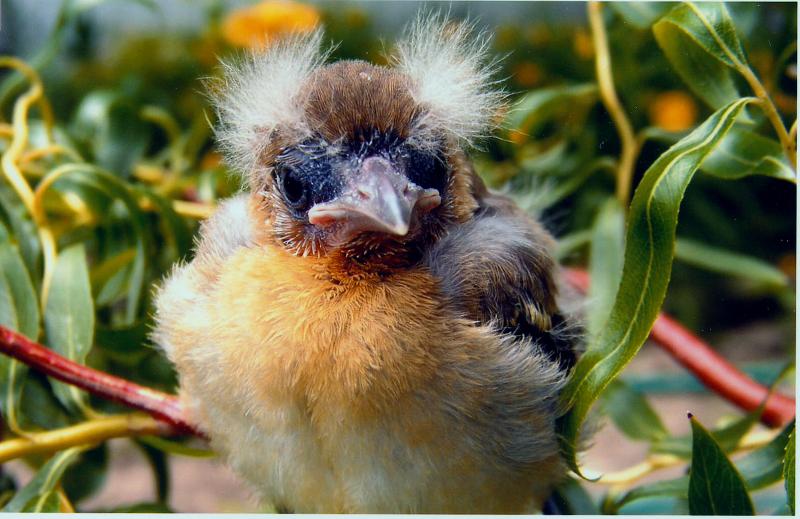
Soon we'll be seeing baby robins
with their funny little tufts

Even though the dandelion is considered a weed by many and a lowly plant by most, I still welcome these sunny yellow buttons every spring and always have the urge to hold a dandelion flower under someone's throat to look for "butter".

Weeping willows are my favorite trees in April. That's because they are such a lovely, pale light green at this time of the year. In a light breeze, the flexible branches undulate like curtains.

And finally, it absolutely could not be spring in North Dakota without meadowlarks and their melodious song. When I was growing up in my little village we could hear them when we walked out the door. Now I have to drive out to the country (admittedly that doesn't take long) to hear those precious cascading notes. These birds, with their brilliant yellow and black markings, prefer to sit on fence posts rather than high wires. They even build their nest on the ground.


Forsythia

Signs of spring in North Dakota may sometimes be subtle, but they certainly are welcome.