Saturday, September 8, 2007

RAINY DAY WOMAN


Rain, rain, go away
Why'd you ruin my special day?
I'm not going to Woman Song
It'll be raining there all day long.
Driving 300 miles in heavy showers
Is not a fun way to spend my hours.
Artists, vendors, I feel your pain,
And singers hate "singin' in the rain"!
I wanted to be a Woman Wild
Now I'm just a pouting child.
The radar screen is totally green
But I am blue - get what I mean?
It'll be cold too - only 60 degrees;
I'll need hot soup and an afghan, please.
You can tell that I'm depressed;
The dogs are all muddy - what a mess.
It's ruining Bismarck's Powwow too;
That's Mother Nature, what can you do?
It'll rain on the Natives' pretty parade
And the beautiful costumes that they made.
I guess it's time to end this drivel,
Before it makes your poor head swivel.
I think I'll just go back to bed
And pull the covers up over my head.

Friday, September 7, 2007

A NEW ADDITION TO MY MENAGERIE

SEA OTTER

This little sea otter came to live at my house today, all the way from California. This photo really doesn't do him justice. The color of the waters swirling around him is actually a lovely shade of blue, his little tongue is shell pink and he has the most wonderful expression on his face! Yeah, he's a he, I just know it.

I thought I had better have a representation of my sea otter totem to join my dolphins figurine and my bluebird of happiness sitting on an acorn. The bluebird is a precious symbol to me and my sister, although we have never seen real bluebirds, because our Grandma had bluebird patterned china. Whenever we see some bluebird china in a shop, we draw a collective sigh of remembrance (and a little gasp at the prices). Each of us has just a tiny bit of bluebird china - for me, a teacup and saucer. I also gave my sis a little bluebird (pin) to sit on her collar.

As for the acorn, that is my remembrance of Daisy Lupin, who wrote about the mighty oak and about the protective powers of its acorns. One of these days I will try and take a photo of all of these creatures on my desk, but for now, in lieu of a digital camera, please enjoy my playful sea otter.

Thursday, September 6, 2007

A NEW SACRED WHITE BUFFALO?


North Dakota has a possible second albino buffalo (actually bison), an extremely rare occurrence. The white calf was first spotted with its mother, "White Cloud" over Labor Day weekend. White buffalo are sacred to the Lakota, or Sioux, Indians.

The following is the newspaper article on the calf, copied from the Grand Forks (ND) Herald:

JAMESTOWN, N.D.

White Cloud, the albino bison that has been a tourist attraction here for 11 years, has given birth to a calf that could be a rare albino as well.

Bob Mountain, the treasurer of the board of Jamestown's National Buffalo Museum, said White Cloud and her calf were spotted for the first time Saturday. The calf was believed to have been born late Friday night. Officials said they did not know whether it is a male or female.

"It has a pink nose and ears, so I think it's an albino," Mountain said. "But it will be awhile before we know for sure."

White Cloud is a DNA-tested albino bison. The calf was her fifth since she joined the Jamestown museum herd 11 years ago.

Officials say the odds of a white calf being born are extremely rare. Many bison born white eventually turn brown.

"The problem is, there's nothing to compare it to," Mountain said.

The odds of White Cloud giving birth to an albino bison are considerably better than normal, however, Mountain said, because she was bred back to her only bull calf, Dakota Thunder. The process called line breeding gave her a 50-50 chance she would have a white calf, he said.
"You line breed for certain traits," he said.

Daniel and Jean Shirek, of the northeastern North Dakota town of Michigan, own White Cloud and lease her to the buffalo museum. The Shireks also are joint owners of the new calf with the museum.

"It took us by surprise, and we think it's wonderful," Daniel Shirek said. He planned to come to Jamestown to see the calf and discuss DNA testing with museum board members.

"We'll do whatever they want to do," he said.

The white buffalo is sacred to most Plains Indian tribes and is often seen as a sign of great changes in the world. To some tribes it is a blessing. Others believe it is a sign of peace, prosperity, unity and hope.

The birth of a white calf is a boost for tourism in Jamestown, said Buffalo City Tourism Director Nina Sneider.

"White Cloud has been a tremendous draw for the last 11 years, and I'd guess we'll have even more visitors now," Sneider said. "We get visitors, even in the dead of winter, who want to see her."

Sneider said it doesn't matter whether the calf is an albino or was just born with a white hide; it's still a rarity. Part of the Lakota legend speaks of the white buffalo changing to a brown one as it walked, she said.

"So, it's in keeping with the legend and, spiritually, makes the calf precious to them," she said.

**********
When I go to my Woman Song Retreat this weekend, I'll be turning south right at Jamestown (which is about 90 miles east of Bismarck). It would be fantastic if I could see White Cloud and her calf. That would really make my trip special.

In the post below I have reprinted the Legend of the White Buffalo Calf Woman.

WHITE BUFFALO CALF WOMAN


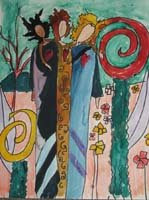
"White Buffalo Calf Woman" by Rogue Guirey Simpson

LEGEND OF THE WHITE BUFFALO CALF WOMAN

The White Buffalo are sacred to many Native Americans. The Lakota (Sioux) Nation has passed down the The Legend of the White Buffalo --a story now approximately 2,000 years old--at many council meetings, sacred ceremonies, and through the tribe's storytellers. There are several variations, but all are meaningful, and tell of the same outcome. Have communication with the Creator through prayer with clear intent for Peace, Harmony and Balance for all life living in the Earth Mother.

Spirituality among Natives Americans and non-Native Americans has been a strong force for those who believe in the power of the Great Spirit or God.

It matters not what you call the Creator. What matters is that you pray to give thanks for your blessings and trust the guidance given to you from the world of Spirit. Many truths about Spirit are told and handed down from one generation to the next.

The legend of the White Calf Woman tells how the People had lost the ability to communicate with the Creator. The Creator sent the sacred White Calf Woman to teach the People how to pray with the Pipe. With that Pipe, seven sacred ceremonies were given for the people to abide in order to ensure a future with harmony, peace, and balance.

Legend says that long ago, two young men were out hunting when from out of nowhere came a beautiful maiden dressed in white buckskin. One of the hunters looked upon her and recognizing her as a wakan, or sacred being, lowered his eyes. The second hunter approached her with lust in his eyes desiring her for his woman. White Buffalo Calf Woman beckoned the lustful warrior to her, and as he approached a cloud of dust arose around them causing them to be hidden from view. When the dust settled, nothing but a pile of bones lay next to her. As she walked toward the respectful young hunter, she explained to him that she had merely fulfilled the other man's desire, allowing him, within that brief moment, to live a lifetime, die and decay.

White Buffalo Calf Woman instructed the young man to go back to the People and tell them to prepare for her arrival to teach them of the way to pray. The young hunter obeyed. When White Buffalo Calf woman arrived with the sacred bundle (the prayer pipe) she taught the People of the seven sacred ways to pray. These prayers are through ceremonies that include the Sweat Lodge for purification; the Naming Ceremony for child naming; the Healing Ceremony to restore health to the body, mind and spirit; the adoption ceremony for making of relatives; the marriage ceremony for uniting male and female; the Vision Quest for communing with the Creator for direction and answers to one's life; and the Sundance Ceremony to pray for the well-being of all the People.

When the teaching of the sacred ways was complete, White Buffalo Calf Woman told the people she would again return for the sacred bundle that she left with them. Before leaving, she told them that within her were the four ages, and that she would look back upon the People in each age, returning at the end of the fourth age, to restore harmony and spirituality to a troubled land. She walked a short distance, she looked back towards the people and sat down. When she arose they were amazed to see she had become a black buffalo. Walking a little further, the buffalo laid down, this time arising as a yellow buffalo. The third time the buffalo walked a little further and this time arose as a red buffalo. Walking a little further it rolled on the ground and rose one last time as a white buffalo calf signaling the fulfillment of the White Buffalo Calf prophecy.

The changing of the four colors of the White Buffalo Calf Woman represents the four colors of man--white, yellow, red and black. These colors also represent the four directions, north, east, south and west. The sacred bundle that was left to the Lakota people is still with the People in a sacred place on the Cheyenne River Indian reservation in South Dakota. It is kept by a man known as the Keeper of the White Buffalo Calf Pipe, Arvol Looking Horse.

The legend of the White Buffalo Calf Woman remains ever promising in this age of spiritual enlightenment and conscious awareness. In today's world of confusion and war many of us are looking for signs of peace.

"With the return of the White Buffalo it is a sign that prayers are being heard, that the sacred pipe is being honored, and that the promises of prophecy are being fulfilled. White Buffalo signals a time of abundance and plenty." (from Sams and Carson, Medicine cards)

Though harsh as the world we live in may be throughout recorded history there have been spiritual leaders teaching peace, hope and balance (synergy) amongst all life. This was taught by great teachers such as Jesus, Buddha, the Dali Lama's, and Native American leaders. Chief Crazy Horse, Chief Seattle, and Chief Red Cloud are a few of the visionary leaders who committed their lives to bring peace, and internal happiness to all who they touched. They were tangible signs of goodwill toward all men, women and children.

Legend courtesy Jim and Dena Riley, Spirit Mountain Ranch
March, 2005 (From www.legendsofamerica.com)

Wednesday, September 5, 2007

HOW MANY GOLDEN RETRIEVERS DOES IT TAKE TO CHANGE A LIGHT BULB?

Hi, this is Penny, Julie's big Golden Retriever and smartest dog, just after my seasonal clipping. Can you believe all that dog hair? No wonder I pant so much. Anyway, I finally got Gracie to stop napping on my back, so I could get to the computer to share a little something that my best girl, Kristen, sent her mom today. Yeah, I know it's difficult, since my paws are really big, and I don't have opposible thumbs, but I am very smart and manage just fine.


How many dogs does it take to change a light bulb?
1. Golden Retriever: The sun is shining, the day is young, we've got our whole lives ahead of us, and you're inside worrying about a stupid burned out bulb?
2. Border Collie: Just one. And then I'll replace any wiring that's not up to code.
3. Dachshund: You know I can't reach that stupid lamp!
4. Rottweiler: Make me.
5. Boxer: Who cares? I can still play with my squeaky toys in the dark.
6. Lab: Oh, me, me!!!!! Pleeeeeeeeeze let me change the light bulb! Can I? Can I? Huh? Huh? Huh? Can I? Pleeeeeeeeeze, please, please, please!
7. German Shepherd: I'll change it as soon as I've led these people from the dark, check to make sure I haven't missed any, and make just one more perimeter patrol to see that no one has tried to take advantage of the situation.
8. Jack Russell Terrier: I'll just pop it in while I'm bouncing off the walls and furniture.
9. Old English Sheep Dog: Light bulb? I'm sorry, but I don't see a light bulb!
10. Cocker Spaniel: Why change it? I can still pee on the carpet in the dark.
11. Chihuahua : Yo quiero Taco Bulb. Or "We don't need no stinking light bulb.
12. Greyhound: It isn't moving. Who cares?
13. Australian Shepherd: First, I'll put all the light bulbs in a little circle...
14. Poodle: I'll just blow in the Border Collie's ear and he'll do it. By the time he finishes rewiring the house, my nails will be dry.

Oops, Mom caught me. She told me to tell you that is NOT an actual photo of me with all that dog hair. Alright, I admit that I stole it off the Internet. I don't need clipping, but Mom says that could really be a picture of all the hair I SHED. And, what is more amazing, that is about how much dog hair she had to clip off our cocker spaniel, Lady.
She also says to tell you that she has owned a Golden Retriever and a Cocker Spaniel, and has seen many Labs in action, and those descriptions are very true.
(Mom has threatened to give Gracie and me away and get a little dog, like the stupid dachshund pictured above. But I know in my heart of hearts that she would never do that. We have "dog security" here.)
Finally, Mom told me to tell you that the original "changing a light bulb" joke was about Norwegians, and went like this: "How many Norwegians does it take to change a light bulb? Three. One to hold the bulb and two to turn the chair." (And yes, she is proud to be a Norwegian.)

Monday, September 3, 2007

SEASONAL DELIGHTS

SEASONAL DELIGHTS
(copyright Kelli Winn and Phillip Winn)

Kelli Winn over at "There's No Place Like Home" had posted that she had a big surprise for us tomorrow. Some speculated that she might be expecting a baby - that's always big news. But this is even bigger. You can still say that she and her husband, Phillip, have given birth, but it is to a magazine. It is "Seasonal Delights," a quarterly online magazine "for young ladies and their mothers." (She was a little premature in her announcement, having released it today!)

I just downloaded the free first issue at http://www.sdquarterly.com/. It's 20 FULL-COLOR pages of recipes, poems, craft projects, a crossword puzzle and word search, and much more. I don't have a young daughter at home anymore and I'm not a grandmother yet either, but I'll be darned if I'll let that stop me from reading this delightful magazine. There's no saying I can't try the cambric tea myself. (I've read lots of books that mention this mild sweet tea for younger palates.) I'm also going to try the potato chowder and the apple crisp.

All the recipes and projects are lavishly photographed and the directions are clear and easy. Of course, everything in this first issue of a quarterly, seasonal magazine is autumn themed: making leaf rubbings, creating an autumn banner and autumn paper cones, making a nature journal and taking a nature walk, a list of autumn children's books and a fall calendar.

I have previously written to Kelli, telling her that I think she is a homemaker in the truest sense of the word - someone for whom taking care of home and family is an art and a sacred undertaking. I've also told her that I'm amazed at how much baking, decorating, gardening and other activities she can accomplish in a day. Sometimes she makes me tired just reading her blog. But with this magazine she's really outdone herself. Congratulations and best wishes, Kelli!

AUGUST BOOKS


1. "The Sun Also Rises," by Ernest Hemingway. I recently made myself a promise to read or re-read at least one classic a month. I had never read this book, although I had seen the mini-series with Jane Seymour in the role of Lady Brett Ashley. Ex-pat American in Paris Jake has a "little problem" left over from a WWI wound. He can't make love to Lady Brett, so she has countless affairs with dangerous men, but they still love each other. They go to Pamploma for the runnng of the bulls. Lady Brett gets herself in trouble, Jake rescues her, she gets in trouble again, he rescues her again. When will Jake finally tire of it? Not before I did.

2. "The Owl and Moon Cafe" by Jo-Ann Mapson. I have read and liked Mapson before ("Hank and Chloe"), and I knew this book was set in Pacific Grove, California, just about my favorite spot in the entire world, so I knew I would enjoy it. It's sweet little story about a family of single women who are extremely dysfunctional but extremely likeable.

3. "Where the Lilies Bloom", by Vera and Bill Cleaver. This book, a National Book Award Winner, is actually my second classic of the month. I had read this book when I was younger and enjoyed it as much as I did the first time. It's a story of orphans who are determined to stay in their home in the Appalachian Mountains, keep the family together and hide their father's death from the world. The oldest is spunky and determined Mary Call, only 14 years old, trying desperately to keep her family from descending into poverty. What's so interesting and informative to me was that Mary Call and the other children make their living by "wildcrafting", which is gathering wild plants to sell for medicinal and beauty purposes.

4. "Middlesex", by Jeffrey Eugenides. This book deserves to be on the bestseller list. It's a thoughtful and tender look at an intersexed person - first called Callie, then Cal, and her/his struggle with gender identity. In a wider scope, it is also about Callie/Cal's family, Greeks who immigrated to the United States, and their struggles to make successful lives for themselves in Detroit.

5. "Grace (Eventually): Thoughts on Faith," by Anne Lamott. I have written posts in which I have stated that I am exploring my spirituality, but that does not mean I have turned my back on the Christian church. I have thoroughly enjoyed several of Lamott's fiction works ("Blue Shoe" and "Crooked Little Heart"), so I thought I might enjoy these essays on Lamott's exploration of her Christian faith. I did. What I especially liked is that Lamott uses stories from her daily life to show how she is always seeking grace (and how she sometimes fails.)

6. "Water for Elephants" by Sara Gruen. I read this wonderful, wonderful book earlier this year and posted about it then. But I re-read it for book club in August, seeing as how I, like the other members, Can't Remember S---. It's another bestseller, which of course is a sign of a good book. Another sign of a good book is how long your book club discusses it, and we discussed "Water for Elephants" far into the evening.

HAPPY LABOR DAY!

(I collect holiday postcards but don't have a Labor Day card. They are as scarce as hens' teeth and just as valuable, so this one I found on the 'net will have to do.)

Happy Labor Day, especially to those people who do not have the day off - service and retail industry people, medical, fire and law enforcement personnel, my own husband and all the others who work hard while we play.
I want to especially thank you because I will be availing myself of your services today. (Not the medical, fire, or law enforcement people, I hope!)
Every Labor Day weekend for years and years, Dan and I and Kristen spent the holiday in the Twin Cities, going to Twins' games, visiting the Minnesota Renaissance Festival and traveling the short distance to Stillwater, the coolest little Midwest town ever.
Now, that Dan has to work weekends (and today), that trip is out. I was going to make Saturday a little fun day out for me here in Bismarck, but as I had a bad tummy that day I thought I had better stick close to home!
So today is going to be my day to have some Chinese buffet, go to "Becoming Jane" and go shopping for a new pillow for Dan and for new comfy, soft-soled flats for me. So thanks in advance to all the people who have forfeited their holiday to help me enjoy mine.
Happy Labor Day, everyone!
P. S. Added Later: Please visit Pea at http://www.peascorner.blogspot.com/ to read about the real reason we should celebrate Labor Day - or as she and fellow Canadians spell it - Labour Day. Thanks, Pea!

Sunday, September 2, 2007

SEASON OF MISTS AND MELLOW FRUITFULNESS

Writing about Gladys Taber yesterday reminded me of her love for the English poet John Keats. Might Daisy Lupin have agreed to a theme of "Poems We Love In Autumn" for a September Poetry Fest? Here is my favorite John Keats poem:

TO AUTUMN

Season of mists and mellow fruitfulness,
Close bosom-friend of the maturing sun;
Conspiring with him how to load and bless
With fruit the vines that round the thatch-eves run;
To bend with apples the moss'd cottage-trees,
And fill all fruit with ripeness to the core;
To swell the gourd, and plump the hazel shells
With a sweet kernel; to set budding more,
And still more, later flowers for the bees,
Until they think warm days will never cease,
For Summer has o'er-brimm'd their clammy cells.
Who hath not seen thee oft amid thy store?
Sometimes whoever seeks abroad may find
Thee sitting careless on a granary floor,
Thy hair soft-lifted by the winnowing wind;
Or on a half-reap'd furrow sound asleep,
Drows'd with the fume of poppies, while thy hook
Spares the next swath and all its twined flowers:
And sometimes like a gleaner thou dost keep
Steady thy laden head across a brook;
Or by a cyder-press, with patient look,
Thou watchest the last oozings hours by hours.

Where are the songs of Spring? Ay, where are they?
Think not of them, thou hast thy music too,
--While barred clouds bloom the soft-dying day,
And touch the stubble-plains with rosy hue;
Then in a wailful choir the small gnats mourn
Among the river sallows, borne aloft
Or sinking as the light wind lives or dies;
And full-grown lambs loud bleat from hilly bourn;
Hedge-crickets sing; and now with treble soft
The red-breast whistles from a garden-croft;
And gathering swallows twitter in the skies.

Saturday, September 1, 2007

GOLDENROD AND GLADYS

An excerpt from Gladys Taber's book, "Stillmeadow Calendar":

SEPTEMBER

"One morning I go out to pick wild asters and suddenly it is September at Stillmeadow. I think it is the smell of the air, like wild grapes and windfall apples. I know fall is here, although the world is still green with summer. And I feel an urgency to gather in all the loveliness of the past blazing days and star-cooled nights and keep them forever.

"The Stillmeadow road is edged now with gold. From the picket fence I look up the hill to the mailbox and see the wave of goldenrod, accented with the purple of wild asters. It gives me a sense of sadness, lovely as it is, for goldenrod is the forerunner of the bright, cool autumn which will make our valley
blaze with glory."


On days like this, when the calendar page is turned to a new month AND a new season, I often think, what would Gladys Taber say about this new turn of the wheel? I have been familiar with her work since I was a young girl, reading her column, "Butternut Wisdom" in a woman's magazine my mom used to get. Later, I was able to purchase four of her books used.

Gladys Taber wrote about the changing seasons, life at her old Connecticut farmhouse and dogs. Stillmeadow Farm raised champion cocker spaniels, who rotated between staying in the kennels and living in the house as part of the family. Her very favorite of all the cockers was Teddy. Her descriptions of Teddy, Sister, Jonquil and the other cockers, and the one Irish Setter, Holly, of course were heavenly to me, a dog lover. But anything Gladys wrote about carried her own special stamp of love for places, animals, people and home. (By the way, I'm calling her Gladys in the first person because she has always been an old friend to me.)

Gladys was an English professor in New York City when she and her husband and another couple purchased Stillmeadow as a vacation retreat. But Gladys and Jill ended up living there full time after their husbands' deaths.

Gladys was kind of like an old-fashioned blogger without a computer. Pure and simple, she wrote about her daily life. She wrote about eating the first asparagus of the season, alfresco, a meal in itself. She wrote about swimming in the pond in her old decrepit swimsuit (okay because no one saw her) and tennis shoes (because of the muddy bottom). She wrote about a band of cockers flying gaily across the lawn with their ears flapping high, and about Teddy peeking mournfully into the bedroom window to watch Gladys at her typewriter, too busy to play.

We learn about the trials and tribulations of living in a 17th-century house, about the good neighbors who helped out in blizzards and other trying times. We learn about the hard work of driving long distances to dog shows and the triumphs of winning ribbons. We listen in on her visits with her dear friend Faith Baldwin, also a famous writer. We watch as Jill, ever the practical, sturdy one, goes off to plant another dozen bushes before supper.

Along with Gladys, we hear the peepers in early springtime, smell the lilacs in May and see the blazing swamp maples in the fall. We celebrate a quiet New Year's Eve popping popcorn and listening to good records on the hi-fi in this earlier, more simple time. We see her darling little granddaughter, Muffin, arrive from the city for a visit. We see her cherished milk glass collection and learn to tell the difference between real and fake. We hear in her words her undying admiration for the English poet "Johnny" Keats, as she called him.

Gladys also reminisces about her growing up years in Wisconsin with her much loved "dear mama", her irascible but also beloved papa and her steady stream of "beaus" (love that quaint word.)

Gladys was an excellent cook too, and shared recipes in her books. She also wrote cookbooks, including "Stillmeadow Cookbook." I don't own it but I am sure it is chock full of comfort food recipes. In fact, Gladys wrote 79 books, both fact and fiction, including books about dogs, other books about Stillmeadow and about Stillcove, her Cape Cod house. One of my favorites is "Stillmeadow and Sugarbridge" which is a series of letters between Gladys and Barbara Shenton, another New Englander. Barbara's husband, Ed Shenton, a famous artist, added his delightful illustrations to this book and at least one of Gladys' Stillmeadow books. Sidonie Coryn's drawings add much charm to other books.

Oh, yes, this too: Gladys had a unicorn, a real unicorn, she insisted, one she would watch cropping violets in the moonlight.

Gladys Taber's books are available on Ebay and at amazon.com.

Below: Gladys Taber in the kitchen of her Connecticut farmhouse.