Monday, December 12, 2011

NORWEGIAN KRUMKAKE AND SPRITZ


NORWEGIAN KRUMKAKE

Krumkake (with various spellings) and spritz (sprits) are two more cookies in the Norwegian cook's holiday
arsenal. To make krumkake, one must invest in a krumkake iron and cone form. To make spritz, one needs a simpler and less expensive tool, the cookie press.


KRUMKAKE IRON AND CONE FORM

There are two kinds of krumkake irons, the old-fashioned stove-top kind, and the electric iron. Surprisingly, there's not much different in the price - about $45 for the stove-top version, and $50 for the electric iron. Both leave a pretty, intricate pattern on the pastry. And either way, the hot krumkake is immediately rolled onto the cone form until it hardens.


YOU CAN FILL YOUR KRUMKAKE WITH
WHIPPED CREAM


OR WHIPPED CREAM AND FRUIT!


Or, you can enjoy your krumkake plain, as we did. I'm printing this recipe, which features whipped cream and nutmeg, but there are other recipes that use vanilla or cardamom for flavoring. All you have to do is Google Krumkake, Krumkaka, Krum Kake, Krumkaker or Krumkager.

WHIPPED CREAM KRUMKAKE

1 cup sugar
1/2 teaspoon nutmeg
1/2 cup cream, whipped
1/2 cup butter
3 eggs
2 cups flour

Beat eggs, add sugar, cream, butter and nutmeg. Add enough flour to handle easily, testing on the hot iron. Place one teaspoon of dough on iron and bake until a very light brown. Roll quickly onto a cone form.


NORWEGIAN SPRITZ OR SPRITS

In a previous post I said that Norwegian Christmas cookies are all made with similar, simple ingredients, and that it's the presentation that counts. There could be no better example than spritz, or sprits, made only with butter, eggs, sugar and flour and squeezed out through a spritz press.


SPRITZ PRESS

A spritz press costs about $17.00 at Scandinavian import shops or on amazon.com.

SCANDINAVIAN SPRITZ COOKIES

1 pound butter
2 eggs
1 cup sugar
5 cups flour

Mix well and put through a cookie press. Bake in a moderate oven until lightly browned. Leave plain or top with colored sugars, nonpareils, dragees or candy sprinkles. Add a maraschino cherry to the  middle if desired.

Thursday, December 8, 2011

MY HOLIDAY POSTS THROUGH THE YEARS


"CHRISTMAS TIME" by Susan Dwyer

I have a couple of posts left regarding Norwegian Christmas cookies, but I am going to take a break. Although I have concentrated on recipes so far this December, I have written many holiday posts since 2007. 

I have a widget called Feedjit on my sidebar that tells me which subjects people are looking for when they land on my blog. (I mean, besides those readers who are actually looking for me!) It is the most fun to check Feedjit at two times each year, the first when people are looking for information on Samhain, or Celtic Halloween, and now. I have noticed many recent visitors looking up such holiday subjects as The Legend of the Christmas Robin, the Holly and the Ivy and Lillejuleaften.


VINTAGE IMAGE

I thought I'd list the holiday posts I've written over the years - year by year - so you can easily see what I had to say about various topics. To find these posts, all you have to do is scroll down the right side of my blog until you reach "BLOG ARCHIVES". Click on the year 2007, and you will find all the December posts right at the top. (Some years I wrote so many holiday posts that you may have to click on "Older Posts" at the bottom of the page.) Do the same for 2008, 2009 and even last year, when I only wrote two posts the whole month.

I have written a Solstice or Yule post every year. (As a Celt, I must celebrate this most important holiday!)That is the one constant. Otherwise, I am all over the place - Norway, Sweden, Victorian England, Scotland, Mexico, the Holy Land, Germany, Holland, France, Poland, Czechoslovakia.

2007

Dec 21:  HAPPY WINTER SOLSTICE (The Holly King, holly lore and Old English poems)

Dec 20: 12 THINGS ABOUT ME AT CHRISTMAS (Christmas memories, good and bad. This was a MeMe challenge and so fun to do.)

Dec. 16: MY OWN LIVING DOLL (Trying to get my daughter to pose for the Christmas card photo)

Dec. 13: ST. LUCIA DAY (Celebrating the Swedish holiday)


"LILLEJULEAFTEN" by Rudolf Koivu

2007 continued

Dec. 11: FATHER CHRISTMAS AND FRIENDS (Christmas Finds at the Flea Market)

Dec. 8: A VINTAGE CHRISTMAS (Vintage ornaments in my collection)

Dec. 4: SCANDINAVIAN CHRISTMAS TREATS (An overview of the treats I am featuring in depth this year)

Dec. 1: IN THE SPIRIT OF THE SEASON (My favorite vintage Christmas books, plus my Christmas resolutions)


MY MANTEL AT CHRISTMAS TIME


2008

Dec. 31:  A SCOTTISH NEW YEAR (All about Hogmanay - Scottish New Year, even more important than Christmas in Scotland! Featuring Scottie, Westie and Corgi cards)

Dec. 25: "BETWEEN THE DARKNESS AND THE LIGHT" (a poem)

Dec. 23: LILLEJULEAFTEN (all about Norwegian "Little Christmas Eve", Dec. 23, and featuring my Norwegian Christmas decorations and ornaments)

Dec. 21: HAPPY SOLSTICE/YULE (featuring great artwork)


MY CHRISTMAS GIFTS, AGE 5??

2008 continued

Dec. 17: SCANDINAVIAN CHRISTMAS CUSTOMS (featuring Norwegian holiday art)

Dec. 13: MY 10 BEST CHRISTMAS BOOKS

Dec. 9: THE MAGIC OF CHRISTMAS (memories of my grade school Christmas pageants, featuring vintage Santa Claus/Father Christmas postcards)

Dec. 5: "I AM THE CHRISTMAS SPIRIT" (my favorite Christmas poem)


SCOTTISH HOGMANAY (NEW YEAR'S) CARD


2009

Dec. 31: HAPPY BLUE MOON NEW YEAR (New Year's Eve and a blue moon on the same day, featuring vintage postcards with snowmen from around the world)

Dec. 29: SIXTY THINGS (another MeMe, this time 60 things about me in honor of my 60th year, featuring my home decorated for Christmas)

Dec. 24: NIGHT OF CANDLES (or Oidche Choinnle in Scottish Gaelic, featuring Scottish Christmas customs)
Dec. 21: YULE (Winter solstice celebrated around the world, featuring more great artwork)


"THE HOLLY KING" by Joanna Powell Colbert

2008 continued

Dec. 19: THE LEGEND OF THE CHRISTMAS ROBIN (with great paintings of Christmas robins - the English robin which is different from the American robin)

Dec. 17: THE HOLLY AND THE IVY (Holly and Ivy carol, lore and artwork)

Dec. 15: CHRISTMAS PLANT LORE (The stories behind our favorite Christmas flowers and plants, featuring beautiful paintings)

Dec. 10: THEY INVENTED CHRISTMAS (Featuring Victorian Christmas customs and paintings and yet another MeMe in which I answer 15 random holiday questions)

Dec. 5: I WANT OLD CHRISTMAS BACK (Memories of a simpler Christmas and Old-Fashioned Christmas paintings)


VINTAGE CHRISTMAS SNOWMAN CARD


2010

Dec. 20: Yuletide (Yule/Solstice poems and artwork)

Dec. 13: WINTER GIFT/CHRISTMAS SPIRIT (In which I re-print my favorite Christmas poem, and feature the art of Julia Jeffries)

I really dropped the ball last year. My excuse is that I had started a new job after being unemployed for almost a year. It involved learning a lot of information and 8 hours a day pounding away at the computer.


"HOLLY AND IVY" by Anita Stanhope

After having typed this list, I must admit that I am quite impressed with myself for all of the research I've done and artwork I've found! I also have to admit that I am running out of holiday themes to write about. If I did some research, I could write about Christmas in Ireland. But, I wouldn't need to do research to write a post about our childhood church Christmas programs, or Christmas on the Prairie.

So many people have written about their Top 10 Christmas movies. I could make a list too, but it would include quite a few movies that don't make other lists.  Do you have any other ideas for me?


"HOLIDAY MEMORIES MARIETTA, OHIO, 1959"
by Michael Dickinson


All I know for sure is that after this post, it's back to the Norwegian Christmas cookies recipes.


"CHURCH ROBIN" from Quarriers Cards


Tuesday, December 6, 2011

ROSETTES AND FATTIGMAND


ROSETTES

Rosettes and fattigmand are two Norwegian Christmas cookies that are deep fried in hot oil. Rosettes are lighter than air and incredibly fragile. They taste best when sprinkled with powdered sugar when they are still hot and eaten right away.

Rosettes are made with a special tool called a rosette iron. They used to be made with iron but some are now made with aluminum. When I was a child we only saw the classic rose shape, but now I see that there are all kinds of shapes, including stars and Christmas trees, and playing card designs.

I found this set on amazon.com for $15.00. It not only includes three rosette patterns but also three timbales. I never knew what a timbale was, until I pulled up this image. What do you know? They're tart tins - or sandbakkel tins.

I had forgotten to mention in my last post that sandbakkel tins cost about $12.00 a set, so to get the rosette iron and the tins is a real bargain.

ROSETTES

2 eggs
1 cup flour
1 cup milk
1/2 teaspoon vanilla
1 teaspoon sugar
1/4 teaspoon salt

Beat eggs, sugar and salt slightly. Add milk and flour. Beat until smooth. Bake with a rosette iron. Heat form well in boiling oil or fat and dip into batter, being careful not to let batter run over the edge of the form. Dip the iron with the batter sticking to it into the hot fat until nicely browned. This makes about 40 rosettes. When serving, sprinkle with powdered sugar.


FATTIGMAND (POOR MAN)

Fattigman may be made with a special cutter or roller, but it isn't necessary. A plain old kitchen knife will work very well. The recipe below features brandy. If you don't care for it, there are other recipes in the From Norwegian Kitchens cookbook, but this one explains how to cut the dough.

6 egg yolks
6 tablespoons whipping cream
3 tablespoons brandy
2 tablespoons cardamom
Flour to make a soft dough
6 tablespoons sugar
6 tablespoons melted butter
2 egg whites

Beat egg yolks until very light. Add sugar, cream, butter, brandy and cardamom and beat. Add flour to make soft dough and fold in beaten egg whites. Chill dough. Roll as thinly as possible and cut with a pastry wheel or knife into diamond shaped pieces about 3 or 4 inches long from point to point. Cut a slit directly in the middle of each diamond and pull through one tail. Fry in hot fat. Drain on brown paper.


A fattigmand cutter or roller, nice but not necessary. Amazon.com sells them for $19.00.

Enjoy these deep fried Christmas treats!

Saturday, December 3, 2011

SEVEN DIFFERENT KINDS OF NORWEGIAN CHRISTMAS COOKIES


For most of the year, I natter away on this blog about how proud I am to be a Celt of the Scottish and Irish persuasion. But I'm also half Viking, a Norse, and I'm proud of that too. And at this time of the year I'm all about being Norwegian. Because Norwegians certainly know how to "do" Christmas.

In times past it was said that a proper Norwegian housewife should have seven different kinds of cookies on hand to serve her Christmas guests, be it for afternoon coffee or after a holiday meal. There are a number of lists on the Internet for these seven cookies, but frankly I had never heard of some of the cookies, and I was raised in a Norwegian community!

These lists differ among themselves too, so I thought I would present my own list from memories of my childhood and what I have discovered as an adult. So this is Julie's List of the Seven Different Kinds of Norwegian cookies:

1. Krumkakke (pronounced KROOM ka ka, also spelled Krumkake or Krumkaka)
2. Sandbakkels - or Sandbakkelse (Sand Tarts, pronounced SAAND bockles)
3. Rosettes
4. Norwegian Almond Cookies
5. Ginger Cookies
6. Fattigmand (pronounced FOTTY mun, meaning Poor Man)
7. Spritz

The "trouble" with a lot of cookies on the list is that they require special tools or tins to make them. My Grandma Julia's family didn't make any of these cookies. I don't know if it's because my Scottish Grandfather had told my Grandma that "We're in America now, and the Norwegian part of you must go away", or words to that effect. Or perhaps they didn't have the money to buy the special tins or tools.

But why bother to make them when you could buy them? By my time (and that was after Grandpa's time), you could go to any cafe in Crosby and come home with a big box of assorted Norwegian cookies. You had to handle the box very carefully, as some of the cookies are very fragile.

In coming posts, I am going to write about the 7 kinds of cookies, starting with Sandbakkels. These cookies need special tins, which can be obtained from Scandinavian import stores on the Internet.


When I was growing up, we only saw the round sandbakkel tins. I see they have branched out with other shapes since then.

Below is just one recipe for Sandbakkelse, taken from the cookbook shown at the top of the post, From Norwegian Kitchens to Your Kitchen, compiled by Bergquist Imports in Cloquet, MN. You can find this cookbook on the Bergquist website as well as other Scandinavian import store websites. You will also see the older, "vintage" edition available used on amazon.com and eBay.

All the recipes I feature will be from this cookbook, but you can find hundreds of similar recipes on the web by Googling Norwegian or Scandinavian Christmas cookies. It is said that Norwegian cookies are made with "butter and love", and it is certainly true about the butter part! You will note that a lot of them feature the same or similar ingredients. It's the presentation that makes them different.

SANDBAKKELSE

3/4 cup sugar
1 cup butter (not margarine!!)
1 egg
1 cup finely chopped almonds
1 teaspoon vanilla
2 1/2 cups flour

Cream sugar and butter. Add egg and dry ingredients and mold into sandbakkelse forms. Bake in 300 degree oven until golden brown.

We always ate them plain and I was surprised to learn that other Norwegians fill them with a creamy filling or fresh fruit, fruit filling or jam and dab them with whipped cream. Who knew? But we always thought they were just great, plain.


Thursday, November 24, 2011

HAPPY THANKSGIVING


I have been away from this blog for such a long time - four weeks to the day - that you may have thought that the Queen of the Fairies did spy me on Samhain Eve and spirited me away. But no, here I still am.

It seems to me that I went to sleep on a balmy Halloween Eve and awoke to a whole new world. A whole new world of:

Colder weather.

A brand new month, a month I'm not very fond of.

A new job, which meant jumping out of my comfort zone and into yet another learning-new-things zone.

Going back to working full time, when I had been spoiled working afternoons for about six weeks.

Getting up in the dark.

The time change.

I adapted to the new world of November, as one always does, having learned the new job, having adjusted to the time change and waking up at 6:30, having put my beautiful garden to sleep, having dragged out the winter coat, hats and gloves.

Yesterday, I had a couple of setbacks. I learned that my employers grossly overestimated the amount of work they had for us, and our jobs will be winding down by the end of next week at the latest, instead of the end of December. (And new temp jobs are few and far between in December.)

When I drove home at the end of the day, I knew something was definitely wrong with my car, and I had to limp it home. I am praying it is something small and not monumental like the transmission.

Of course, immediately my mind jumped to the worst scenarios: no jobs all winter, no car. The only thing going for yesterday, it seemed, was the unheard of temperature of  62 degrees. Indeed, it broke a record for Bismarck on Nov. 23.

But here it is Thanksgiving Day and I find I do have a lot to be grateful for.

Although it will be just Dan and me for Thanksgiving this year, my sister will have Christmas off and we'll all celebrate together, including Kristen, who flies in Christmas Morning.

The ground remains brown, not white, and promises to remain so until the calendar page turns to December. As everyone around here is saying, "That's one less month of winter for us", as November has been known to wallop us with a blizzard in its first week.

I have been continuously employed for 13 months, yay! And the economy in Bismarck is so good that I will probably get another assignment early in the new year.

I have plenty of food to eat, a cozy house, a husband who loves to cook (even Thanksgiving dinners), and my sweet but nutty dog, Gracie.

I am not one of those crazy ass people out shopping at Wal-Mart today, or going to bed early tonight so they can get up at MIDNIGHT and enter the insanity of Black Friday.

I AM one of those people who has not forgotten the meaning of Thanksgiving and does not let Christmas madness overtake this day.

The car will eventually get fixed. I'll eventually get another job. And if winter comes, can spring be far behind?

I am truly blessed. I hope you all are too. Happy Thanksgiving.

Thursday, October 27, 2011

SAMHAIN DANCE


Artist Unknown

"I will dance
the dance of dying days
and sleeping life.

I will dance
in cold, dead leaves
a bending, whirling, human dance.

I will dance
as the horned god rides
across the skies.

I will dance
to the music of his hounds
running, baying in chorus.

I will dance
with the ghosts of those
gone before.

I will dance
between the sleep of life
and the dream of death."

There are many kinds of dances to be done on Samhain, or Halloween Eve. For instance:

There's the Spiral Dance:


Actual Spiral Dance in Asheville, NC in 2007.
Notice all the orbs, which are fairies or spirits!

The Spiral Dance, also called the Grapevine Dance and the Weaver’s Dance, is a Neopagan group dance emphasizing community. It is especially popular at festivals due to its accommodation of large numbers of people.

The first Spiral Dance was performed in Berkeley, CA, in celebration of the publication of the book The Spiral Dance by Starhawk. It melded art, music, ritual and politics. It turned into a yearly celebration, although a large portion of the politics was removed for later versions. It currently exists as a Samhain celebration to honor the dead and celebrate rebirth.

There's the Celtic/Pagan Bonfire Dance:


With a huge community bonfire ablaze, the ancient Celts would extinguish all household fires. Each family then solemnly lit its hearth from the common flame, thus bonding the families of the village together. Often two bonfires would be built side by side, and the people would walk between the fires as a ritual of purification. Sometimes the cattle and other livestock would be driven between the fires, as well.

The bonfires held at Samhain, the Celtic New Year's Eve, were meant to warm friendly spirits and ward off evil ones, and also represented the sun which they wished would return, bringing heat and growth. The bonfires of the Celts continued to blaze down through the centuries, and will again be alight in Britain on Monday night.

There's the Witch's Dance:


Vintage Halloween decoration

What self-respecting witch and her black cat familiar would not dance on Halloween evening?

There's the Halloween Costume Dance of the early 20th century:


There's the Monster Mash Dance:


There's the Solitary Dance:


"Samhain Dance", copyright
Greta M. Margherita

 
There's the Full Moon Dance:


"Halloween Dance" by Holly Stokes

There's the Faeries' Dance:


"Spiral Dance" by Naze-Melnyk

At Samhain the veil between this world and the next grows thin. The fairies come out to dance and make mischief. Beware, the Queen of the Fairies may capture you and spirit you away to her home in the hollow hills.

There's the Midnight Madness Dance:


Vintage Halloween Image

There's the Dancing Jack O'Lanterns:

Vintage Halloween Postcard

Which dance will you be dancing on Halloween/Samhain Eve? For me, there will be no full moon and no firelight, just a small solitary dance across the crunchy leaves.

Friday, October 21, 2011

THE MUCH-MALIGNED HALLOWEEN BLACK CAT


"The Samhain Lantern", copyright Terrauh Barrett

From vintage postcards to modern illustrations, black cats are as much a symbol of Halloween as are pumpkins and ghosts. They were also symbols of Samhain, the ancient Celtic holiday that occurs at this time, inasmuch as they were seen as companions of Celtic goddesses.

Old village tales, superstitions and folklore regarding black cats abounded, and still exist in some communities to this day. Some European cultures consider a black cat to be a bad omen. The superstition of a black cat crossing your path being bad luck is very well known throughout North America and other parts of the world.


Samhain Flag

Irish culture believed the appearance of a black cat beneath the moonlight foretold great illness. Likewise, the Italians believed that a sick person visited by a black cat would soon perish. Others, in particular the South African religion Hoodoo, believes that a particular bone within a black cat can be used to impart someone with invisibility or other powers.

However, black cats didn't take on a really sinister aspect and become affiliated with evil until the Middle Ages, when the Christian Church began to associate black cats with women they accused of being witches. I had long known that black cats are considered to be familiars of witches, but I had no idea what that meant for the poor black cat!


By famous postcard maker Whitney

Some superstitions have it that a "familiar" - or familiar spirit - is an actual witch who has shape shifted into a different form. Others say that a familiar is a supernatural entity, perhaps an imp or minor demon in animal form, that shares a special bond with a witch.

Not that long ago, the scary duo of witch and black cat was regarded with fear and trepidation. Woe to anyone walking alone on a dark night if he spied a black cat lying in wait on a path. And worse still, a witch may be lurking nearby, seeking to cast a hex on the unwary traveler!


Artist Unknown

Familiars could take the shape of many different creatures, including mice, snakes, owls, hedgehogs, toads, hares, ferrets, lizards, bats, crows or ravens, black dogs and even "humanoid" creatures. But by far it is the black cat that maintains the most powerful association with witches.

The fact that the cat - especially a black cat - received the most attention makes sense, because cats possess a particular unique personality. Cats are nocturnal by nature, and black cats blend in with the night. Their eyes glow in the dark, which could be considered a sign of evil. They also possess an unearthly wail.


"Hecate/Samhain", copyright Wendy Andrew.
Here the witch is associated with Hecate, the crone.

Familiars were considered at least as dangerous as witches. They could spy or wreak havoc for their witch without being easily detected. Here are other things people said about familiars.

1. The main purpose of familiars is is to serve the youngest witches, providing protection for them as they come into their new powers.

2. They assist witches in their practice of magic, casting spells and hexes.

3. They act as intermediaries for the witch, carrying out her orders so that she won't have to be at the scene of the crime when the evil deed is done.

4. Hungarians believed that cats became familiars between the ages of 7 and 12 years.

5. It was possible to deliver the cat from the witch by making an incision on its skin in the form of a cross. (Woe the poor cat!)


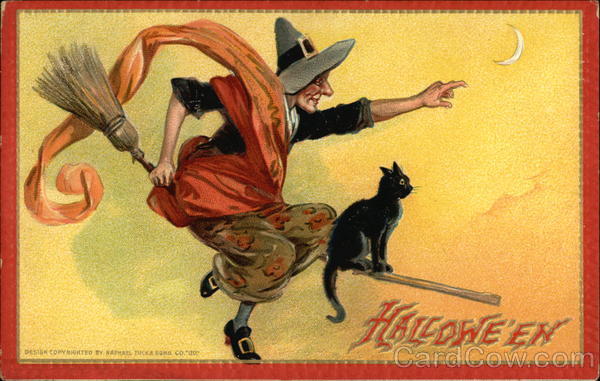
Vintage Halloween Postcard, Raphael
Tuck and Sons of London

6. A witch received her familiar spirit following her initiation into a coven or sect.

7. If a witch becomes human, her black cat will no longer reside in her house.

8. Witches grew an "unnatural nipple", with which they suckled their familiars. This was called a "witch's teat".

9. Witches turned themselves into cats or other animals in order to transport themselves to a sabbat (a midnight meeting) presided over by the devil.

10. A witch's cat came to be called a grimalkin. The Scottish goddess of witches was called Mither o'the Mawkins, a mawkin or malkin being either a cat or hare.


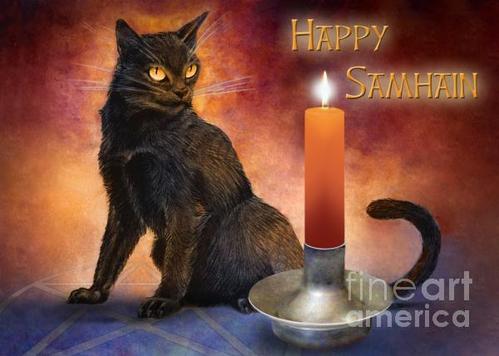
"Happy Samhain Kitten and Candle",
copyright Melissa A. Benson

John Richard Stephens explains in his book, The Enchanted Cat, how people twisted the concept of association with cats into something demonic and evil: "(It) began with the Catholic Church's persecution of religious groups, some of which worshipped the cat. In the 12th Century this persecution spread to splinter groups of the church itself, such as the Cathars, whom the church accused of worshipping the devil in the form of a cat. This led to stories of Satan's appearing at black masses as a cat."


Vintage Halloween postcard by artist Frances
Brundage, published by Tuck and Sons

The black cat suffered most in the areas of Europe that partook in the practice of witch trials, which started in the 13th Century. In 1233, Pope Gregory IX even went so far as to declare black cats to be evil, satanic creatures, leading to their widespread extermination. In 1484 Pope Innocent VIII issued a decree denouncing ALL cats and anyone who owned one! Inquisitor Nicholas Remy echoed this a century later when he said that all cats were demons. During this period priests presided over festivals where cats were burned by the hundreds.

Older women in the Middle Ages were almost always marginalized and lonely. Isolated from society, they turned to small animals for friendship. At one point during the witch hysteria in Europe, the mere possession of a black cat (or of a unusual pet like a frog, lizard or rat) was sufficient cause for investigation as a witch. Close animal companions were sometimes considered proof that a person was a witch!


"The Love Potion" by Ellen Morgan.
Though not a Halloween painting, it
shows a black cat as a witch's familiar.

The Black Death devastated Europe from 1346 to 1349. This and other plagues were blamed on witchcraft, and the witch trials intensified. As economic problems grew, and food and jobs became scarce, the trials offered an excuse to get rid of "economically useless" old women.

Witch trials often produced "evidence" of a witch's teat on the body of the supposed witch - which could possibly have been a birthmark or growth. Regardless, any bodily imperfection on the suspect was immediately pronounced as evidence of a witch's teat.


Vintage Halloween Postcard -
Usually the cat is scary, not scared!

For several centuries these "witches" were rounded up, tried, and killed by burning, drowning or other violent methods, and their "familiars" were killed with them. In Europe and Britain over 200,000 supposed witches were executed. In New England there were over 2,000 cat-related witch trials. Millions of cats were destroyed, and the species was brought to the point of extinction.

Of course today we know that most of the women considered to be witches were either falsely accused or were simply "cunning women", those who were well-versed in herbal lore and other folk remedies, which was sometimes considered witchcraft by overly superstitious folk.


Artist Unknown

Although we no longer burn and drown witches and their familiars, the poor black cat still can't catch a break! Did you know that black cats are the ones most often put to death in shelters? That's because they are the color of cat least adopted.

Wisely, shelters here in the United States will not adopt out black cats at Halloween and a few weeks prior and after, for fear they will be tortured, or used as "living decorations" for the holiday and then abandoned.


"Avoid grinning black cats on full green moon,
If your lover is true, he'll come back soon.
It breaks the charm, the witches scream
And never return, till next Halloween."


However, familiars have been depicted in a much more positive light in the Harry Potter movies, where the owls and other animals pair with the young spell casters to form a special bond. And modern day Wiccans and Neo-Pagans consider the black cat to be more like the Christian concept of a guardian angel. A Wiccan's familiar can be his or her closest companion, offering moral support, special knowledge, and/or physical healing.

So if you see a black cat  (or a cat of any color) this Halloween/Samhain, offer it a big hug and give thanks that the cat survived as a species. Do not be afraid - be kind to the poor, abused, dreaded, maligned black cat!


"Hecate's Cauldron", Artist Unknown
Here, the witch has a black cat,
a hare and a raven!

~~~~~~~~~~~~~~~~~~~~~~~~~~~~~~~~

ADDED 10/24: Thank you so much, WOL, for your very insightful added information (see comments).

Tuesday, October 18, 2011

ORCHIDS FOR THE CURE


"Pink Ribbon" (Phaelenopsis) Orchid
from ProFlowers website

Are you feeling pinkwashed right now?" Pinkwashing" is a new term used to describe the abundance (some would say overabundance) of pink products in the marketplace this month. October being Breast Cancer Awareness Month, a lot of products (many bearing the name Susan G. Komen) are being offered with percentages of the purchase prices beingdonated to support breast cancer research.

Just a quick perusal on the web reveals a myriad of pink products for the cure, including: T-shirts, BIC stationery products, bracelets, tea, robes and underwear, soccer balls, umbrellas, cosmetics, chip clips, magnets, Hallmark cards, even a wireless computer mouse.

Several online sites that I visited expressed dismay regarding the Kentucky Fried Chicken "Buckets for the Cure" campaign. Right now KFC is donating 50 cents for every bucket sold. Detractors consider this pairing ironic in the extreme. Fried chicken, they say, is unhealthy and promotes rather than prevents breast cancer.
Up until now, I had not purchased any pink items. My goal in life right now is to de-clutter, not amass possessions. However, Breast Cancer Month coincides with the end of the gardening year here in Bismarck, and with trips to several shops which are displaying something pink that would be sure to attract me: phaelenopsis orchids.

K-mart is selling these easy-to-grow members of the orchid family for $14.98 in a pretty pastel ceramic pot. However, I passed them up for being a bit costly. At Lowe's, however, I found the same type of orchids for sale at $5.99, in the same attractive pot, only bigger!

I though that was a really great price and snapped up a couple of pots. (Lowe's is donating 10% for every 6-inch Orchid for the Cure sold during October.) I had grown phaelenoposis - also called moth -  orchids 30 years ago (along with cattleyas) and found them surprisingly easy.

Then, a house fire destroyed all my plants (about 100 of them of all types) and I didn't have the heart to replace them.When we moved into our new home with our brand new daughter a couple of months later, my interests went in many different and diverse directions. But now, facing winter's gloom, I'm ready to grow houseplants again, starting with a few orchids.

Bromeliad from Lowe's, another
very easy to grow plant

NOTE: The Lowe's website also shows other "Plants for the Cure": bromeliads, anthuriums, hypoestes (pink polka dot plant) and peace lilies. The moth orchids come in all colors, ranging from white to light pink to hot pink to purple to light green to multicolored.

Also, the ProFlowers website has what it calls the Pink Ribbon Flower Collection. They will donate 10% for every item sold from this collection, which includes lily and tulip bouquets, wreaths, bromeliads, orchids and tiny potted evergreens. However, this collection is spendy, with prices starting at $40.00 and going up to $70.00.

I'm really glad to have found something pink to purchase For the Cure. My Aunt Mary died of breast cancer, and I am sure all of you have/had a family member or friend affected by this terrible disease.