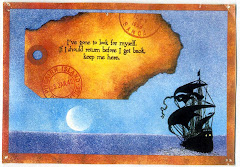
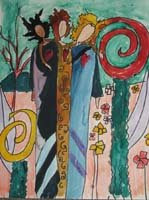
"SELKIE BRIDE" (artist unknown to me)
Selkies are creatures found in Faroese, Icelandic, Irish and Scottish mythology. They can transform themselves from seals to humans. The legend apparently originated on the Orkney Islands, where selch or selk(ie) is the Scots word for seal.
Selkies are able to change into human form by shedding their seal skins, They often do this to sunbathe upon the rocks. They can revert to seal form by putting their skin back on. But if their skins are lost or stolen, they are trapped on land and are forced obey the one who holds their skin.

(Artist unknown to me)
(In "The Secret of Roan Inish, a baby is swept out to sea.)
Once their seal-skins were discarded, selkies became extremely attractive to humans and it was not uncommon for relationships to form. In human form, female selkies are depicted as beautiful women with dark hair and eyes and webbing between their fingers and toes.
Male selkies are very handsome in their human form, and have great seduction powers over human women. They typically seek those who are dissatisfied with their romantic life. This includes married women waiting for their fishermen husbands. If a woman wishes to make contact with a selkie male, she has to go to a beach and shed seven tears into the sea.
 (Artist unknown to me)
Stories concerning selkies are generally romantic tragedies. If a man steals a female selkie's skin, she is in his power, to an extent, and she is forced to become his wife. Female selkies are said to make excellent wives, but because their true home is the sea, they will often be seen gazing longingly at the ocean. If a selkie finds her skin again, she will immediately return to her true home, and sometimes to her selkie husband, in the sea.
In some tales, a selkie maiden has several children by her human husband. In these stories, it is one of her children who discovers her seal skin (often unwitting of its significance). The selkie woman usually avoids seeing her human husband again but is sometimes shown visiting her children and playing with them in the waves.
The husband (or person who took and hid her skin) is said to pine for her and eventually die.

Selkies are not always unhappy on land and choose to live there. One tale tells of a fisherman who married a seal-woman. Against his wife's wishes he set sail dangerously late in the year, and was trapped battling a terrible storm, unable to return home. His wife shifted to her seal form and saved him, even though this meant she could never return to her human body and hence her happy home.
Some stories from Shetland have selkies luring islanders into the sea at midsummer, the lovelorn humans never returning to dry land.
 (Artist unknown to me)
In "The Secret of Roan Inish" which was based on Rosalie K. Fry's book "Secret of the Ron Mor Skerry, a young girl named Fiona learns from her grandparents the tales of the selkies, who have connected with Fiona's family over the ages.
The film also tells the story of Fiona's brother, Jamie, who was swept out to sea in a wooden cradle when they were moving off of Roan Inish. Fiona, though is convinced that her baby brother still lives and, indeed, she later sees Jamie on the island.
One folklorist theory of the origin of the belief in selkies is that shipwrecked Spaniards washed ashore and their jet black hair resembled seals. This was likely the origin of black hair in Celtic nations.

"The Great Selkie o' Suleskerry" (or "Grey Selkie of Suleskerry", as it is also known), is one of the most famous selkie ballads, and one of Orkney's best-known and most haunting.
It recounts the tale of a young Orcadian maiden who falls in love with an elusive selkie-man. She has a child by him but, shortly after, the selkie-man disappears, leaving her alone with her baby son.
Some years later the maiden comes across a grey seal by the shore. She realises the creature before her is none other than her selkie lover, but he once again vanishes beneath the waves, only to return again seven years later. After she gives her son a golden chain, the boy leaves his mother and goes with father to the sea.
The woman marries and some time later, when her husband is out hunting, he shoots two seals - one old and grey, the other younger. Around the neck of the young seal was a gold chain, which the hunter takes home to give his wife.
Upon receiving the gift she realises her son is dead. (The old ballads seldom, if ever, have happy endings.) As with all folk ballads there are various versions. Here's one:
I heard a mother lull her bairn,
"I'll tell where thy bairn's father is
"I am a man upon the land;
my dwelling is in Sule Skerry.
And when that weary twal'month gaed,
"The one who wears the chain o' gowd,
"And thou will get a hunter good,